

I'll use this eBay item to illustrate the question:
http://cgi.ebay.com/ws/eBayISAPI.dll?ViewItem&item=930298779&category=4713
If you read the post and take a look at the back of the instrument, you'll see the body wings starting to come unglued from the neck.
Aside from the fact that this particular bass was "dropped on it's neck", has anybody here ever had this happen to one of their Rick basses?
Same question about the headstock wings... has anybody ever seen those come unglued?
How often does this happen to Rick basses?
Moderators: rickenbrother, ajish4
How often does this happen to Rick basses?
My first bass was a Rickenbacker...
My best bass is a Rickenbacker...
My last bass may very well be a Rickenbacker
My best bass is a Rickenbacker...
My last bass may very well be a Rickenbacker
-
jwr2
-
jwr2
-
mortivan
Jeff's right. I've always been told that a good glue joint was stonger than the wood.
Think of all the g*****s with glued necks (L** P***'s for example) with no problems. The string tension can be pretty enormous: I've seen old acoustics with cracked wood heels (following the grain) due to years of heavy string tension.
The separated "wings" of that bass concern me. Even if sustain is not affected much, I'd be worried about it causing dead notes etc., not to mention the separation worsening.
Think of all the g*****s with glued necks (L** P***'s for example) with no problems. The string tension can be pretty enormous: I've seen old acoustics with cracked wood heels (following the grain) due to years of heavy string tension.
The separated "wings" of that bass concern me. Even if sustain is not affected much, I'd be worried about it causing dead notes etc., not to mention the separation worsening.

-
jwr2
-
jwr2
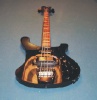
Dropping the guitar on its neck would not cause that to happen.
Either:
The neck and/or body maple was not sufficiently dry when glued, or
The neck and body wings were not perfectly smoothed through a jointer before attached, or
The glue was not applied properly, or
The cracks are actually in the wood, not the joint.
If the glued joint was properly set, you could not break the neck apart from a body wing on the joint. The wood itself would break first. This looks like a Rickenbacker production mistake.
Either:
The neck and/or body maple was not sufficiently dry when glued, or
The neck and body wings were not perfectly smoothed through a jointer before attached, or
The glue was not applied properly, or
The cracks are actually in the wood, not the joint.
If the glued joint was properly set, you could not break the neck apart from a body wing on the joint. The wood itself would break first. This looks like a Rickenbacker production mistake.
Guys, my 1972 4001LH exhibits the same 'problem' as this ebay bass does, but IMHO it is not from abuse of the instrument, but rather an instance of improper curing of the wings, or mis-alignment of the wood when fitted...I am not the original owner of the bass but it hasn't been abused, and has its original Mapleglo finish..No problems with playability whatsoever.
It also looks as though it will not get progressively worse either.... My .02....
It also looks as though it will not get progressively worse either.... My .02....
Brad, I'm fifty-five and I've been working with wood since childhood. You're welcome to disagree all you want, but you are mistaken.
I'll give you just one example: hide glue joints can be steamed apart. If someone puts an instrument in a sauna, the joints may well come unglued. That's_not_a manufacturing defect, that's abuse. It's using an instrument in a manner clearly not intended by the maker.
Some other glues are water resistant but have low shock resistance. Not all glue joints are stronget than the wood.
Fact is, you have no evidence of a manufacturing defect here. Even if the bass had not admittedly been dropped, the photo evidence says it's been treated harshly. So there's no reason to even suspect it's Rickenbacker's fault.
I'll give you just one example: hide glue joints can be steamed apart. If someone puts an instrument in a sauna, the joints may well come unglued. That's_not_a manufacturing defect, that's abuse. It's using an instrument in a manner clearly not intended by the maker.
Some other glues are water resistant but have low shock resistance. Not all glue joints are stronget than the wood.
Fact is, you have no evidence of a manufacturing defect here. Even if the bass had not admittedly been dropped, the photo evidence says it's been treated harshly. So there's no reason to even suspect it's Rickenbacker's fault.