
There are a couple of people who've done some great work for me.
One is Mike Lull and the other is Jack Pimentel.
In fact- Mike did a re-fret and then sent it to Jack for the
laquer. Jack doesn't do the Conversion/Catalised what ever stuff-
Just Nitro, but a darn good and quick job.
Fretting over a 4005
Moderator: jingle_jangle
-
chefothefuture

- Advanced Member
- Posts: 1886
- Joined: Sun Oct 30, 2005 6:00 am
-
jingle_jangle

- RRF Moderator
- Posts: 22679
- Joined: Wed Dec 22, 2004 6:00 am
- Contact:
John, very few luthiers know anything but nitro, because it's easy to apply and buff out and looks nice and shiny. But, I repeat, it is non-original, besides being much less durable than CV. If nitro was better than CV, would Rick have been using CV since 1959? I seriously doubt it.
It takes a lot of work and maintenance to equip a shop to regularly spray conversion varnish, and then to do the color sanding/buffing out that's essential to the look. Fretboards are particularly tough to get right in a CV finish.
Luthiers are basically involved with the nuts and bolts of building and maintaining all kinds of guitars. Very few take the time and expend the effort to learn to properly apply a proper CV finish. Yet guitars coming from Japan, Korea, and Indonesia these days, all use a CV topcoat for longevity and superior gloss.
Back in the late '50s, when Fender was just discovering Duco (nitro) custom colors, Rickenbacker was a generation ahead, spraying catalyzing clearcoats on their guitars and basses.
So, why go back nearly 50 years when refinishing an instrument? Why use inferior materials and methods?
Because they're easier for the luthier, that's why. Because any owner can apply a mediocre nitro finish on his project guitar using dreadful spray cans, thanks to StewMac and ReRanch, who'll tell you that you can get a perfect finish like this because they want to sell you paint and sandpaper. But the difference is day and night between a mediocre refin and a real properly done pro job.
Applying CV is not a job for an amateur, nor can it be done with spray cans, due to its chemically-catalyzing and highly-toxic nature.
Ken, conversion varnish was most certainly used on your '72.
I'm glad you are happy with your '72 with its lacquered fretboard. If it worked for you, fine. But it is MUCH less durable than CV, besides being non-OEM. And it is the non-OEM, owner-modified stuff that drives vintage dealers mad and has them discouraging refinishes, period.
It takes a lot of work and maintenance to equip a shop to regularly spray conversion varnish, and then to do the color sanding/buffing out that's essential to the look. Fretboards are particularly tough to get right in a CV finish.
Luthiers are basically involved with the nuts and bolts of building and maintaining all kinds of guitars. Very few take the time and expend the effort to learn to properly apply a proper CV finish. Yet guitars coming from Japan, Korea, and Indonesia these days, all use a CV topcoat for longevity and superior gloss.
Back in the late '50s, when Fender was just discovering Duco (nitro) custom colors, Rickenbacker was a generation ahead, spraying catalyzing clearcoats on their guitars and basses.
So, why go back nearly 50 years when refinishing an instrument? Why use inferior materials and methods?
Because they're easier for the luthier, that's why. Because any owner can apply a mediocre nitro finish on his project guitar using dreadful spray cans, thanks to StewMac and ReRanch, who'll tell you that you can get a perfect finish like this because they want to sell you paint and sandpaper. But the difference is day and night between a mediocre refin and a real properly done pro job.
Applying CV is not a job for an amateur, nor can it be done with spray cans, due to its chemically-catalyzing and highly-toxic nature.
Ken, conversion varnish was most certainly used on your '72.
I'm glad you are happy with your '72 with its lacquered fretboard. If it worked for you, fine. But it is MUCH less durable than CV, besides being non-OEM. And it is the non-OEM, owner-modified stuff that drives vintage dealers mad and has them discouraging refinishes, period.
“I say in speeches that a plausible mission of artists is to make people appreciate being alive at least a little bit. I am then asked if I know of any artists who pulled that off. I reply, 'The Beatles did.”
― Kurt Vonnegut
― Kurt Vonnegut
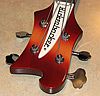
Basses are musical instruments that are made to be played. I would have it refretted. Of course Im more of a player than a collector, but if its just going to sit in its case, it really seems like such a waste to me.
Even a classic car needs a tune up and a new set of tires once and a while.
Even a classic car needs a tune up and a new set of tires once and a while.
"Knowledge is Power"



-
jingle_jangle
- RRF Moderator
- Posts: 22679
- Joined: Wed Dec 22, 2004 6:00 am
- Contact:
Great shot, Jeff. Yeah, the hype around vintage guitars has never been bigger...
And virtually all the guys who deal and set prices in Fenders and Gibbies also deal in the occasional Rickenbacker, too, and generally don't know much about them except to set prices too high and quote occasional misinformation and downright nonsense in their ads, too.
Every issue of VG is filled with helium. I have to put it under some bricks overnight to be able to read it the next day.
You oughta hear it squeaking and squealing...
And virtually all the guys who deal and set prices in Fenders and Gibbies also deal in the occasional Rickenbacker, too, and generally don't know much about them except to set prices too high and quote occasional misinformation and downright nonsense in their ads, too.
Every issue of VG is filled with helium. I have to put it under some bricks overnight to be able to read it the next day.
You oughta hear it squeaking and squealing...
“I say in speeches that a plausible mission of artists is to make people appreciate being alive at least a little bit. I am then asked if I know of any artists who pulled that off. I reply, 'The Beatles did.”
― Kurt Vonnegut
― Kurt Vonnegut

My old fretless Gibson has 30 year-old strings on it. Does this mean that if I ever get stupid enough to sell it I can claim in the eBay listing that it even has "Vintage" strings? At least it doesn't have any fret wear.... I've never understood these people who remove that varnish to "improve playability". If you ask me, it's total B.S. (I guess that would be methane, not helium). Trust me, if you can't play a bass line on a varnished fingerboard because it's too fast or complicated, you still won't be able to play it after you strip the fingerboard.
-
jingle_jangle
- RRF Moderator
- Posts: 22679
- Joined: Wed Dec 22, 2004 6:00 am
- Contact:
Stereophile...
I had a subscription back in the '80s heyday, when it was pocket-sized, and digital was just beginning. The controversy was very interesting.
I let it lapse because it was establishing itself as a cult of personality around Gordon and some of the columnists, and I frankly found some of their claims and theories hard to swallow.
I did like the New Mexico base, though.
I never did try green magic marker on the edges of my CDs. I recently went to an estate sale of a gent who was heavily into classical music, and I'll be darned if every one of the CDs his family had for sale didn't have the green edge.
The latest thing seems to be a proprietary passive EPROM device that is placed on top of your CD player. It supposedly realigns some electron path or other the clean up your musical act.
A bit like Ex-Lax in size, color, and result.
I'm going to pick up a copy today--it's been awhile since I tread in those elevated, stratospheric heights. Then I'll go home and spend the evening listening for odd digital artifacts from my '77 Sansui AU/TU 717 rig.
I had a subscription back in the '80s heyday, when it was pocket-sized, and digital was just beginning. The controversy was very interesting.
I let it lapse because it was establishing itself as a cult of personality around Gordon and some of the columnists, and I frankly found some of their claims and theories hard to swallow.
I did like the New Mexico base, though.
I never did try green magic marker on the edges of my CDs. I recently went to an estate sale of a gent who was heavily into classical music, and I'll be darned if every one of the CDs his family had for sale didn't have the green edge.
The latest thing seems to be a proprietary passive EPROM device that is placed on top of your CD player. It supposedly realigns some electron path or other the clean up your musical act.
A bit like Ex-Lax in size, color, and result.
I'm going to pick up a copy today--it's been awhile since I tread in those elevated, stratospheric heights. Then I'll go home and spend the evening listening for odd digital artifacts from my '77 Sansui AU/TU 717 rig.
“I say in speeches that a plausible mission of artists is to make people appreciate being alive at least a little bit. I am then asked if I know of any artists who pulled that off. I reply, 'The Beatles did.”
― Kurt Vonnegut
― Kurt Vonnegut
-
jingle_jangle
- RRF Moderator
- Posts: 22679
- Joined: Wed Dec 22, 2004 6:00 am
- Contact:
This takes us back to '83-4. Some wonk who I believe was affiliated with Stereophile back then, claimed that the coloring ameliorated the "digital harshness". Turning to the ad pages in the back of the same magazine would reveal a couple of guys selling green magic markers for $30.00 a pop.
Not the first, and not the last, wacky claim to be made in the rarified air of high-end audio.
Not the first, and not the last, wacky claim to be made in the rarified air of high-end audio.
“I say in speeches that a plausible mission of artists is to make people appreciate being alive at least a little bit. I am then asked if I know of any artists who pulled that off. I reply, 'The Beatles did.”
― Kurt Vonnegut
― Kurt Vonnegut
-
jingle_jangle
- RRF Moderator
- Posts: 22679
- Joined: Wed Dec 22, 2004 6:00 am
- Contact:
And the whole cable thing seems to be the most consistent "black magic" area of the whole audiophile realm.
I really believe that, up to a point, the better the cables, the better the sound.
Beyond that point, it's bragging rights and things only dogs can hear.
Buying those cables would have probably been a waste, because in order to hear the drummer fart during the second chorus of "Joy to the World", you have to first believe, brutha!!!
I really believe that, up to a point, the better the cables, the better the sound.
Beyond that point, it's bragging rights and things only dogs can hear.
Buying those cables would have probably been a waste, because in order to hear the drummer fart during the second chorus of "Joy to the World", you have to first believe, brutha!!!
“I say in speeches that a plausible mission of artists is to make people appreciate being alive at least a little bit. I am then asked if I know of any artists who pulled that off. I reply, 'The Beatles did.”
― Kurt Vonnegut
― Kurt Vonnegut
-
incubus2432

- Senior Member
- Posts: 4174
- Joined: Sat Jul 17, 2004 11:26 am
I bought quite a nice theater system a few years ago when we got our new house....not all "tubey stereophile" stuff but nothing you'd find at Best Buy either and I was horrified at how much it cost me for connecting cables and speaker wire. The "recommended" speaker wire and connecting cables would have cost me almost $1000....that's nuts. I ended up just shopping around for reasonably priced well constructed cable/wire and put the money I saved towards other "needs".