
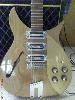
I've been giving some thought to the question of early toaster pickup specification. So often we just discuss dc impedance. 50's ones are said to be 3K - 5K, 60's ones - around 8K etc.
I'd be curious to know whether anyone has taken any impedance readings of early toasters. These days it's not so hard to do. Many digital meters have an impedance range. How about setting the meter to mH and taking some readings? I'm especially interested in readings from pre-60 short magnet toasters. combos or capris etc
Early toaster pickup specs
Moderators: rickenbrother, ajish4
-
soundmasterg

- RRF Consultant
- Posts: 1923
- Joined: Tue Oct 01, 2002 1:06 pm
What you are referring to in the first part of your post is actually DC resistance of 3k-5k, or 8k. Impedance is resistance in AC, and it changes with frequency. To be able to measure AC resistance, you need a different meter than usual, and most people seem to use a particular Extech meter. I have one of these Extechs, and a couple of the 7.4k DCR toasters that I can measure, but I don't have any old toasters to measure. I can post the DCR, ACR, inductance and Q readings at 120hz and 1000hz for any of the pickups I've measured. Don't know if it would help you compare sounds, but it is what it is.
-
dale_fortune
- Intermediate Member
- Posts: 1241
- Joined: Sat Oct 30, 2004 6:00 am

hi Glen and Greg,
if they are at 3.5 kOhms and if they use the same wire gauge as the 7.5 kOhms, they will only have a quarter of inductivity. Because inductance goes
with the square of windings. And assumed that half the windings gives half the DC resistance.
So we are at ca. 2.5/4 Henry , this is only 0.625 Henry.
btw: it is not so easy to measure pu inductance.
Helmuth Lemme made some suggestions in the 1980s
in his book "Elektro Gitarren Sound".
A superb book, still available in Germany.
But it is not my only source!!
if they are at 3.5 kOhms and if they use the same wire gauge as the 7.5 kOhms, they will only have a quarter of inductivity. Because inductance goes
with the square of windings. And assumed that half the windings gives half the DC resistance.
So we are at ca. 2.5/4 Henry , this is only 0.625 Henry.
btw: it is not so easy to measure pu inductance.
Helmuth Lemme made some suggestions in the 1980s
in his book "Elektro Gitarren Sound".
A superb book, still available in Germany.
But it is not my only source!!
yes, I did mean to say dc resistance at the start. My slipup there.
It's good to hear these figures, and yes those are very low but not surprising compared to other figures I've seen for 50's toasters. Either these pickups are incredibly low output (Dale might be able to advise us here) or the wire they are wound with is a thicker guage than we've thought. DC resistance isn't really a conclusive method to use when trying to rewind a pickup to the 50's spec. You'd need wire of exactly the same guage and resistivity to use those figures, and I don't know if we can assume that we have that. Can we assume that the modern wire is the same guage and resistivity as the 50's wire? There's also a matter of consistancy. Modern production techniques obtain more consistant wire size (hence - resistivity) and enamelling, than vintage wire.
We've heard tell that the method used in winding the early toasters was by eye. When it looked like it had the correct height of wire turns on the bobbin, it was completed. The thickness of the enamelling has a lot to do with this, and vintage enamelling was thicker than modern. Incidentally, this is probably one reason why many more turns can be fit onto the same size bobbin (up to 13K dc resitance on pre scatterwound re-issue toasters)
For these reasons I don't fully trust using dc resistance as the sole guide to winding 50's spec toasters. We need some more information
The only sure fire way is to unwind a 50's toaster on a counter, and count the turns (which isn't going to happen) alternative to that, a measurement of inductance is a way to get more of an indication if you're in the right ballpark with the # of turns. There are variables like the strength of the pole magnets, and I'm sure the metal housing will come into the equation too.
thanks for the commments
It's good to hear these figures, and yes those are very low but not surprising compared to other figures I've seen for 50's toasters. Either these pickups are incredibly low output (Dale might be able to advise us here) or the wire they are wound with is a thicker guage than we've thought. DC resistance isn't really a conclusive method to use when trying to rewind a pickup to the 50's spec. You'd need wire of exactly the same guage and resistivity to use those figures, and I don't know if we can assume that we have that. Can we assume that the modern wire is the same guage and resistivity as the 50's wire? There's also a matter of consistancy. Modern production techniques obtain more consistant wire size (hence - resistivity) and enamelling, than vintage wire.
We've heard tell that the method used in winding the early toasters was by eye. When it looked like it had the correct height of wire turns on the bobbin, it was completed. The thickness of the enamelling has a lot to do with this, and vintage enamelling was thicker than modern. Incidentally, this is probably one reason why many more turns can be fit onto the same size bobbin (up to 13K dc resitance on pre scatterwound re-issue toasters)
For these reasons I don't fully trust using dc resistance as the sole guide to winding 50's spec toasters. We need some more information
The only sure fire way is to unwind a 50's toaster on a counter, and count the turns (which isn't going to happen) alternative to that, a measurement of inductance is a way to get more of an indication if you're in the right ballpark with the # of turns. There are variables like the strength of the pole magnets, and I'm sure the metal housing will come into the equation too.
thanks for the commments
-
soundmasterg
- RRF Consultant
- Posts: 1923
- Joined: Tue Oct 01, 2002 1:06 pm
Yes, when you measure the inductance, it isn't just the wire we are talking about, but also the magnet type, strength, location in the pickup in relation to the coil, how much metal and what type of metal is near the pickup. I'm sure there are some other aspects I'm forgetting. The Extech meter that I have is the same as the one RIC uses to test their pickups and gives a fairly accurate measurement of inductance, AC resistance, and Q. I haven't measured the toasters I have with it, but I could easily do so if someone wanted to know what the "7.4k" pickups spec out at. I put the quotes up because mine are more like 6.2k DCR and were from new.
There is a lot more info on pickups and how trying to duplicate an old one has many hard to duplicate variables on the Ampage pickup forum. There are some very smart people there who wind pickups themselves, and also experiement with different test methods on a routine basis. Check it out if you haven't already.
The wire gauge is only part of the equation. The type of insulation used, and the thickness of it, and the number of turns are important, but even more important is the tension used in winding the coil, because this can stretch the wire, and affects the turns count. If you unwind the coil on a turns counter, it isn't easy to find out what the tension was, although you can deduce that kind of think sometimes to a fair level of accuracy. You can try to find out the gauss of the magnets used, and find out if the magnets were made using cast methods, or if they were sintered, if they were in a magnetic field when they were made or not....all this stuff has come up at Ampage. People there usually deal with a Strat pickup as it is sort of a standard, but the same ideas usually apply to other pickups too.
There is a lot more info on pickups and how trying to duplicate an old one has many hard to duplicate variables on the Ampage pickup forum. There are some very smart people there who wind pickups themselves, and also experiement with different test methods on a routine basis. Check it out if you haven't already.
The wire gauge is only part of the equation. The type of insulation used, and the thickness of it, and the number of turns are important, but even more important is the tension used in winding the coil, because this can stretch the wire, and affects the turns count. If you unwind the coil on a turns counter, it isn't easy to find out what the tension was, although you can deduce that kind of think sometimes to a fair level of accuracy. You can try to find out the gauss of the magnets used, and find out if the magnets were made using cast methods, or if they were sintered, if they were in a magnetic field when they were made or not....all this stuff has come up at Ampage. People there usually deal with a Strat pickup as it is sort of a standard, but the same ideas usually apply to other pickups too.
Thanks for the reply Greg. Some good points there.
I'm fortunate to have a NOS role of old winding wire, in what is said to be the correct guage for winding toasters. Complete with all it's imperfections. The insulation is the enamelling of the wire. As I mentioned earlier, it's something that has changed over the years. Old wire had thicker enamelling as well as variations in thickness - all part of the tone in old pickups.
One point I'll dissagree with though. Tension will not effect the turns count. A counter will accurately count how many turns are made, no matter how tightly the wire is held. Having been involved in winding many transformers using coil winding equipment, I can be sure of this. Tension will effect how tightly packed the coil is, and hence the interwinding capacitances, but not the turns count. Interwinding capacitances are a tonal issue in pickups. (and output transformers)
We hear that early toasters were "scatterwound", meaning that the bobbin was spun and the wire was allowed to wind on in a random manner. Possibly being hand held. Fortunately, this won't be too hard to replicate. I'd still need an accurate indication of the number of turns though. It's the number of turns that's a key factor in how "hot" the pickup is. The pickups on my 325C58 are noticeably not hot....
I'm fortunate to have a NOS role of old winding wire, in what is said to be the correct guage for winding toasters. Complete with all it's imperfections. The insulation is the enamelling of the wire. As I mentioned earlier, it's something that has changed over the years. Old wire had thicker enamelling as well as variations in thickness - all part of the tone in old pickups.
One point I'll dissagree with though. Tension will not effect the turns count. A counter will accurately count how many turns are made, no matter how tightly the wire is held. Having been involved in winding many transformers using coil winding equipment, I can be sure of this. Tension will effect how tightly packed the coil is, and hence the interwinding capacitances, but not the turns count. Interwinding capacitances are a tonal issue in pickups. (and output transformers)
We hear that early toasters were "scatterwound", meaning that the bobbin was spun and the wire was allowed to wind on in a random manner. Possibly being hand held. Fortunately, this won't be too hard to replicate. I'd still need an accurate indication of the number of turns though. It's the number of turns that's a key factor in how "hot" the pickup is. The pickups on my 325C58 are noticeably not hot....
-
soundmasterg
- RRF Consultant
- Posts: 1923
- Joined: Tue Oct 01, 2002 1:06 pm
Glen, I wasn't clear enough about the turns count and what I meant regarding it and tension.
What I should have said was that if you are winding a pickup to a given turns count, the tension is very important, since it effects how the wire lays on the coil, and the overall thickness of the coil. In many ways it is kind of like winding one coil with 44 gauge single build plain enamel wire as compared to 44 gauge heavy build formvar wire. The two wires have different insulation thicknesses, and so they both lay on the coil differently, and for a given turns count, each pickup will sound completely different. For a given wire type, if you have loose tension and you wind to 6000 turns, then the coil will be bigger and have less wire on it compared to winding with a tight tension with the same wire and to the same turns count. Also, a scatterwind will make the coil bigger than if you wind it in nice, pretty rows. A bigger coil, with wire farther away from the magnets will be less sensitive, and the capacitance of the coil will change, and probably a bunch of other stuff too, including the DCR, ACR, inductance, and Q.
So bottom line....if the vintage pickup had 6000 turns, and you want to emulate it, and so you wind the new coil to the 6000 turns, without duplicating the tension and winding pattern of the old pickup, it won't be the same, even if you are able to track down wire with the same insulation thickness and type and gauge.
So the tension doesn't affect how the turns counter is functioning per se, as in the turns counter will count 1 turn, 2 turns, 3 turns, etc, for each revolution of the coil, but the tension will affect the overall sound of the coil to a great deal and will impact the overall meaning of a given turns count for the reasons I mentioned.
Does that make a little more sense?
What I should have said was that if you are winding a pickup to a given turns count, the tension is very important, since it effects how the wire lays on the coil, and the overall thickness of the coil. In many ways it is kind of like winding one coil with 44 gauge single build plain enamel wire as compared to 44 gauge heavy build formvar wire. The two wires have different insulation thicknesses, and so they both lay on the coil differently, and for a given turns count, each pickup will sound completely different. For a given wire type, if you have loose tension and you wind to 6000 turns, then the coil will be bigger and have less wire on it compared to winding with a tight tension with the same wire and to the same turns count. Also, a scatterwind will make the coil bigger than if you wind it in nice, pretty rows. A bigger coil, with wire farther away from the magnets will be less sensitive, and the capacitance of the coil will change, and probably a bunch of other stuff too, including the DCR, ACR, inductance, and Q.
So bottom line....if the vintage pickup had 6000 turns, and you want to emulate it, and so you wind the new coil to the 6000 turns, without duplicating the tension and winding pattern of the old pickup, it won't be the same, even if you are able to track down wire with the same insulation thickness and type and gauge.
So the tension doesn't affect how the turns counter is functioning per se, as in the turns counter will count 1 turn, 2 turns, 3 turns, etc, for each revolution of the coil, but the tension will affect the overall sound of the coil to a great deal and will impact the overall meaning of a given turns count for the reasons I mentioned.
Does that make a little more sense?
Greg, I think you're getting a little mixed up here. Turns are turns. When winding a coil, number of turns is the 1st parameter for consideration. In audio applications, this is closely followed by tension and layering. If you wind with the same coil former, same core material, same wire guage - you're going to be in the same ballpark with the resultant sound. Tension and layering are the next factors for consideration. The number of turns will determine the gain of the device, and that's a pretty important issue.
If you have looser tension, the coil will be larger and have more wire on it, not less. The DC resistance will hence, be larger. Yes, other factors will change due to the outer sections of the coil being slightly further away from the core. These are all part of the organic nature of old hand tensioned coils.
44 guage wire, when wound correctly, elongates 24%. Rickenbacker's computerized setup now winds very precisely at 22 grams tension, not so many years ago tensioning was by hand.
Here's a 325C58 pickup bobbin, wound with #44 wire to 3K7 ohms DC resistance. Lots of space there....

If you have looser tension, the coil will be larger and have more wire on it, not less. The DC resistance will hence, be larger. Yes, other factors will change due to the outer sections of the coil being slightly further away from the core. These are all part of the organic nature of old hand tensioned coils.
44 guage wire, when wound correctly, elongates 24%. Rickenbacker's computerized setup now winds very precisely at 22 grams tension, not so many years ago tensioning was by hand.
Here's a 325C58 pickup bobbin, wound with #44 wire to 3K7 ohms DC resistance. Lots of space there....
I haven't done anything to my C58 pickups yet. In fact today was the first time I've managed to open one. It was quite a task with the superglue all over the screws.
I was surprised to see how little space was taken up on the bobbin (see above pic). Given that the early winding technique apparently consisted of winding it until it appeared reasonably full (by eye). Even allowing for thinner enamelling on modern wire it's interesting to see how little space on the bobbin is used.
The 325C58 pickups have been scatter-wound to 3K7 ohms dc resistance with #44 wire. The last thing I'd do is unwind them any further, as they're already quite low in sensitivity.
I've been trying to come up with a method to compare the sensitivy of a 325C58 re-issue toaster and an actual 50's toaster? It requires someone who owns a 325C58 and also a 50's Ric with toaster pickup/s. It also requires that the clearance between strings and pickup be virtually the same on both instruments.
1) Use the bridge pickup selection on both instruments.
2) Volume set to maximum on both instruments.
3) The test is carried out by plugging first one, then the other guitar back and forth (A-B) into the same amplifier without changing the volume setting of the amp.
4) Softly strike the same string on each instrument with the same force so a clear note is heard from the amp.
5) Note whether one instrument is much louder than the other.
Striking the note consistantly will be a little subjective, but should be sufficiently accurate to pick any distinct difference in sensitivity.
Are you in a position to do this John? It must be a pre '59 toaster that's used for comparison to the C58 for this test, as we already know that 60's pickups are more sensitive....
I was surprised to see how little space was taken up on the bobbin (see above pic). Given that the early winding technique apparently consisted of winding it until it appeared reasonably full (by eye). Even allowing for thinner enamelling on modern wire it's interesting to see how little space on the bobbin is used.
The 325C58 pickups have been scatter-wound to 3K7 ohms dc resistance with #44 wire. The last thing I'd do is unwind them any further, as they're already quite low in sensitivity.
I've been trying to come up with a method to compare the sensitivy of a 325C58 re-issue toaster and an actual 50's toaster? It requires someone who owns a 325C58 and also a 50's Ric with toaster pickup/s. It also requires that the clearance between strings and pickup be virtually the same on both instruments.
1) Use the bridge pickup selection on both instruments.
2) Volume set to maximum on both instruments.
3) The test is carried out by plugging first one, then the other guitar back and forth (A-B) into the same amplifier without changing the volume setting of the amp.
4) Softly strike the same string on each instrument with the same force so a clear note is heard from the amp.
5) Note whether one instrument is much louder than the other.
Striking the note consistantly will be a little subjective, but should be sufficiently accurate to pick any distinct difference in sensitivity.
Are you in a position to do this John? It must be a pre '59 toaster that's used for comparison to the C58 for this test, as we already know that 60's pickups are more sensitive....