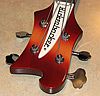
I haven't had My ric 4003 for long and have always loved that growly slightly raw but essentially clean sound that these guys get. I was interested to read in other threads that it seems that is not so much down to using overdrive as it is to compressing the sound to help get the growl.
Now I bunged my Ric through a Peavey 212 guitar amp when I first got it ( bass rig was at the rehearsal rooms) using a touch of chorus through the crunch channel and just the slightest bit of reverb and got fairly close, but lost a lot of the bottom end. So when I got my Ashdown rig home I was already really excited. 4x10 cab, ABM 300 head and a 1510 trace cab I thought I would be well in, especially with the ability to get slight overdrive by mixing the pre amp and solid state together, but it is not there. Either too clean or too messy. Tons of bass thopugh.wow. Now I am no tech head when it comes to setting up sounds, so I shot off to our local music shop and got them to drag out the Boss pedal board (GT6B??) for me to have a go on. Didn't have my Ric with me, it was a spur of the moment thing, but used a Fender Jazz. Good as the Boss was, on a quick play the distortion side was out there.....Lemmy would have been proud, in fact I think most Nu metal guitarists would have been happy with the ridiculously over the top distortion level and the compression had 4 or 5 settings with a huge range of adjustability, but just as I was getting somewhere close you could hear it clipping the top end..obviously it's job, but it was too prominent.
So what I am asking is, am I on the right track with sticking to the compression route, or do I need to overdrive it and use compression? Will the Boss box of tricks get me there if I persevere (I am sure it must) or is there a simpler way to attack the situation?
In 20 years I have never chased a sound, always preferring to get my own, but once the Ric was bought the bug started!!
Any help for a "TechnoTwat" would be gratefully accepted. Thanks
Compression to get a Squire/Lee sound??
Moderators: rickenbrother, ajish4
-
bassmandudge
- New member
- Posts: 9
- Joined: Tue Feb 07, 2006 12:04 pm
-
jwr2
-
shinynewtoy
- Intermediate Member
- Posts: 1347
- Joined: Fri May 27, 2005 7:46 pm
There are a lot of ways to achieve that end. Geddy did not use distortion much until Moving Pictures (Red Barchetta and The Camera Eye) and as we found out recently, he considered his action to be high. Much of the tone you are seeking is in the technique not the equipment. Geddy played his Ricks hard - lots of attack. He says he keeps the nails on his plucking hand a bit long to add to the attack. At times it even sounds like he is using a pick. He has used a lot of different amp / preamp rigs over the years and I am sure some of that has colored his sound but the bass tone on songs like "The Spirit Of Radio" and "Freewill" is mostly the result of technique.

Frankly, I find compression is the WORST way to go about getting that sound . . . actually, I find compression is the worst way to go about getting ANY good bass sound.
I just hate compression in general for bass; in my experience, it ruins everything unique and powerful about bass tones . . . it made my Ric lose its definition, its Ric-ness, and it made my old Squier P-bass sound like glass shattering on every note. Compression has always made me sound incredibly thin and squeaky-clean, no matter what bass I'm using, active or passive, any number or type of pickups, flats or rounds, single-coil or humbucker . . . it just ALWAYS sound like [expletive] for me. I've tried every possible setting on several different compression units (pedals, rackmount, built-in in a mixer, ProTools digital . . .) and it has never been good. It's a boon when recording vocals, though. Seriously, if someone can tell me what I'm doing wrong or even what advantages I would have from using compression, it'd be greatly appreciated.
For Geddy's sound, you need: a)A bass that can get a nice, aggressive, rumbly tone . . . Ric, J, P, Wal, Steinberger, whatever . . . b)Roundwound strings, or else the BRIGHTEST flats you can possibly find . . . c)A really hard attack on the strings. It helps, but is not necessary, to have some sort of overdrive (as in, very very light distortion) from a pedal or just from the gain knob on your amp. Usually, though, playing really hard with rounds on a Ric with low action will distort enough anyway. That's it.
I just hate compression in general for bass; in my experience, it ruins everything unique and powerful about bass tones . . . it made my Ric lose its definition, its Ric-ness, and it made my old Squier P-bass sound like glass shattering on every note. Compression has always made me sound incredibly thin and squeaky-clean, no matter what bass I'm using, active or passive, any number or type of pickups, flats or rounds, single-coil or humbucker . . . it just ALWAYS sound like [expletive] for me. I've tried every possible setting on several different compression units (pedals, rackmount, built-in in a mixer, ProTools digital . . .) and it has never been good. It's a boon when recording vocals, though. Seriously, if someone can tell me what I'm doing wrong or even what advantages I would have from using compression, it'd be greatly appreciated.
For Geddy's sound, you need: a)A bass that can get a nice, aggressive, rumbly tone . . . Ric, J, P, Wal, Steinberger, whatever . . . b)Roundwound strings, or else the BRIGHTEST flats you can possibly find . . . c)A really hard attack on the strings. It helps, but is not necessary, to have some sort of overdrive (as in, very very light distortion) from a pedal or just from the gain knob on your amp. Usually, though, playing really hard with rounds on a Ric with low action will distort enough anyway. That's it.
-
sloop_john_b
- Rick-a-holic
- Posts: 13843
- Joined: Tue Jan 25, 2005 6:00 am
Robert, i've used compression to great effect on my bass recordings. But I think it has a lot to do with the style of music and playing. I use a c64 with flatwound Pyramid strings and my tone and style are very reminiscent of McCartney's, which is heightened very much with some compression added on.
I'm not sure what type of music you're playing, but perhaps compression simply isn't...helpful? to your style.
I'm not sure what type of music you're playing, but perhaps compression simply isn't...helpful? to your style.
That might be it. Tone-wise, I aim for a nice middle ground between Chris Squire, Geddy Lee, Mike Rutherford (especially whatever bass he's using on "Lamb"), and John Wetton, so it's very aggressive, growly, and mid-y . . . not really McCartney-ish at all. Same with playing . . . I tend to go for semi-busy counterpoint to either the guitar/keys or vocals, whereas McCartney is very much a "keep it moving" kind of player. I dunno . . . compression just seems to yank the guts out of my sound whenever I use it. At least it's just me, though, and not compression in general.
-
revolver323

- Intermediate Member
- Posts: 997
- Joined: Mon Jul 04, 2005 5:48 am
- Contact:
Run the bass in stereo through both channels of a Sunn Coliseum guitar head to 6 x 12 cabs and you'll have the Squire sound. This is what Chris used, to my knowledge, on the first few Yes albums and also live up until about 1974. Maestro Bass Brassmaster for fuzz, the amp's tremolo for songs like "Starship Trooper." Might've been compressed in the studio and through the board live, but no outboard compression pedal or anything like that. Back in "the day," I ran my 4001 in stereo through an Acoustic 360 1 x 18 for bottom end, and a Kustom 250w guitar head powering a midrange horn for highs. I used an Electro Harmonix tremolo unit and the Brassmaster, no compression. From listening to tapes I still have from that era, it was very close -- some distortion down low, clanky up high but not piercing -- to the 6 x 12 sound. Probably a bit better low end, actually.

On the Lamb, Mike Rutherford mostly used a Microfret doubleneck (12-string guitar & 6 string bass/baritone guitar), as well as a Rickenbacker 12-string. Some of the bass parts definitely use distortion (e.g. the title track, the midde part of Anyway etc.).
There's a small mention of the Microfret in this article from the Shergold site:
Shergold - Beat Instrumental
There's a small mention of the Microfret in this article from the Shergold site:
Shergold - Beat Instrumental
Rickenbackers: 4003 FG, 4080 BG, 4001CS, 4003 DCM, 4080/12 MG, 4003s5 JG, 4004Cii MG.
Others by: Wal, Fender, Warwick & Washburn
Amps by : TC Electronics & Ashdown.
Others by: Wal, Fender, Warwick & Washburn
Amps by : TC Electronics & Ashdown.