

My '77 MG 4001 had the same thing happen to its tailpiece... and it WAS something that developed over time; I bought it new and it didn't come out of the box like that.
And I can't imagine it had anything to do with string tension, since I never had a chance to load it with anything other than Rickenbacker flats before I (stupidly) sold it away. *sniff*
Ah, well... I was young and didn't know any better.
4003 tailpiece bending up?
Moderators: rickenbrother, ajish4
-
jeff_ulmer
- Intermediate Member
- Posts: 873
- Joined: Sat Jan 18, 2003 6:00 am
- Contact:

Well here's my two cents worth. The old three screw bridges were made of chrome plated aluminum. The five and seven screw ones are chrome plated pot metal. Pot metal is to aluminum what hod dogs are to steak. A little bit of everything but mostly aluminum and zinc. Pot metal is softer and I think would explain this phenomenon. I have an NOS 4003/8 bridge sitting in front of me and the bottom is flat. That's the way these things come out of the mold. The top of the guitar is flat too so therefore they DO bend over time. Like all pot metal it will only bend so far till it cracks and breaks. And then it's BOING! as the rear half of your bridge is sling shotted across the stage resulting in wild applause from the audiance who though you were actually aiming for the guitar player. The F****r bridges don't do this because they are made out of steel. They are and always have been a piece of S*** though. Serj, generally speaking, your Rick-knowledgeability is impressive, but some of the measurements these other Rick-philes are giving for "bridge lift" are just too outta wack. Even flat wound strings put tension equal to the weight of grown man on the bridge. Mr. Hall, how much would it increase the cost of 4000 series basses if the bridges were chrome plated CNC machined stainless steel?
If John answers this one, be prepared for sticker shock; milled stainless would be obscenely expensive.Though after it was milled, it could be polished to a mirror finish and not need chroming.
They will no more do this than tool up for lefty R tailpieces.Hypothetically a good idea, But.....
Better idea; take the bridge off your 4001, and find a local tool and die/machine shop that works with stainless. Show the Rick bridge to them and ask if they could or would do it and can they give you a price quote.FWIW, on a related issue, I once had the local metal shop custom mill a stainless channel bridge for a 4005 bass, including the baseplate and 4 saddles. My cost?? $250.
They will no more do this than tool up for lefty R tailpieces.Hypothetically a good idea, But.....
Better idea; take the bridge off your 4001, and find a local tool and die/machine shop that works with stainless. Show the Rick bridge to them and ask if they could or would do it and can they give you a price quote.FWIW, on a related issue, I once had the local metal shop custom mill a stainless channel bridge for a 4005 bass, including the baseplate and 4 saddles. My cost?? $250.
Its a shame such a fine instrument like a Rickenbacker 4003 had a tailpiece that bends- thats not too good, i hope mine doesnt bend anymore, since getting one sent to the UK would cost a lot.........
I still want to know John Hall's opinion
I still want to know John Hall's opinion
The email address shown is down, you can email me at [email protected]
-
anonymous
I used to think that the way to stop this problem was to bang a couple of extra screws in the back of the tailpiece with devcon underneath to stop the top denting in.
It is true to say that the old 60s tailpieces were stronger, but there is another problem.
The routing under the bridge is often too deep and tightning the screws will actually incourage the tailpiece to "dive into the hole" or so to speak.
The way to stop this problem is to put spacers made of shim or plate (or washers if you are desperate) under the part of the tailpiece that the bridge sits apon. The aim is to get the front of the tailpiece to sit off the guitar body a fraction of an inch (about 5 to 10 thousands of an inch) this does two things.
1) stops the tailpiece sliding into the routing which then causes the end of it to bend up and
2) another pleasing side effect is it can improve the dead low E string problem that somtimes plagues these basses.
You also don't have non standard holes in the back of your tailpiece.
I have done this mod to 4 of 5 ric basses and since then none of them has bent a tailpiece.
The other cure would be to have the bridge routing the correct depth to start with
(perhaps I should not speak such heresy).
Bent tailpieces can be straightend by making a simple jig to hold them in a vice and then tap the bent end with a rubber mallet, but be careful!
It is true to say that the old 60s tailpieces were stronger, but there is another problem.
The routing under the bridge is often too deep and tightning the screws will actually incourage the tailpiece to "dive into the hole" or so to speak.
The way to stop this problem is to put spacers made of shim or plate (or washers if you are desperate) under the part of the tailpiece that the bridge sits apon. The aim is to get the front of the tailpiece to sit off the guitar body a fraction of an inch (about 5 to 10 thousands of an inch) this does two things.
1) stops the tailpiece sliding into the routing which then causes the end of it to bend up and
2) another pleasing side effect is it can improve the dead low E string problem that somtimes plagues these basses.
You also don't have non standard holes in the back of your tailpiece.
I have done this mod to 4 of 5 ric basses and since then none of them has bent a tailpiece.
The other cure would be to have the bridge routing the correct depth to start with
(perhaps I should not speak such heresy).
Bent tailpieces can be straightend by making a simple jig to hold them in a vice and then tap the bent end with a rubber mallet, but be careful!
-
anonymous
-
jwr2
-
rickenbrother

- RRF Moderator
- Posts: 13212
- Joined: Sun May 26, 2002 5:00 am

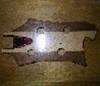
Yes the black paint or chrome shows some stress on the sides of the tailpiece when it is straightned but not where it has been hit (hence the use of a rubber mallet)
some bend up only a little, If it plays fine don't touch it. but with some of the older 4001's that did not have the back angled neck, with even a small bend in the tail you would lose tension over the bridge which would then cause rattles. those ones usually require a really straight tailpiece.
No two are the same!
some bend up only a little, If it plays fine don't touch it. but with some of the older 4001's that did not have the back angled neck, with even a small bend in the tail you would lose tension over the bridge which would then cause rattles. those ones usually require a really straight tailpiece.
No two are the same!
I confused Faraday's cage, with Schrodinger's cat box....
I haven't posted in a couple years but this topic fired up my interest again. Does anyone think that a steel bridge plate that sits flush to the body would increase sustain? Both my '76 4001 and a modified '88 V63 have the plate curl. I've owned the '76 a long time and it doesn't appear to be any worse than it was years ago.
-
jwr2
pretty much every other bass manufacturer in the world uses steel or brass bridges ... a lot of other Ric instruments use better bridges ...
The old style Ric bass bridge looks nice ... but it would not be hard to design one that had a similar look and better functionality and a better metal ...
I have seen the pull up problem on 70's, 80's, and 90's basses .... I repaired a '93 that had been stored in a basement for a while and all the screws were rusted and the backside of the bridge was all corrodided.
I am getting pretty good at retrofitting 2 screws into a ric bridge.
The old style Ric bass bridge looks nice ... but it would not be hard to design one that had a similar look and better functionality and a better metal ...
I have seen the pull up problem on 70's, 80's, and 90's basses .... I repaired a '93 that had been stored in a basement for a while and all the screws were rusted and the backside of the bridge was all corrodided.
I am getting pretty good at retrofitting 2 screws into a ric bridge.
well, thanks for everyones input here : my mind is now at rest. Weemac, you are right, if it plays fine, leave it be.
Its nice to know that some of you have bent tailpieces, that have not gotten any worse!
Its nice to know that some of you have bent tailpieces, that have not gotten any worse!
The email address shown is down, you can email me at [email protected]
-
mortivan