I still think it must have been - at least in part - for structural reasons. I've seen necks (one of them on a Ric that I own) that are dead straight and still you need to set the bridge as low as it will go for low action. That means that either the neck angle was wrong from the start (which I doubt) or that it has changed over the years, where the weak spot is.
The bridge on my first Rick bass, a '68 4000 purchased new, would not go low enough. I had to actually file the bottom of the bridge to get it down. A friend who purchased a '69 4001 new at the same time had the same problem. Since the woodworking process today now involves CNC machining I would think this would tend to be less of an issue.
The 60's instruments seem to simply have been built that way. The neck angle can't change without some very apparent outward signs of distortion somewhere else on the instrument. There would have to be some laminate separation or cracking from the neck changing that much. At the very least, the neck would no longer be straight. My '63 has a very straight neck but it angles forward very slightly from the body. The action is wonderful up to about the 10th fret but a bit high after that. It was built that way. The fact is that the geometry of the 4000 series has evolved considerably over the years. The early ones were far from perfect. Ask anyone who has played an early (57-62) 4000. If you look carefully at 4000 series basses from the beginning you will notice evidence of constant re-thinks and improvements. Some changes are very subtle and others more drastic. 70' 4001s and all of the 4003 necks I have measured have a 1.5 degree back angle which is not present on the early and mid 60's examples that I have seen. The 4003 started with the nearly straight out headstock of the 4001 but later gained a 4.5 degree back angle. This was done presumably to pull the strings down harder against the nut - a widely accepted lutherie practice to prevent string rattles and increase sustain. In some cases it strengthens the neck joint.
The headstocks of my 3 all have a slight back angle. The years are: '76, '77, & '81. Models: 4000, 4001, & 4080 respectively.
It's not much of an angle, but it's definitely there.
If I enlarge the route in a new-ish Ric to accept the pickup in the half-inch location, will I compromise neck stability? What about 4004 basses that have the route near the neck - are they weaker?
I'm asking because a used late 90's 4003 with the strong neck and modern truss rods and thin horns and long headstock would be perfect for me... only if I can move the neck pickup to the half-inch spacing, replace the 'hump' pickguard with a 70's style (Pickguardian does an excellent job) and replace the neck hi-gain with a toaster. Then it would be just perfect. Like a '74 just without the baby headstock and weak neck. That would make a great workhorse. I'm thinking Mapleglo - never had one in MG.
Kevin: The head angle of the 70's era 4000s is slight - only about 1.5 to 2 degrees. Later the angle was augmented to it's present 4.5 degrees.
Ilan: The V63 and C64 are based on the 4003 and have the 1/2 inch spacing. I have not looked at mine very closely but I suspect if you modeled your mod after the factory work on either of those two you would be ok. The 4004 is a different story because the pickup route is not as deep as the one on a 4003. I would not expect the 4004 to have any issues like that at all. Jeff Rath sometimes refers to what he calls "ski jump" necks on 4004s. I am not totally clear on the nature or the cause of the problem.
Ted has it right with his assessment of the 60's build/quality.
Example:
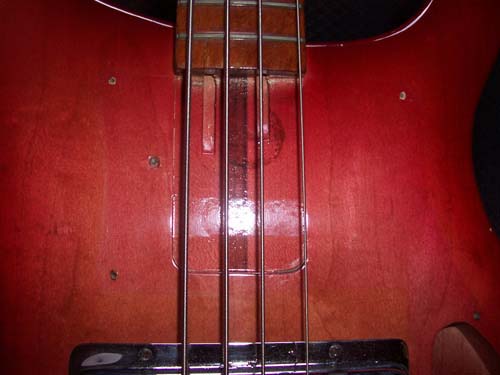
Here's a remedy to that 60's bridge problem. File down the bridge...Nah, still not low enough. Let's just rout out the body!
Both my 64 RM1999 and 64 deluxe have suffered because of that headstock angle, with lamination where the neck meets the body. In both cases the action is very high on both basses.
No wonder you see very few original examples from this period...
Ilan, In starting this thread, this is exactly what I intend to do. If you look at Ted's photo above, very little material is acutally removed. Just a 1/4" depth X 3/8" wide. This is an area that already is routed for truss rod removal. This recess is just to clear the pickup trim ring. I would argue that this wood removal affects sonic characteristics unto itself, but moving pickups relative to string harmonics by 1/2" will make a difference. I am looking however for asthetics with the toaster mod. Nothing I can really do about the baby headstock, but I don't find it that noticable except in side by side comparisons.
Ted, what have you found about this lead neck thing? Sounds interesting and plausible. I'm not going to pull the fretboard to find out. I did have the fretboard off my old '68 once and don't remember any slugs of anything under there.
...ooops. I would argue that this wood removal does not affect the sound. Typed it out wrong. That and argue is a strong stance. I don’t think it would affect it until proven wrong with my own ears.
Nasty, deep grooves cut in the pickup surround, too!
Ouch!
You know, I'd often thought about the feasibility of adding a neck pup to my 4000 (back before I knew better). It actually has the starter dimples where drilling & routing would have commenced had this been a 4001s model. Perhaps the set neck bodies were largely done this way.
Anyway, a very interesting thread.
Ted, I noticed the "ski jump" on my Cheyenne I also. The neck seems pretty straight from the nut on down, but right where the neck deepens for the heel that meets the body wings, the fretboard pitches up ever so slightly. You probably wouldn't have trouble with it unless you had the action set super low and were playing high up on the neck. Then you might have some fret buzz.
Author: "The Rickenbacker Electric Bass - 50 Years As Rock's Bottom"
"You probably wouldn't have trouble with it unless you had the action set super low and were playing high up on the neck."
I set the action super low and often play high up the neck, that is why neck stability is so important for me. My Shadow is almost like a "fretless wonder" Les Paul Custom. It almost plays itself.
"Jeff Rath sometimes refers to what he calls 'ski jump' necks on 4004s. I am not totally clear on the nature or the cause of the problem"
I have seen 4001s that have been routed out for other than Rick pickups that ends up ruining the bass due to neck angle drastically changing. I would stick with replicating the factory route. Finding one of the short magnet toasters would be a plus.
Note my (former) V63 was just the opposite. The bridge needed to be so high that it would lean towards the nut. I came up with a reversible mod to the height screws to stop the lean.
I just worked on a 4004CII that went the other way. The neck is dead flat until about the 13th fret then the fingerboard begins to falls away. By the 20th fret there is about .020 difference between the top of the fret and the plane of the rest of the neck.