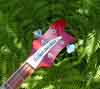
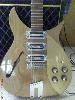
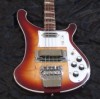
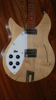
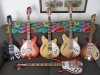
Tony, just as nice as a regualr RIC. I've got a few 425s and thats essentially what it is. Just a little less buffing on the clearcoat and another TRC. Two position switch must cut on/off a capacitor. Down is very trebly. Up is a more full tone. Playability? Funny, but it plays more Strat like because of the proximity of the neck to body. I've heard people say that Strats play well. Lol. And this guitar is in superb condition. I paid $785. (including shipping) for the Ryder and it's original accompanying Electro amp.
I'd bet that this is identical to the ES-16 I have, with the obvious exception of the TRC.
Differences between it and a standard Rick of the era involve mostly finishing operations. I'd bet it's a grade of maple lower, as well, just to save a few bucks. The tuners are not premium. The finish is sprayed, there are fewer coats of conversion varnish, and this is the biggest difference--there is neither hand-flatting of the varnish nor buffing back to a mirror shine. Instead, the natural gloss of the varnish is left, as-is. This saves a lot of money in the build process.
And, you're right, John, there's a cap that cuts in at one switch position to give some tonal variety, using only the one pickup. These guitars stayed the same for fully twenty years, with the exception of the later models using hi-gain instead of toaster pickups.
“I say in speeches that a plausible mission of artists is to make people appreciate being alive at least a little bit. I am then asked if I know of any artists who pulled that off. I reply, 'The Beatles did.”
― Kurt Vonnegut
Gary, I'm guessing that these Ryders, Electros, Contellos, Symfonia Grands, etc...were all built in small numbers. But they are out there. I wonder what other names they were built under? John Hall once checked on a Symfonia Grand. He mentioned a run of 50 or so. I know certainly there were more Electros made than the rest. Funny but one of my dreams is to be let loose in the room where RIC keeps all of the old records. I would be hell on wheels. Anyone care to join me? Lol.
Looks similar to my '64 ES-16, purchased in 1980 for $30 (including original silver case):
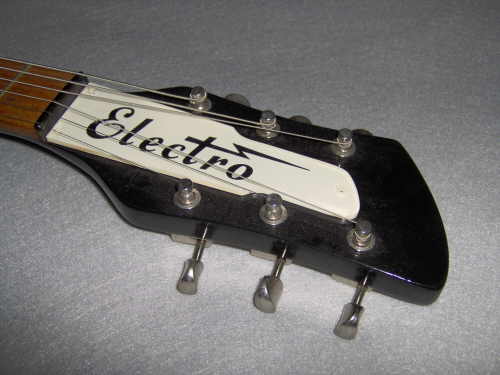
And here's the headstock (pardon the dust and changed tuners):
We've talked about Randy's Jetglo guitar before; that guitar is actually like a Rickenbacker 900, which has 21 frets, the Ryder/Electro/Rickenbacker 1000 was only 18 frets and a different body shape....Randy's was probably meant to be a Rickenbacker, but was just taken off the line and had an Electro nameplate installed. Cool.
John: My ES-16 is definitely an oddball. The horns on my guitar are very different from a 900. The contoured edges add a touch of style (like a 400 or 610-series guitar). The original JG finish must be fairly rare for a 3/4-scale student model. I tried to get it repainted in the 1980's, but the respray was poor. In the near future, I'd like to get the guitar properly refinished.