
The ROS box is essentially a fancy, professional splitter box. Just high quality parts & cable. I made my own out of an MXR stomp box case & some standard Switchcraft parts & it worked fine, but looked like what it was: home made.
It's an accessory. I figured that since I spent a pile of money on a 4080 & had my 4001 rewired back to stock (minus the cap) that I should have that one little accessory, & since they're no longer being produced I might as well get one now.
A good quality splitter cable will achieve the same end, but it's not a ROS kit. I even toyed with the idea of leaving it sealed in the bag & never using it, but I'm not a collector & I wanted to try it.
A real collector would buy, use one & keep the other for an investment I suppose.
The wonderfull world of Ric-O-Sound!!!!!
Moderators: rickenbrother, ajish4
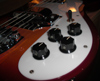
I made this in about an hour.
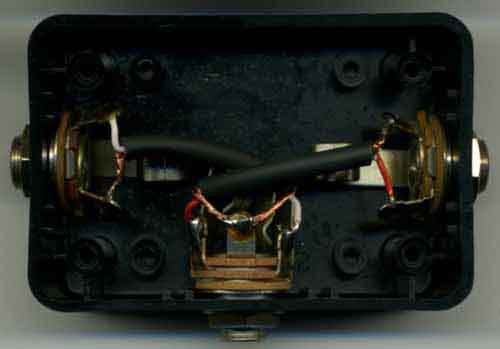
The box is $3.99 at Radio Shack.
It measures 1" X 2" x 3".

I already had the 1/4" stereo and mono jacks which are stainless.

Looks pretty nice if you ask me.
The box is $3.99 at Radio Shack.
It measures 1" X 2" x 3".
I already had the 1/4" stereo and mono jacks which are stainless.
Looks pretty nice if you ask me.
'73 4001 MG '88 4003S JG '89 4003S FG '91 4003S MG
I used to run stereo with a home made splitter which was essentially a stereo cable wired into two mono cables with no box which then each went to their respective inputs. I got a great sound in practice but I got all kinds of noise from lighting and all sorts of noise generating sources when I was in clubs. Evidently I didn't use quality cables, I ended up completely shielding both my Rics with soldiered together pieces of sticky copper (which doesn't seem to be available anymore) at that time which worked great, they were much quieter than a stock Ric. I think the key is using good quality cable if you want to do it yourself.
-
hieronymous

- Intermediate Member
- Posts: 837
- Joined: Fri Feb 11, 2005 10:46 pm
- Contact:


Quoting Harry Bridge: "I've said it before and I'll say it again - are Ric-O-Sound users really willing to lose the tonal qualities that both pickups together can offer? You can only get the sound of the neck pup in one amp and the bridge pup in the other."
It's for this very reason that I made a tiny mod to my Ric. I added a small toggle switch that gives me the a choice of NORMAL / MONO / SWAPPED.
Used in conjunction with the Ric's own pickup selector switch, this gives me options of:
1) Bridge to Amp A / Neck to amp B
2) Neck to amp A / Bridge to amp B
3) Neck to amp A / Nothing to amp B
4) Nothing to amp A / Bridge to amp B
5) Bridge to amp A / Nothing to amp B
6) Nothing to amp A / Neck to amp B
and of course...
7) Both pickups in mono to both amps!
I run the 2-channel guitar output down a cable with individually screened cores to avoid crosstalk. This terminates via an XLR at my own home-made die-cast "Ric-o-sound" splitter box, from which emerge two mono cables to feed two Ashdown ABM 300 combos. One is a 2x10+Tweeter and the other is a 1x15.
My favourite tone setting is to have the 2x10 combo with its EQ all clean and trebly to get plenty of clang, and the 1x15 with the valve stage dialled in for warmth/grind. It's perfect for that grungy, aggressive Ronnie Lane/Bruce Foxton sound!
It's for this very reason that I made a tiny mod to my Ric. I added a small toggle switch that gives me the a choice of NORMAL / MONO / SWAPPED.
Used in conjunction with the Ric's own pickup selector switch, this gives me options of:
1) Bridge to Amp A / Neck to amp B
2) Neck to amp A / Bridge to amp B
3) Neck to amp A / Nothing to amp B
4) Nothing to amp A / Bridge to amp B
5) Bridge to amp A / Nothing to amp B
6) Nothing to amp A / Neck to amp B
and of course...
7) Both pickups in mono to both amps!
I run the 2-channel guitar output down a cable with individually screened cores to avoid crosstalk. This terminates via an XLR at my own home-made die-cast "Ric-o-sound" splitter box, from which emerge two mono cables to feed two Ashdown ABM 300 combos. One is a 2x10+Tweeter and the other is a 1x15.
My favourite tone setting is to have the 2x10 combo with its EQ all clean and trebly to get plenty of clang, and the 1x15 with the valve stage dialled in for warmth/grind. It's perfect for that grungy, aggressive Ronnie Lane/Bruce Foxton sound!
2004 4003 JetGlo
Epiphone Jack Casady
Ovation Magnum 1
Mania VTB-4BS
Dean Stylist w/ John Birch Magnum II pups
Yamaha BB414
Trace Elliot VA350/GP11 Mk1
Peavey TB-Raxx
2 BFM Omni 10.5 crossfire cabs
Roland Bass Cube 100
Epiphone Jack Casady
Ovation Magnum 1
Mania VTB-4BS
Dean Stylist w/ John Birch Magnum II pups
Yamaha BB414
Trace Elliot VA350/GP11 Mk1
Peavey TB-Raxx
2 BFM Omni 10.5 crossfire cabs
Roland Bass Cube 100
Hi Robert,
It's actually fairly simple, although with a subminiature switch, the soldering is very fiddly.
The trickiest part is getting hold of the right kind of switch to start with! What you need is a Quadruple-Pole, Double-Throw (QPDT) switch that is ON-ON-ON. I was lucky: my little local electronics shop had some old stock still on the shelf.
The switch goes into the circuit between the outputs from the volume pots and the stereo output jack. That way, you retain full volume/tone control over both pickups independently. The only inter-reaction between their controls occurs when the switch is in the 'mono' setting. In this position, the volume pots still work independently, but the tone controls kinda work as one.
To explain how it's wired, I've uploaded a PDF file (107kB) here:
http://www.mtproductions.co.uk/private/stereo_switch.pdf
To download it, right-click the link and choose "save target as..."
Finally, when I made my list of switching options, I forgot a couple! They are:
 Bridge only to both amps, mono
9) Neck only to both amps, mono
If you want to try this mod and you find it impossible to get the right kind of switch, send me a message and I'll see if my local shop still has some.
Cheers,
Ken
It's actually fairly simple, although with a subminiature switch, the soldering is very fiddly.
The trickiest part is getting hold of the right kind of switch to start with! What you need is a Quadruple-Pole, Double-Throw (QPDT) switch that is ON-ON-ON. I was lucky: my little local electronics shop had some old stock still on the shelf.
The switch goes into the circuit between the outputs from the volume pots and the stereo output jack. That way, you retain full volume/tone control over both pickups independently. The only inter-reaction between their controls occurs when the switch is in the 'mono' setting. In this position, the volume pots still work independently, but the tone controls kinda work as one.
To explain how it's wired, I've uploaded a PDF file (107kB) here:
http://www.mtproductions.co.uk/private/stereo_switch.pdf
To download it, right-click the link and choose "save target as..."
Finally, when I made my list of switching options, I forgot a couple! They are:
Bridge only to both amps, mono 9) Neck only to both amps, mono
If you want to try this mod and you find it impossible to get the right kind of switch, send me a message and I'll see if my local shop still has some.
Cheers,
Ken
2004 4003 JetGlo
Epiphone Jack Casady
Ovation Magnum 1
Mania VTB-4BS
Dean Stylist w/ John Birch Magnum II pups
Yamaha BB414
Trace Elliot VA350/GP11 Mk1
Peavey TB-Raxx
2 BFM Omni 10.5 crossfire cabs
Roland Bass Cube 100
Epiphone Jack Casady
Ovation Magnum 1
Mania VTB-4BS
Dean Stylist w/ John Birch Magnum II pups
Yamaha BB414
Trace Elliot VA350/GP11 Mk1
Peavey TB-Raxx
2 BFM Omni 10.5 crossfire cabs
Roland Bass Cube 100
-
hieronymous
- Intermediate Member
- Posts: 837
- Joined: Fri Feb 11, 2005 10:46 pm
- Contact:
Hi Harry,
The good news is that, in practice, the options aren't nearly as mind-bendingly complicated as they might look on paper, and they're really easy and logical to dial in quickly, without to much fiddling.
I must confess that in live situations I hardly ever have just one pickup going to one amp and nothing to the other, as the drop in volume would be considerable. If I do choose just one pickup, it's usually switched to feed both amps at once, and obviously I can back off the treble on the "clangy" channel if needs be.
If I were in Mr. Hall's shoes, I'd have made this switching arrangement a standard feature by now! The beautiful thing about it is that it "degrades gracefully" as they say in computing - i.e. if I run the guitar through the mono jack, it becomes a normal mono Ric again. Commoning the outputs in this way simply renders the fancy switch redundant.
Another factor about being able to switch instantly between pickups / amps is that you really get to appreciate how sonically different from each other the standard Ric neck & bridge Hi-Gains are. Simply swapping the channels gives a startling change in timbre.
Speaking of pickup tone, I've been toying with the idea of changing my neck p/up for an HB1, but I'm not sure.... Any ideas?
Finally, all this talk of switches has reminded me of one of my few complaints about the 4003 design: the fact that, owing to lack of cavity space, the leaf-spring pickup selector switch has to be oriented to throw up/down instead of left/right. It took me AGES to learn which position corresponds to which pickup - and I still occasionally get it wrong! Left/right (with the toggle actually pointing toward the pickup in question) would make so much more sense!
The good news is that, in practice, the options aren't nearly as mind-bendingly complicated as they might look on paper, and they're really easy and logical to dial in quickly, without to much fiddling.
I must confess that in live situations I hardly ever have just one pickup going to one amp and nothing to the other, as the drop in volume would be considerable. If I do choose just one pickup, it's usually switched to feed both amps at once, and obviously I can back off the treble on the "clangy" channel if needs be.
If I were in Mr. Hall's shoes, I'd have made this switching arrangement a standard feature by now! The beautiful thing about it is that it "degrades gracefully" as they say in computing - i.e. if I run the guitar through the mono jack, it becomes a normal mono Ric again. Commoning the outputs in this way simply renders the fancy switch redundant.
Another factor about being able to switch instantly between pickups / amps is that you really get to appreciate how sonically different from each other the standard Ric neck & bridge Hi-Gains are. Simply swapping the channels gives a startling change in timbre.
Speaking of pickup tone, I've been toying with the idea of changing my neck p/up for an HB1, but I'm not sure.... Any ideas?
Finally, all this talk of switches has reminded me of one of my few complaints about the 4003 design: the fact that, owing to lack of cavity space, the leaf-spring pickup selector switch has to be oriented to throw up/down instead of left/right. It took me AGES to learn which position corresponds to which pickup - and I still occasionally get it wrong! Left/right (with the toggle actually pointing toward the pickup in question) would make so much more sense!
2004 4003 JetGlo
Epiphone Jack Casady
Ovation Magnum 1
Mania VTB-4BS
Dean Stylist w/ John Birch Magnum II pups
Yamaha BB414
Trace Elliot VA350/GP11 Mk1
Peavey TB-Raxx
2 BFM Omni 10.5 crossfire cabs
Roland Bass Cube 100
Epiphone Jack Casady
Ovation Magnum 1
Mania VTB-4BS
Dean Stylist w/ John Birch Magnum II pups
Yamaha BB414
Trace Elliot VA350/GP11 Mk1
Peavey TB-Raxx
2 BFM Omni 10.5 crossfire cabs
Roland Bass Cube 100
Quote: "Ken - my caveat with the 4001/3 leaf switch is that it is wired up for bass (neck) and down for treble (bridge). Intuitively, bass is a lower frequency and should be the down position."
Yup, John, you've hit it right on the head. That must be why I keep getting it wrong: it's anti-intuitive. Time to get out the soldering iron again!
Yup, John, you've hit it right on the head. That must be why I keep getting it wrong: it's anti-intuitive. Time to get out the soldering iron again!
2004 4003 JetGlo
Epiphone Jack Casady
Ovation Magnum 1
Mania VTB-4BS
Dean Stylist w/ John Birch Magnum II pups
Yamaha BB414
Trace Elliot VA350/GP11 Mk1
Peavey TB-Raxx
2 BFM Omni 10.5 crossfire cabs
Roland Bass Cube 100
Epiphone Jack Casady
Ovation Magnum 1
Mania VTB-4BS
Dean Stylist w/ John Birch Magnum II pups
Yamaha BB414
Trace Elliot VA350/GP11 Mk1
Peavey TB-Raxx
2 BFM Omni 10.5 crossfire cabs
Roland Bass Cube 100