
I plan on pulling the truss rods on my 1975 4001..
Two reasons... One is that I want to see EVERY last part of my bass.. I have a weak E-string when fretting between the 2nd fret and 8th fret... SO I need to pull them to examine them, clean and straighten them and re-tape them and re-install...Re-tapp the threads..ect..
The other reason i am doing this is to acurately measure these rods and then draw them into SolidWorks, a CAD program...this way making the blue-prints... I will then determine the exact type of steel used... I will either make this info available to others or simply have these rods machined in quantity for those who need them... I am not trying to make profit or push any kind of business...I figure this could be a group effort for volume machining, this way keeping the price down and reasonable...
One member here was kind enough to describe the procedure to pull the rods... I believe he said to pull the rods out from the headstock, since it would be easier on the rods, rather than pullling them from the body end...
If any one could chime in and best ways to pull these rods along with any tips and what to watch out for..I would appreciate it... Also, when I re-install the rods, when do i stop?? How do I know when the rods is in it's proper place??
Best Regards
Chris
Ready to pull my 4001 truss rods.....
Moderators: rickenbrother, ajish4
The hardest part is getting the tips of the rods out of the cutout area in the headstock, it takes some pulling up and some force. I think I used needle nose pliers if I remember right. I've removed several pairs of them but it's been several years. Make sure you put them in right side up when you put them back and again the hardest part is getting the tips into the cutout. I bend them a little to make it easier to reinsert them. It's not really very hard to do, just a pain. The aluminum block is sometimes hard to get out especially if the tips have bent down as many of them have and make sure you put it back the way it came out.
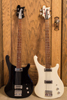
Some rods slide out easily other require a bit of help. First, protect the face of the headstock with a few layers of masking tape. Next, clamp the first fret just below the nut. This is important as a little misplaced pressure can break the lamination of the fingerboard. Now, loosen the rods. If the rod tips are bent back into the wood, leave the nuts on and use a flat screwdriver to pry them away. This is where the clamp comes in to play. Once the rods are loose take the nuts off and pry the bearing plate up and off of the rods. On most 4001s the rods will come out by hand just by grabbing the end of the rod and pulling. If not, slide a short piece of rod stock into the bottom (body end) of the truss channel and tap gently with a hammer to get them to move. Do one at a time. As the rod rises out of the headstock, bend it up slightly by hand and place a clean folded rag under the tips to further protect the headstock. Then pull the rod out. Use your hands as much as possible. Go back to using tools only if the rod just won't move. Once they are out, rub them down with steel wool to clean off any rust or other crud that might be on them. Re-tape if necessary (usually not required). Clean up the threads and straighten any bends especially at the tip. The old style rods are actually longer than they need to be. That is so if they break you can re-cut the offset and re-thread the long side. I don't know exactly how much rod is necessary but I would guess that they should at least reach the 16th fret. When you are ready to reinstall them, wax them with a good carnuba wax and slide them back in. Replace the bearing plate and nuts.
The rods are made of a kind of flat wire that is very difficult to find these days. Most major steel suppliers have withdrawn the material from their catalogs. I have the necessary tooling to squeeze round rod down to the spec used for the original rods. Some day I will actually get around to making some.
The rods are made of a kind of flat wire that is very difficult to find these days. Most major steel suppliers have withdrawn the material from their catalogs. I have the necessary tooling to squeeze round rod down to the spec used for the original rods. Some day I will actually get around to making some.

I must admit I don't quite get how these rods work. I understand that they are not fastened or anchored at all at the body side? How can they apply any straightening force to the neck? Would't they just come out of the headstock as you tighten the screws?
I have read written descriptions of this, but can any of you make a sketch so even I can get this?
I would do the same thing as you do Chris, take them out, clean and reinstall them, as the tips/nuts are now bent back towards the headstock (on both my 75 MBrefin and my 76 FG).
I have read written descriptions of this, but can any of you make a sketch so even I can get this?
I would do the same thing as you do Chris, take them out, clean and reinstall them, as the tips/nuts are now bent back towards the headstock (on both my 75 MBrefin and my 76 FG).
Lars... I am just as baffled as you are of the mechanics behind these truss rods... Since I am an engineer,I can't wait to take it apart and do the analysis and put an end to this truss rod mystery 
I suspect the force is diplaced in the semi-circle shape of the truss rods under pressure..
So the force is distributed along the semi-circle and transfered to the top finger-board..
So there is not enough orthaganol force on the other end of the rods to pull the truss rods out...this is only a guess until I actually see it apart..
Chris
I suspect the force is diplaced in the semi-circle shape of the truss rods under pressure..
So the force is distributed along the semi-circle and transfered to the top finger-board..
So there is not enough orthaganol force on the other end of the rods to pull the truss rods out...this is only a guess until I actually see it apart..
Chris

It is a rod that is folded at the body end. The threaded end is installed toward the back of the neck. As you tighten the the nut it causes the top rod to react against the aluminum block and to bow in the center pushing out toward the fret board. Since the rod is contained in the neck channel the rear (threaded) rod bows with it. Bend a coat hanger and try it. It is very simple.
"The best things in life aren't things."
Ken is correct. The rods are variable springs. They tend to bow backward and expand when tightened which is why the neck must be set by hand. If not, the fingerboard can be popped off or worse.
The design is actually quite old. I was poking around an old instrument repair shop in Prague a few years ago and saw an 18th century lute with a broken neck. To my surprise, it had a truss rod that worked just like an old RIC rod. Prior to that, I had believed that adjustable steel truss rods were a 20th century invention but the shop owner said that they can be found in longer lute necks back into the late 1600's.
The design is actually quite old. I was poking around an old instrument repair shop in Prague a few years ago and saw an 18th century lute with a broken neck. To my surprise, it had a truss rod that worked just like an old RIC rod. Prior to that, I had believed that adjustable steel truss rods were a 20th century invention but the shop owner said that they can be found in longer lute necks back into the late 1600's.


The nice thing about this design is the the truss rods react against themselves. They are less affected by temperature or humidity. If the RIC design had a pocket welded onto the threaded rod for the upper portion to react against as in Hot Rods® they wouldn't have the issues with bending or poping off the fretboard.
"The best things in life aren't things."
Hot Rods are probably the best truss rod design going. They require no special routing. They don't press on the back of the fingerboard. They don't apply a compressive force to the wood at either end. They can address bow in both directions. They are sealed units that don't get gummed up with errant glue. So shat is not to like? They have a taller profile than most other rods and are a little heavier.