Back from vacation - my (and my wife's) latest senior moments - it was during the week off we realized if we took today off also we'd have had 11 days off in a row! Doh!
Glenn, it is but it isn't. You'd think with 3 colleges in the metro area there would be more night places with live music but it just ain't so.
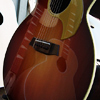
On Saturday, the entire bass was flatted, prior to its second group of clearcoat coats.
Flatting consists of sanding all surfaces with #320 aluminum oxide sandpaper, dry, mounted to a hard EVA block.
It takes two hours alone to flat the fretboard properly by hand, using four different widths of EVA rubber blocks.
Two more double coats of clear varnish were sprayed Saturday afternoon. These were allowed to cure until this morning, when another flatting took place over the entire bass, including once again the fretboard.
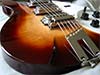
Two more double coats of clear varnish were sprayed this afternoon. There will be one more flatting with #800, wet, followed by #2000, wet, before it meets the buffing wheel.
Still waiting for parts on this one, too, Paul.
“I say in speeches that a plausible mission of artists is to make people appreciate being alive at least a little bit. I am then asked if I know of any artists who pulled that off. I reply, 'The Beatles did.”
― Kurt Vonnegut
Thanks for the update, Paul. Sounds like your making good headway with it. Sorry if we all sound impatient but it is a lot of fun and very satisfying to see your projects. Happy 4th!
My restorations typically get 6-8 double coats (12-16 coats) of CV.
They're called "double coats" because they go on two at a time, with about five minutes between. Then there's about an hour wait and a second set of double coats is put on. A typical schedule calls for two double coats, cure overnight, flatten, two more, cure overnight, flatten, two more, ditto, two more, ditto except flatten wet with fine paper, buff, detail, wax, assemble.
A typical guitar refinish takes 20-24 ounces of varnish. A bass takes slightly more.
The gnarliest part of any refinish is the fretboard. It takes the most time, whether it's been refretted or not. By the time a guitar or bass is buffed out and ready to assemble, about 1/3 of the total time was spent on the fretboard.
“I say in speeches that a plausible mission of artists is to make people appreciate being alive at least a little bit. I am then asked if I know of any artists who pulled that off. I reply, 'The Beatles did.”
― Kurt Vonnegut
“I say in speeches that a plausible mission of artists is to make people appreciate being alive at least a little bit. I am then asked if I know of any artists who pulled that off. I reply, 'The Beatles did.”
― Kurt Vonnegut
I know the plating is vacuum deposition (not the usual tank stuff), but Russ will have to fill in the blanks here.
“I say in speeches that a plausible mission of artists is to make people appreciate being alive at least a little bit. I am then asked if I know of any artists who pulled that off. I reply, 'The Beatles did.”
― Kurt Vonnegut
Thanks for all the compliments folks. Paul is right about the gold. I wanted to stay away from gold plating because it just doesn't stand up to wear. I am using low temp vapor deposition. It is much more expensive than plating since it can't be done in small batches. I use this process in my business (Aerospace) and so I have a relationship that allows me to slide a few pieces in here and there with other jobs.