
Fireglo 360c63/12
Moderators: rickenbrother, ajish4
-
jingle_jangle
- RRF Moderator
- Posts: 22679
- Joined: Wed Dec 22, 2004 6:00 am
- Contact:
"...we all know that color is subjective in photography."
Beg to differ here. Color is subjective only in the way we describe it, and it's been very accurately mapped and referenced over the decades in Munsell, CCA, Pantone, and other systems for graphic and product design, architecture, printing, and other applications.
The problems we have in depicting and transmitting color data, come down to the color temperature of our lighting or our monitors, and how fresh the chemicals in our developing tanks are (with reference to film and paper).
In many cases, something like whether the center of a burst tends toward steak or salmon, is very difficult to evaluate on any computer monitor, unless color-corrected and certified for graphics arts use.
And, don't forget that many people are color-blind to a greater or lesser degree over part or all of the visible spectrum. This also applies to digital cameras vs. film cameras. My Sony digital (second from top of their "prosumer" line) messes up purples, greens and blues under fluorescent lights.
Beg to differ here. Color is subjective only in the way we describe it, and it's been very accurately mapped and referenced over the decades in Munsell, CCA, Pantone, and other systems for graphic and product design, architecture, printing, and other applications.
The problems we have in depicting and transmitting color data, come down to the color temperature of our lighting or our monitors, and how fresh the chemicals in our developing tanks are (with reference to film and paper).
In many cases, something like whether the center of a burst tends toward steak or salmon, is very difficult to evaluate on any computer monitor, unless color-corrected and certified for graphics arts use.
And, don't forget that many people are color-blind to a greater or lesser degree over part or all of the visible spectrum. This also applies to digital cameras vs. film cameras. My Sony digital (second from top of their "prosumer" line) messes up purples, greens and blues under fluorescent lights.
“I say in speeches that a plausible mission of artists is to make people appreciate being alive at least a little bit. I am then asked if I know of any artists who pulled that off. I reply, 'The Beatles did.”
― Kurt Vonnegut
― Kurt Vonnegut
Paul, you certainly may beg to differ with me on the subjective thing, but if I understand clearly what you just said, I think we are saying virtually the same thing but with moderate diversity. I would also respectivefully add to my position that not only our monitors but our printers can vary a hue depending on the type of paper and the grade and amount of ink we are using, not to mention whether inkjet or laser. I was in the wedding photography business for many years and I have literally sweated bullets on both the chemical and digital processing to get those bridesmaid gowns just the color the bride thought they should be with a push here or a tweak there. Now I do photography for beauty pageants and it is deja vue all over again trying to reproduce those flesh tones, pastels and light colors. The low light scenarios I often find myself in wreak havoc with both focusing and "getting the colors right" for those ladies, too.
I also have one of those Sony prosumer contraptions, which I dearly love, and to further muddy the waters, mine has three settings for color: vivid, Adobe RGB, and standard. Now I know that deals mostly with shades, saturation and hues, but under just the wrong lighting choosing the wrong setting can create nightmares for accurately reproducing an "exact" color, especially when we are dealing with a light color like pink.
"But you know, I know when it's a dream. I think a 'no,' I mean a 'yes,' but it's all wrong. That is, I think I disagree."
I also have one of those Sony prosumer contraptions, which I dearly love, and to further muddy the waters, mine has three settings for color: vivid, Adobe RGB, and standard. Now I know that deals mostly with shades, saturation and hues, but under just the wrong lighting choosing the wrong setting can create nightmares for accurately reproducing an "exact" color, especially when we are dealing with a light color like pink.
"But you know, I know when it's a dream. I think a 'no,' I mean a 'yes,' but it's all wrong. That is, I think I disagree."
Nothing compares to the sound of a Rick 12 with a JangleBox and a touch of chorus.
Paul, you said "My Sony digital (second from top of their "prosumer" line) messes up purples, greens and blues under fluorescent lights."
I have found on my Sony DSC1 if you adjust the white balance it clears that up. Sometimes I have to do it manually because the AWB won't always work correctly.
I have found on my Sony DSC1 if you adjust the white balance it clears that up. Sometimes I have to do it manually because the AWB won't always work correctly.
Nothing compares to the sound of a Rick 12 with a JangleBox and a touch of chorus.
-
beatlefreak

- Senior Member
- Posts: 6160
- Joined: Wed Jun 14, 2006 5:45 am
- Contact:
Acknowledging the sometimes significant differences due to monitors, I'm pretty sure my c63 looks different than that. When I get back from my current trip, I'll try and post a picture of my 3 FG guitars.
Paul, I wonder if the new FG formula that JH mentioned during the tour is part of the difference between my c63 and Jays? Look at the differences between the 3 1996s that Kevin Kuney posted in a different thread.
../7/119278.html"#EECD9C">
Paul, I wonder if the new FG formula that JH mentioned during the tour is part of the difference between my c63 and Jays? Look at the differences between the 3 1996s that Kevin Kuney posted in a different thread.
../7/119278.html"#EECD9C">
-
1ststatestereo
-
beatlefreak
- Senior Member
- Posts: 6160
- Joined: Wed Jun 14, 2006 5:45 am
- Contact:
-
studiotwosession

- Advanced Member
- Posts: 2215
- Joined: Fri Jul 29, 2005 1:36 pm
-
beefandbones
- Intermediate Member
- Posts: 893
- Joined: Thu Feb 19, 2004 7:27 am
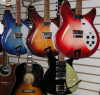
John, Kevin could give you the best answers about his guitars of course, but in that photo, I believe the 1996 on the left is the standard fireglo finish from about 10 years ago, the center 1996 is an early formulation of Amber Fireglo for NAMM, and the 1996 on the right is the standard production Amber Fireglo finish. Amber Fireglo is not available on C-series instruments to the best of my knowledge.
Please, not trying to provoke anyone
Unless anyone has lately seen George's 360 in person, how can you tell how much a C63 really resembles his? How much does/should relating published photos decide? What about comparing guitars made in 1963/64 and today.
When I first opened the case of my C63, I initially saw quite a lot of Burgundy (you could say - almost - Violet... "Some mistake has been made!!!)" I really don't see it as much anymore. Depending on the light the red really sparkles, it's a chameleon.
A few weeks ago I was in the local guitar emporium and, amongst the RICs, one 330/6 FG DEFINITELY did not resemble the others. A kind of soft red/non-standard FG. Somewhat like the C63 photos above. It actually stood out quite nicely... "BUY ME" it said! If only I could have.
Unless anyone has lately seen George's 360 in person, how can you tell how much a C63 really resembles his? How much does/should relating published photos decide? What about comparing guitars made in 1963/64 and today.
When I first opened the case of my C63, I initially saw quite a lot of Burgundy (you could say - almost - Violet... "Some mistake has been made!!!)" I really don't see it as much anymore. Depending on the light the red really sparkles, it's a chameleon.
A few weeks ago I was in the local guitar emporium and, amongst the RICs, one 330/6 FG DEFINITELY did not resemble the others. A kind of soft red/non-standard FG. Somewhat like the C63 photos above. It actually stood out quite nicely... "BUY ME" it said! If only I could have.
This is my first long post. Please forgive my rambling...
As a guitar/Rickenbacker/Beatles fan, I have been scanning the web over the last 18 months or so gathering pictures of 360/12C63 guitars that have shown up at various dealers, and from forum posts of owners that share pictures of their new guitars. I have observed that within a particular run of 360/12C63 guitars, individual guitars in that run have similar color and shading patterns. The few in that run that varied more than “usual” seemed to have had a larger/different shading pattern that allowed for blending of dark grain, mineral streaks, etc. This color/shading consistency within a run indicates that the same paint tech probably sprayed the finish on all the guitars in that run.
Some of the different runs of these guitars have varied quite a bit. The most unique run was the large batch that shipped this past July. Unlike other runs of 360/12C63s, this run was distinct in that they all had a very dark coloring at the outer edge of the shading pattern. These guitars also had a different rim shading pattern. Rather than the natural wood areas being in the side recesses, the natural areas were on the widest part of the rims.
Before the first 360/12C63 guitars began shipping some 18 months ago, I remember reading a post that said something along the lines of a life-size picture of George’s guitar being posted in the spray booth so that techs could exactly duplicate that spray pattern. At that time most all 360-style guitars in fireglow came with that shading pattern. My favorite color/shading combination on 360/12C63 guitars so far were from the first two runs shipped. I think guitars from those two runs looked the closest to the sample 360/12C63 guitar shown on the Rickenbacker web site and the closest to George's guitar so far.
I also think slight variations in color and shading patterns are normal and are to be expected. However something looks different with the shading on the true to the 1963 fireglow finish. This could be due to many reasons. I have read recent posts that discuss the finishing process changing to meet federal regulations. I imagine paint techs get promoted, are assigned other responsibilities, take on different responsibilities and change from run to run or change jobs permanently. Maybe the recent maple stock absorbs the finish differently, or has lots of dark grain and/or mineral streaks that require the color and shading pattern to vary significantly to help things blend-in better. Maybe the picture of George’s guitar is no longer in the booth, or maybe they just want to change things so that each guitar has the spirit of the original, but is an individual instrument and not one of an endless stream of exact duplicates.
The guitar player in me tells me that these 360/12C63 instruments are well made, reasonably priced instruments that are made in the USA. The Rickenbacker fan in me tells me that these guitars are meticulously built to the highest standards and play and sound great. The Beatles fan in me tells me that these guitars are structurally and sonically as close to George’s guitar as possible… but that the color and shading on most of them don’t look like George’s.
As mentioned above, I fall into all three categories. I know the first two categories can be easily fulfilled with any new 360/12C63. It’s the third category that I’ll have to be patient and wait for the right one to come along.
As a guitar/Rickenbacker/Beatles fan, I have been scanning the web over the last 18 months or so gathering pictures of 360/12C63 guitars that have shown up at various dealers, and from forum posts of owners that share pictures of their new guitars. I have observed that within a particular run of 360/12C63 guitars, individual guitars in that run have similar color and shading patterns. The few in that run that varied more than “usual” seemed to have had a larger/different shading pattern that allowed for blending of dark grain, mineral streaks, etc. This color/shading consistency within a run indicates that the same paint tech probably sprayed the finish on all the guitars in that run.
Some of the different runs of these guitars have varied quite a bit. The most unique run was the large batch that shipped this past July. Unlike other runs of 360/12C63s, this run was distinct in that they all had a very dark coloring at the outer edge of the shading pattern. These guitars also had a different rim shading pattern. Rather than the natural wood areas being in the side recesses, the natural areas were on the widest part of the rims.
Before the first 360/12C63 guitars began shipping some 18 months ago, I remember reading a post that said something along the lines of a life-size picture of George’s guitar being posted in the spray booth so that techs could exactly duplicate that spray pattern. At that time most all 360-style guitars in fireglow came with that shading pattern. My favorite color/shading combination on 360/12C63 guitars so far were from the first two runs shipped. I think guitars from those two runs looked the closest to the sample 360/12C63 guitar shown on the Rickenbacker web site and the closest to George's guitar so far.
I also think slight variations in color and shading patterns are normal and are to be expected. However something looks different with the shading on the true to the 1963 fireglow finish. This could be due to many reasons. I have read recent posts that discuss the finishing process changing to meet federal regulations. I imagine paint techs get promoted, are assigned other responsibilities, take on different responsibilities and change from run to run or change jobs permanently. Maybe the recent maple stock absorbs the finish differently, or has lots of dark grain and/or mineral streaks that require the color and shading pattern to vary significantly to help things blend-in better. Maybe the picture of George’s guitar is no longer in the booth, or maybe they just want to change things so that each guitar has the spirit of the original, but is an individual instrument and not one of an endless stream of exact duplicates.
The guitar player in me tells me that these 360/12C63 instruments are well made, reasonably priced instruments that are made in the USA. The Rickenbacker fan in me tells me that these guitars are meticulously built to the highest standards and play and sound great. The Beatles fan in me tells me that these guitars are structurally and sonically as close to George’s guitar as possible… but that the color and shading on most of them don’t look like George’s.
As mentioned above, I fall into all three categories. I know the first two categories can be easily fulfilled with any new 360/12C63. It’s the third category that I’ll have to be patient and wait for the right one to come along.
Roger,
Very thoughtful comments, thanks...
Ethan,
I'm pretty sure that the 1996s on the left and in the center were both made in the Fall of 2005 for the NAMM show in January of 2006. The one on the left (also has the earlier serial number BTW) was the guitar slated to go to NAMM, but at the last minute, Ben Hall switched and chose the middle one instead (as I recall, he doesn't remember why).
The 1996 on the right is very new and I'm guessing uses the most recent FG formulation. I'm just wondering aloud if the differences in the two FG formulations account for some of the differences we are (or at least think we are) seeing. While all of Roger's comments above are very plausible reasons, I'm curious as to whether the newer FG paint forumulation is contributing to differences in c63s as well. I'm hoping Paul (or any other paint/finish wizards) can provide some expert comments.
Very thoughtful comments, thanks...
Ethan,
I'm pretty sure that the 1996s on the left and in the center were both made in the Fall of 2005 for the NAMM show in January of 2006. The one on the left (also has the earlier serial number BTW) was the guitar slated to go to NAMM, but at the last minute, Ben Hall switched and chose the middle one instead (as I recall, he doesn't remember why).
The 1996 on the right is very new and I'm guessing uses the most recent FG formulation. I'm just wondering aloud if the differences in the two FG formulations account for some of the differences we are (or at least think we are) seeing. While all of Roger's comments above are very plausible reasons, I'm curious as to whether the newer FG paint forumulation is contributing to differences in c63s as well. I'm hoping Paul (or any other paint/finish wizards) can provide some expert comments.