

The search for enlightenment....
Moderators: rickenbrother, ajish4
-
rickaddict
- Senior Member
- Posts: 6163
- Joined: Mon Mar 29, 2004 7:46 am

"As for the crack on the neck, yeah, she would never stay in tune and I bought her that way. " "Loved the tone but hated that she never stayed in tune, even after many intonations. "
The issue was that ebony board, as Ted mentioned:
"The poor old girl was wearing an ebony fingerboard that was fretted for a 34 inch scale. Ouch! Of course it would not play in tune very well."
The issue was that ebony board, as Ted mentioned:
"The poor old girl was wearing an ebony fingerboard that was fretted for a 34 inch scale. Ouch! Of course it would not play in tune very well."

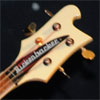
Here is s summary of how I made the fingerboard. I left out a few steps for brevity. Others were omitted out of deference to Dale. You start with a bubinga plank.

This plank is far too large so it was cut into smaller sections that were planed and jointed so they were square and true.
Now you take one of the sections and trace the shape onto the wood.

I use a genuine Rickenbacker fingerboard as a guide. This is the one John wanted to install on the bass in the first place. It is exactly the same size as the 4005 neck.
Now you mark the fret lines.

Again, I use the genuine board as a guide.
Now cut the fret slots.

The saw in the mitre box is a fret saw. Fret saws are designed to make slow controlled cuts. With a relatively thick blank you want a little faster cut so I use the japanese saw on the right after the fret saw establishes a straight line.
This plank is far too large so it was cut into smaller sections that were planed and jointed so they were square and true.
Now you take one of the sections and trace the shape onto the wood.
I use a genuine Rickenbacker fingerboard as a guide. This is the one John wanted to install on the bass in the first place. It is exactly the same size as the 4005 neck.
Now you mark the fret lines.
Again, I use the genuine board as a guide.
Now cut the fret slots.
The saw in the mitre box is a fret saw. Fret saws are designed to make slow controlled cuts. With a relatively thick blank you want a little faster cut so I use the japanese saw on the right after the fret saw establishes a straight line.
After the slots are cut, lay out the triangles. I made bubinga triangles that I trace onto the wood.

The guides are carefully positioned then traced.

It is a bit hard to see here but the triangles are drawn in position then dark lines are dropped over the edges of the board to act as reference marks when the cutouts are made.
Once the triangles are drawn the board is hotglued face-down onto a jig that will hold the board in a set angle as it passes over the table saw.

Here is the board mounted on the tool.

The guides are carefully positioned then traced.
It is a bit hard to see here but the triangles are drawn in position then dark lines are dropped over the edges of the board to act as reference marks when the cutouts are made.
Once the triangles are drawn the board is hotglued face-down onto a jig that will hold the board in a set angle as it passes over the table saw.
Here is the board mounted on the tool.
Now cut the bottom sides of the triangles on the table saw.

Here the jig is holding the board at a 90 degree angle to the blade. One side of the tool is strapped to the rip fence of the saw for stability. The square is used to confirm the angle before the cut is made.
After the bottom cuts are done, do the angle cuts.

Here the #9 cutting guide is used to set the angle of the jig. Once the angle is set we check the alignment at the saw blade.

The saw blade is aligned just inside the mark. Push the assembly over the saw blade and it looks something like this.

Once both lines are cut it is a trivial matter to route the inlay out with a Dremel tool. Sorry about the fuzzy pic.

Here the jig is holding the board at a 90 degree angle to the blade. One side of the tool is strapped to the rip fence of the saw for stability. The square is used to confirm the angle before the cut is made.
After the bottom cuts are done, do the angle cuts.
Here the #9 cutting guide is used to set the angle of the jig. Once the angle is set we check the alignment at the saw blade.
The saw blade is aligned just inside the mark. Push the assembly over the saw blade and it looks something like this.
Once both lines are cut it is a trivial matter to route the inlay out with a Dremel tool. Sorry about the fuzzy pic.

This is how I size the MOP particles.

The mesh of the screen is just about the perfect size for the MOP. First I dump a small quantity on the screen letting as much fall through as possible. The rest goes into the mortar for a little crushing then back to the screen. It takes about 15 minutes to sort a batch of MOP this way.
The mesh of the screen is just about the perfect size for the MOP. First I dump a small quantity on the screen letting as much fall through as possible. The rest goes into the mortar for a little crushing then back to the screen. It takes about 15 minutes to sort a batch of MOP this way.
Once the MOP is prepared it can be mixed with resin to create the inlays. The factory method used sheets of MOP and resin that were cut into appropriately sized triangles. Here is one of my sheets.

The dust from the MOP is very hazardous so cutting the sheets has to be done carefully. I used a wet saw to keep the dust down. Dale's method does not require any cutting of the MOP so there is no dust and there are no edge gaps to fill or voids beneath the inlays.
The dust from the MOP is very hazardous so cutting the sheets has to be done carefully. I used a wet saw to keep the dust down. Dale's method does not require any cutting of the MOP so there is no dust and there are no edge gaps to fill or voids beneath the inlays.


-
green_us90
- Intermediate Member
- Posts: 530
- Joined: Fri Jun 04, 2004 12:23 pm
Ted, as others said, simply amazing work!!
"yes Sam Adams beer helps me work up the nerve to drill holes in brand new Rickenbackers ..."
Me too- I am not good at soldering and the only way I could dig into my '75 4001 was to have a beer or two, just so I thought I could do it by not knowing what I couldn't do, or something like that.
Also, slightly off topic, I really appreciate how Edgar used to own this bass and now he gets to see it again going thru the restoration it so desparately needs. It's amazing how thru this forum things have a way of crossing paths. It's kind of how I happened on the neck to finish up my Frickenbird project- I was browsing Ebay for a neck and I came across a '95 USA Precision neck- which happened to come off of a bass I sold 8 years ago (the ser#s matched from the sales receipt I have when the bass was bought new) It's now on my bass and I don't think I will ever let it go again!
"yes Sam Adams beer helps me work up the nerve to drill holes in brand new Rickenbackers ..."
Me too- I am not good at soldering and the only way I could dig into my '75 4001 was to have a beer or two, just so I thought I could do it by not knowing what I couldn't do, or something like that.
Also, slightly off topic, I really appreciate how Edgar used to own this bass and now he gets to see it again going thru the restoration it so desparately needs. It's amazing how thru this forum things have a way of crossing paths. It's kind of how I happened on the neck to finish up my Frickenbird project- I was browsing Ebay for a neck and I came across a '95 USA Precision neck- which happened to come off of a bass I sold 8 years ago (the ser#s matched from the sales receipt I have when the bass was bought new) It's now on my bass and I don't think I will ever let it go again!
Gitch-Pang, Gitch-Pang- the RIC trademark