
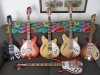
Paul, you may or may not recall that we've touched on this subject a little, but I can't remember to what detail, so anyhoo----
To speculate, what(clearcoat)could be applied over an old (ca. 1961) conversion varnish finish that would remain soft and even feel tacky in spots after application? Secondly, what could be used to remove it without damaging what is underneath?
For example, I can take my thumbnail or the end of a credit card and easily remove this topcoat of whatever-it-is in small portions.
As hard as CV is, what (if anything) can chemically remove this topcoat without harming the original Fireglow?
Thank you.
Removing 'something' that was sprayed over CV...
Moderator: jingle_jangle
-
jingle_jangle
- RRF Moderator
- Posts: 22679
- Joined: Wed Dec 22, 2004 6:00 am
- Contact:
OK, the most important factor to consider, John, is the advanced age of the original CV. We both know that the formula for CV has changed many times over, and that CV ages (oxidizes) with time--especially with the passing of several decades. Old CV was particularly thin and with age, any 40+ year old CV topcoat will split a bit along the grain, allowing stuff to soak into the pores of the wood.
I'm thinking that someone sprayed a xylene-based clearcoat (Krylon Crystal-Clear, for example) over the CV. When this stuff goes on over a non-porous surface, it goes all weak in the knees.
I'd try a clean soft cloth dampened (not too saturated) with mineral spirits, on a small area of the guitar to see if it does any good. If it works, you're home free. Then, when you're done, let the guitar air out for a couple of days before re-casing it.
I'm thinking that someone sprayed a xylene-based clearcoat (Krylon Crystal-Clear, for example) over the CV. When this stuff goes on over a non-porous surface, it goes all weak in the knees.
I'd try a clean soft cloth dampened (not too saturated) with mineral spirits, on a small area of the guitar to see if it does any good. If it works, you're home free. Then, when you're done, let the guitar air out for a couple of days before re-casing it.
“I say in speeches that a plausible mission of artists is to make people appreciate being alive at least a little bit. I am then asked if I know of any artists who pulled that off. I reply, 'The Beatles did.”
― Kurt Vonnegut
― Kurt Vonnegut
-
jingle_jangle
- RRF Moderator
- Posts: 22679
- Joined: Wed Dec 22, 2004 6:00 am
- Contact:
"Mineral spirits" is aka generic "paint thinner".
Stay away from turps unless you're a Sunday painter obsessed with authenticity...it's nasty stuff that can poison in four different ways.
MS is cheaper, too!
Stay away from turps unless you're a Sunday painter obsessed with authenticity...it's nasty stuff that can poison in four different ways.
MS is cheaper, too!
“I say in speeches that a plausible mission of artists is to make people appreciate being alive at least a little bit. I am then asked if I know of any artists who pulled that off. I reply, 'The Beatles did.”
― Kurt Vonnegut
― Kurt Vonnegut
-
beatlefreak

- Senior Member
- Posts: 6160
- Joined: Wed Jun 14, 2006 5:45 am
- Contact:
-
jingle_jangle
- RRF Moderator
- Posts: 22679
- Joined: Wed Dec 22, 2004 6:00 am
- Contact:
Well, I went to the hardware store, purchased 100% mineral spirits.
I tried a small spot on the neck where I had previously removed some of this with my fingernail.....the mineral spirits don't seem to get much of a reaction out of this stuff, doesn't seem to cut it down very much.....I haven't tried it liberally for I don't wan't to do the original finish more harm than good.
Suggestions?
I tried a small spot on the neck where I had previously removed some of this with my fingernail.....the mineral spirits don't seem to get much of a reaction out of this stuff, doesn't seem to cut it down very much.....I haven't tried it liberally for I don't wan't to do the original finish more harm than good.
Suggestions?
-
jingle_jangle
- RRF Moderator
- Posts: 22679
- Joined: Wed Dec 22, 2004 6:00 am
- Contact:
OK, then it's almost certainly nitro clear. The solvent for this is hardware store lacquer thinner (not body shop type stuff, which is much more aggressive and is acrylic lacquer thinner, a different beast entirely). Used carefully--do NOT saturate the finish or the rag with it--this will remove the sticky surface stuff.
My usual strategy in seeing what works in cases like this (for those who might be interested in it) is to start with less aggressive, "softer" solvents like mineral spirits, and work up through the solvent list to the most aggressive.
(Most aggressive would be very hot urethane reducer. In order we would have mineral spirits, xylene, nitro lacquer thinner, toluene, acetone, acrylic lacquer thinner, "cool" urethane reducer, and "hot" urethane reducer.)
I would not use any urethane reducers on a guitar this old for fear of softening the old finish and rubbing through the CV. So lacquer thinner is as far as I'd go. If you notice any of the color rubbing off on the cloth, stop.
Even though there may be no sticky clear coat under the guard, I'd still try a small area there to see if the solvent is attacking the original finish.
My usual strategy in seeing what works in cases like this (for those who might be interested in it) is to start with less aggressive, "softer" solvents like mineral spirits, and work up through the solvent list to the most aggressive.
(Most aggressive would be very hot urethane reducer. In order we would have mineral spirits, xylene, nitro lacquer thinner, toluene, acetone, acrylic lacquer thinner, "cool" urethane reducer, and "hot" urethane reducer.)
I would not use any urethane reducers on a guitar this old for fear of softening the old finish and rubbing through the CV. So lacquer thinner is as far as I'd go. If you notice any of the color rubbing off on the cloth, stop.
Even though there may be no sticky clear coat under the guard, I'd still try a small area there to see if the solvent is attacking the original finish.
“I say in speeches that a plausible mission of artists is to make people appreciate being alive at least a little bit. I am then asked if I know of any artists who pulled that off. I reply, 'The Beatles did.”
― Kurt Vonnegut
― Kurt Vonnegut