
Old style nameplate or newer style ?
Moderators: rickenbrother, ajish4
-
rob320
Old style nameplate or newer style ?
I've always prefered the older style nameplate's as i think the newer raised one's look, dare i say it, a little cheap on such beautifully made and finished instruments. I don't know what everyone else thinks but why don't Rickenbacker revert to the original design for all their guitars, or is it a question of cost ? Just a thought.
I have never seen, yet, the new style raised letter nameplate.
I have seen the non-raised letter version.
IMHO, I do like the raised letter nameplate better.
As for counterfeiting, I don't think it would be too difficult with the raised letter. The non-raised version, with the name silkscreened (?) would be a little more tricky.
I say this because of many businesses in the plastic injection molding. If someone who works in a tool-room mold shop has a raised letter nameplate, he/she probably can make a small mold out of it. (Please don't get any ideas, anyone!)
So, IMHO, I think it would be in the best interest for the company to switch over the "flat" nameplate. I feel that's a bit more harder to duplicate.
I have seen the non-raised letter version.
IMHO, I do like the raised letter nameplate better.
As for counterfeiting, I don't think it would be too difficult with the raised letter. The non-raised version, with the name silkscreened (?) would be a little more tricky.
I say this because of many businesses in the plastic injection molding. If someone who works in a tool-room mold shop has a raised letter nameplate, he/she probably can make a small mold out of it. (Please don't get any ideas, anyone!)
So, IMHO, I think it would be in the best interest for the company to switch over the "flat" nameplate. I feel that's a bit more harder to duplicate.

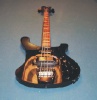
No Paul, I don't think the reverse-screened ones were ever done in black as the black TRCs came out after the change was made to the embossed style. Like some others have said, I'm also of the opinion that the embossed TRCs look better. One of the ways I've 'customized' my basses is to paint the raised lettering to match the basses better.
Thanks for sharing the fact, Brad.
I personally like the embossed type a lot...the pure white background contrasts really well with the black raised letters. White, gold or silver on black is cool too.
However the revere-screened TRC on my '72 4001 Fretless MG, whose white looks a bit grayer under the clear plexiglass, also suits her vintage look very well. My feeling is: Reverse-screen for the old and emboss for the young basses.
I personally like the embossed type a lot...the pure white background contrasts really well with the black raised letters. White, gold or silver on black is cool too.
However the revere-screened TRC on my '72 4001 Fretless MG, whose white looks a bit grayer under the clear plexiglass, also suits her vintage look very well. My feeling is: Reverse-screen for the old and emboss for the young basses.

Robert Fronckowiak said:
No way, Rob. There are literally ten thousand shops that could quite easily & inexpensively forge the older screened TRCs. There are less than a hundred facilities that could even make a replica of the newer embossed TRC, and it would cost significantly more in setup.
As for counterfeiting, I don't think it would be too difficult with the raised letter. The non-raised version, with the name silkscreened (?) would be a little more tricky.
I say this because of many businesses in the plastic injection molding. If someone who works in a tool-room mold shop has a raised letter nameplate, he/she probably can make a small mold out of it. (Please don't get any ideas, anyone!)
So, IMHO, I think it would be in the best interest for the company to switch over the "flat" nameplate. I feel that's a bit more harder to duplicate.
No way, Rob. There are literally ten thousand shops that could quite easily & inexpensively forge the older screened TRCs. There are less than a hundred facilities that could even make a replica of the newer embossed TRC, and it would cost significantly more in setup.

Actually, RIC did make black silk screened TRC's. My Dec.'75 3000 came with just such a piece. The lettering almost looks silver and it also says "Made In USA" but without the model# below it like the TRC's on my other basses. The bass it came on was a wreck missing the original pickguard and pickup. It's currently undergoing restoration and conversion to fretless. The body has been done in deep pearl blue urethane with a clear guard backed in white pearl and a toaster top with vintage knobs and new electronics. Anyway, I prefer the silkscreened TRC's and have made gold and white one's for most of my basses along with old style gold, white and black guards to match.
I like both on the appropriate basses like Paul said, but I would like to see the model # put back on the TRC's. It's little touches like that that makes me like the older ones. I also like the reverse tuners on the mid to late 70's 4001's, they are actually easier to turn and easier to tune with. Turning your hand clockwise to raise the pitch just seems natural to me.