

OK, experienced RIC 12 string players, here's a question for you. There seems to be quite a bit of thought supporting the need for a 12 saddle bridge on RIC 12 strings, as opposed to the 6 saddle bridge that is factory standard on some models. John Hall is on record as saying that a 12 saddle bridge is unnecessary, that a 6 saddle bridge will work just fine assuming that you use quality guitar strings that are a consistent diameter throughout the vibrating length of the string.
Now, when I was a youngster, I had a Yamaha 12 string acoustic guitar. I played that guitar all through college. I never noticed that it had intonation problems stemming from the fact that it had a fixed one piece bridge and saddle. Any intonation issues it had finally developed because the neck was slightly bowed between the 9th and 14th frets.
Based on my experience, and Mr. Hall's thoughts, I'm beginning to wonder about the whole 12 saddle vs. 6 saddle bridge question.
Please share your experiences, and include some objective observations on why one or the other bridge may affect your guitar's intonation the way it does.
JimK
On Second Thought...
Moderators: rickenbrother, ajish4
-
epitreture
- Member
- Posts: 381
- Joined: Wed Jan 11, 2006 10:35 am
I have both bridges. Six saddle on my 610/12 and twelve saddle on my 660/12 and I can honestly say I can't tell any difference between the two. I get perfect intonation on both of them and I only use Rick strings. So I guess that means that JH is right on the money.
If there isn't a 12 string Rickenbacker playing at my funeral, I'm leaving.




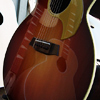
I'm still trying to figure this all out. Most of my acoustic twelves had bridges with a single, angled bone saddle, like this one on one of the Takamines that I own now.

The Martins and Guild that I used to own were pretty similar. My other Takamine has a split saddle.

As far as I've been able to tell, they've all played pretty well and I never noticed any glaring intonation problems.
My Rics have been a different story. My 360/12WB had awful intonation problems when I first got it. It had the six-saddle bridge with Ric strings (which is what I've always used on it) and the low pairs just wouldn't get along when playing on the lower frets. I would literally tune the low E pair depending upon whether a good sounding E chord or G chord was more important to the song and the A strings depending on whether I wanted the A chords or C chords to sound right. I had Arnquist set it up, add the 12-saddle bridge and intonate it with a strobe and the change was a huge improvement. If you'll look at the saddle positions on the current photo, I don't think there is any way to do that with a six-saddle bridge.

My other 360/12 and my 660/12 had twelve-saddle bridges when I got them, so I can't say how they would compare, but anybody with any kind of musical ear could certainly have heard the difference on the WB. I use a very bright and clean-sounding amp and it stood out like a sore thumb. Snake oil? I don't know, but I'm certainly never going back to the six-saddle bridge.
The Martins and Guild that I used to own were pretty similar. My other Takamine has a split saddle.
As far as I've been able to tell, they've all played pretty well and I never noticed any glaring intonation problems.
My Rics have been a different story. My 360/12WB had awful intonation problems when I first got it. It had the six-saddle bridge with Ric strings (which is what I've always used on it) and the low pairs just wouldn't get along when playing on the lower frets. I would literally tune the low E pair depending upon whether a good sounding E chord or G chord was more important to the song and the A strings depending on whether I wanted the A chords or C chords to sound right. I had Arnquist set it up, add the 12-saddle bridge and intonate it with a strobe and the change was a huge improvement. If you'll look at the saddle positions on the current photo, I don't think there is any way to do that with a six-saddle bridge.
My other 360/12 and my 660/12 had twelve-saddle bridges when I got them, so I can't say how they would compare, but anybody with any kind of musical ear could certainly have heard the difference on the WB. I use a very bright and clean-sounding amp and it stood out like a sore thumb. Snake oil? I don't know, but I'm certainly never going back to the six-saddle bridge.
-
jingle_jangle
- RRF Moderator
- Posts: 22679
- Joined: Wed Dec 22, 2004 6:00 am
- Contact:
There's some credence (CCR fans note spelling) given to the sonic difference between a hollow-bodied acoustic twelve--with all that nice, cushiony air inside the body, and any kind of electric twelve, which outputs relatively pure tones directly to an amplifier, which then (supposedly) merely amplifies them. Amplifiers, in fact, add their own twitches, tweaks, overtones, and sonic nuances.
Back to acoustics and that air volume. Things just don't seem to be as difficult between the octave pairs; I suspect that a fair amount of sonic information gets lost in the "woofy" air pillow inside.
The split saddle on the later Takamine does virtually nothing for octave intonations.
It amazes me that a simple bone or tusq saddle running at a slight angle, can suffice to intonate a 12-string acoustic most of the way up the neck, at least to a point where few folks' and many dogs' ears don't protest.
Here's a philosophical point:
An acoustic guitar is less of a machine than an electric guitar. Discuss.
Back to acoustics and that air volume. Things just don't seem to be as difficult between the octave pairs; I suspect that a fair amount of sonic information gets lost in the "woofy" air pillow inside.
The split saddle on the later Takamine does virtually nothing for octave intonations.
It amazes me that a simple bone or tusq saddle running at a slight angle, can suffice to intonate a 12-string acoustic most of the way up the neck, at least to a point where few folks' and many dogs' ears don't protest.
Here's a philosophical point:
An acoustic guitar is less of a machine than an electric guitar. Discuss.
“I say in speeches that a plausible mission of artists is to make people appreciate being alive at least a little bit. I am then asked if I know of any artists who pulled that off. I reply, 'The Beatles did.”
― Kurt Vonnegut
― Kurt Vonnegut
-
dale_fortune
- Intermediate Member
- Posts: 1241
- Joined: Sat Oct 30, 2004 6:00 am

Paul, as a philosophical exercise, do we not have to adopt a definition of "machine" as a common foundation first? A classical definition of machine might be "any mechanical or electrical device that transmits or modifies energy to perform or assist in the performance of human tasks". If so, then an acoustic guitar modifies the energy of a plucked string's vibration and transmits that modified energy in the form of alternately compressed air in waves to our ears directly (with some filtering and added resonances from the passive body of the guitar itself and its enclosed airspaces). An electric guitar does exactly the same thing, but it is not as efficient directly. So it adds the second stage of complexity to convert the electromagnetic changes of its vibrating ferromagnetic string cutting through a magnetic field into an alternating electrical current, and thence through wires into an amplifier to then have the speakers of that amplifier transmit alternating air pressure waves to our ears.
They are both machines, one is not less a machine than the other, and both fit the definition perfectly. The only difference is in efficiency of conversion, which does not make one more or less a machine, but simply more or less efficient. As a side issue, not central to whether they are machines, one achieves the end-purpose of stimulating our hearing more directly than the other, and with less steps and auxiliary components to improve its efficiency.
That's my 2 cents worth and I'm sticking to it
They are both machines, one is not less a machine than the other, and both fit the definition perfectly. The only difference is in efficiency of conversion, which does not make one more or less a machine, but simply more or less efficient. As a side issue, not central to whether they are machines, one achieves the end-purpose of stimulating our hearing more directly than the other, and with less steps and auxiliary components to improve its efficiency.
That's my 2 cents worth and I'm sticking to it
Do unto others as you would have them do unto you, and sit in with the band whenever you can, to keep your chops up!
-
jingle_jangle
- RRF Moderator
- Posts: 22679
- Joined: Wed Dec 22, 2004 6:00 am
- Contact:
Exactly, Elys. Acoustic is less of a machine than electric.
Fewer sound modification components, more art and craft.
Fewer sound modification components, more art and craft.
“I say in speeches that a plausible mission of artists is to make people appreciate being alive at least a little bit. I am then asked if I know of any artists who pulled that off. I reply, 'The Beatles did.”
― Kurt Vonnegut
― Kurt Vonnegut

Acoustic is a more independent creature. It lives & breathes by itself. Electric needs some special "food". If we make a parallel between guitars and people, then perhaps acoustic is like a "grown up" while electric is more like a "baby".
Nothing will get you dead quicker than being deadly serious about yourself.

A guitar is better defined as an instrument.
http://en.wikipedia.org/wiki/Machine
http://en.wikipedia.org/wiki/Instrument
http://en.wikipedia.org/wiki/Machine
http://en.wikipedia.org/wiki/Instrument
“We can't solve problems by using the same kind of thinking we used when we created them.” - Albert Einstein
"You do not really understand something unless you can explain it to your grandmother" - Albert Einstein
"You do not really understand something unless you can explain it to your grandmother" - Albert Einstein