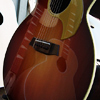
Speaking of Epiphone, their new Ultra is a GREAT sounding guitar. I dont like the orange color but the chambered body (along with the scaloped back) design makes it light and amazingly ballzy. Epiphone has a winner with this one... I just wish they'd come out with other color options.
We now return you to your regularly scheduled program.
“The urge to save humanity is always a false front for the urge to rule it.” ....H. L. Mencken
you COULD make a Les Paul out of maple, but it would'nt sound like a Les Paul and would all together be worthless. you seem to have a slight misconception about the difference between a maple top, and a maple veneer. a maple veneer is a very very thin piece of wood bent over the top that offers no sonic properties whatsoever. it's just prettier. a Maple top is a thick piece of maple, carved in this case, that adds sonic properties to the guitar. There is nothing wrong with this construction technique. Rickenbacker on the other have 3 piece bodies I believe, 2 for the top, 1 for the back. Does that make it inferior??? Does it make the Les Paul inferior??? Not at all in either case.
One more time, just because I think I scrambled my words a bit....
A veneer is usually considered to be something that is very thin...such as 1/16th of an inch or thinner. In furniture making, if you use plywood, you can glue a veneer to the end of the piece of plywood to hide the endgrain for example. In guitar making, a veneer is often used for the headstock like the black one on many Gibsons. It can also be used as a top for a body but is only usually done this way on cheap guitars.
Les Pauls are 2 1/4 inches thick, with 1/2 inch of that being a maple cap. Typically, 2 pieces of figured maple are glued on top of a mahogany body (which could be several pieces itself glued together), and then the top is arched with files to the semi-rounded shape to make it more comfortable to play.
Some of the semi-hollow Epiphones and Gibsons are made using thin maple veneers glued together, so basically plywood. You have a seperate top, back, and sides, and they are all glued together to make a semi-hollow guitar. You might have a solid block of wood in the middle and other times it is fully hollow.
Many Rickenbackers are made from a couple pieces of maple glued together in the thickness of the guitar, then the body is flipped upside down and routed out from the back. Then the neck is glued in, and the back is glued on. It is considered semi-hollow, but is different than the typical Gibson/Gretsch semi-hollow construction, and to my ears, sounds more like a solid body guitar than those, but still sounds semi-hollow compared to a fully solid guitar.
Many solid body guitars are made using various types of wood. A Strat with Alder, a Tele with Ash, a RIC 230 with Maple, etc. These are considered solid body guitars as the body is a solid block of wood, but it is usually at least 2 pieces glued together and sometimes more pieces.
There is also neck thru construction, which would be like the RIC 4001/3 bass. You can use a single solid piece of maple for the center block, but it is stronger if you use multiple pieces and orient the grain opposite from piece to piece, so many guitars and basses made this way use at least 3 pieces of wood for the center piece, glued together and then cut to shape. Then the wing pieces can be the same type of wood or something altogether different too.
Wow. I'm sorry, I didn't mean to cause problems and stuff with my lack of technical language.
I wasn't putting down Les Pauls or anything, it was just a case of not using exact language. I have a Les Paul (a GoldTop) and I love it. I didn't mean in any way to imply that they were inferior, nor did I mean to tell a "lie" about their construction. I didn't know however that a veneer was considered to be thinner than the maple top on a Les Paul. Anything like that is something we've always called a veneer. I didn't know that there was a problem calling a maple cap a veneer or vise versa.
Dusty, no problem--you just led to a discussion of the type we get into around here, just to clarify our terminology. There's a nice variety of knowledge bases and specialties here, so everybody wins in the end.
“I say in speeches that a plausible mission of artists is to make people appreciate being alive at least a little bit. I am then asked if I know of any artists who pulled that off. I reply, 'The Beatles did.”
― Kurt Vonnegut
That's how I felt too. I was really glad to get all the information, because it was something I didn't know. It just seemed that I might have upset some people, and I didn't want any hard feelings about it. I love all the people here. I'd like to thank everybody too. I learned more from this than I could've anywhere else.
Hey Dusty, please accept my apology too! It was really late and I was kinda cranky, and I should not have posted like that. You are correct, a Rick 4001 (which are the only kinds of Ricks I have ) is indeed a three-piece, you are correct. Regardless of strength and stability issues over a solid single piece, I should have edited myself to mean that it is one single thickness of wood from front to back. And there is nothing wonderful or superior about that. The best and longest sustain of any of my basses is actually not a 4001, but is an Alembic Series II, and it is made of five to nine glued-up layers and then more sliced tops and bottoms of ebony, much like a Les Paul, and by golly it works very well for solid sustain and a jaw-dropping fine-carpentry deep-gloss look. And it is very much not solid from front to back either!
Again, please forgive me
Do unto others as you would have them do unto you, and sit in with the band whenever you can, to keep your chops up!
I love Ric 4001s. I used to have a JetGlo, but I lent it to a friend, and he ended up trading it to somebody for a 67 Fender Telecaster bass. :/ Oh well. I ended up using the money from that to get my 330, so all's well that ends well. I don't remember saying anything about three piece bodies on Rics, but it was really late and I was super tired, and when I'm tired I get all spacey. Anyway, thanks everybody, I was grateful for the lessons. Having had little experience with woodworking terms (aside from freshman and sophmore woodshop classes nearly ten years ago) I didn't know much. I'm always glad and appreciative to learn new things.