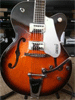
The screws are fine, not sure about the bridge itself.
Paul - maybe I did get the wrong screws, as mine are slotted (regular), not Phillips head. Hopefully you can make that out in the picture.
IIRC, the screws are stainless steel and the bridge is cast metal (zinc?) ... the gist is that the screws are made of harder metal than the bridge, so if the screws are not started correctly, they will cross-thread or strip the hole in the bridge. I take extra care when putting the covers back on after restringing or setting the intonation because of this.
It is better, of course, to know useless things than to know nothing. - Seneca
I'll go against the flow here and declare that I remove the bridge cover. I rest the outer edge of my right hand, in a kind of mute fashion, right next to, or on top of the bridge when I'm playing.
I've tried altering my style and keeping the bridge cover in place, but to no avail.
Gary, you are partially correct. The screws are stainless, but the bridge itself is a stamping (my memory says 18 gauge mild steel).
So, yes, the screws are harder than the bridge stamping. And they will strip the threads in the bridge, as they are harder. But you'd really have to force them along after cross-threading them in the first place, in order to strip out the bridge holes. Oddly, they are really tough to cross-thread, I've found. As long as you're using an undamaged #1 Phillips head screwdriver, they go into the bridge fairly easily.
“I say in speeches that a plausible mission of artists is to make people appreciate being alive at least a little bit. I am then asked if I know of any artists who pulled that off. I reply, 'The Beatles did.”
― Kurt Vonnegut
I always thought that the screws were chrome plated steel also, not stainless. IIRC you can pick them up with a magnetic screwdriver.
As to the bridge cover, that's the frist thing that I do when I get a new Rick, remove the cover and put it in a little zip lock bag with the 2 screws for safe keeping. It gets in my way when I play.
Stainless is not always non-magnetic. Austenitic stainless is magnetic.
18-8 stainless (most commonly used as screw stock) is magnetic, but can be modified to be non-magnetic. It is then called "16-18" stainless.
These screws are made of 18-8 stock.
“I say in speeches that a plausible mission of artists is to make people appreciate being alive at least a little bit. I am then asked if I know of any artists who pulled that off. I reply, 'The Beatles did.”
― Kurt Vonnegut
Both the screws and the channel are stainless but that's only been true for maybe 6 to 8 months now.
The screws are not magnetic which makes them less convenient to install- this has been a complaint by our assembly people, but this was done for environmental reasons, to meet the RoHS compliance requirements for our European customers.
John: While I am sure there must be a straightforward explanation, I am wondering if you could comment on the undesirable environmental consequences of having two magnetic screws installed on our Rickenbackers.
Life, as with music, often requires one to let go of the melody and listen to the rhythm
What cracks me up is the idea some have that RIC makes decisions in a vacuum!
Without inside knowledge, some of our complaints/questions are ludicrous.
I made some complaints about the 75th that didn't sit well, and once I knew the "whole story", it made my complaining look like.....well, you can imagine!
Peter, the use of polished stainless steel avoids the use of chrome plating, which has become a pariah due to the toxic chemicals used for plating. Also, plated products require special disposal in Europe; we even have to print a picture of a rubbish disposal "wheelie bin" with an X across it on the hang-tag to advise Europeans not to put their guitars in the trash!
The downside of stainless is that it can scratch; the upside is that scratches can be polished out, unlike chrome.