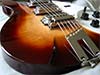
I always thought the whole point of the bridge was intonation and a string anchor. As long as it doesn't look too stoopid, I couldn't care less whether it blends with the aesthetics of the bass.
Ask Geddy Lee about the Badass bridge on his. That looked cool. And the bass sounded kick a**!!!
Here's a little mod that will stop that funky tail lift.
Guaranteed to stop that sucker from tail wagging! if you're "all thumbs" with an adjustable spanner, just take the whole thing to your neighbourhood mechanic.
How do the chaps at RIC go about testing new parts? For example, a new bridge certainly isn't just designed and dropped into the production line, right? Are there any non-production Rick basses out there with a prototype new-design bridge?
Well, I guess if Boeing can design a 777 totally on computer and put it into production, RIC can do the same with a new bass bridge. Computational fluid dynamics is the bomb.
"So why isn't JH going after Pickguardian, WD, AllParts, etc., for making and selling copies of Rickenbacker pick guards?"
************************************************
Good question, especially considering the active promotion of at least one of those companies by customer service when enquiring about the availability of certain pickguards. How is it justified to go after one company that provides a product RIC does not sell yet ignore another that sells an arguably more identifiably "Rick" part than a tail piece?
"Just be glad that it does not have a 60s horseshoe as well. I'm sure you can degauss one by farting near it!" - Eden.
Pick-guard shape probably can't be trademarked due to the similarity of them on all guitars and we haven't claimed it as such. These companies provide a service for customization that we certainly can't. We have no problem with them as long as they treat our trademarks right in their advertising materials.
Other parts of our instruments like tailpieces and pickups for example, are, on the other hand, much more specific to our brand and not customary on other lines.
Of course, if we were to someday create a pickguard as unique as the bass tailpiece, we'd certainly take pains to trademark it.
"I think the rest of the tailpiece needs to be there to cover up the space in the binding where the neck is. I never knew the binding wasn't one line til I looked at my bass. Not like it's a major thing, but still, if the binding goes around the body wings and up the neck why should the space where it isn't show? It would ruin the whole look."
Rick bass wings are bound before gluing them to the center/neck section. It is extremely difficult and time-consuming to run the binding up to the neck on the top of the bass, after the wings are assembled to the body, and to attempt to bind the bottom of the center section/neck separately and then glue the body together wouldn't work, either. Even if you could line up the three pieces so the binding looked continuous, it would only look so from a foot or more; upon close inspection you'd see the joints, which would look really bad.
I like the gap in the binding there. And I've never worked on a Rick bass on which the tailpiece casting covered that gap--they all fall short by 1/16"-1/4" or so. And it looks just fine.
This illustrates the difficulties that you can get into when you attempt to rationalize a design feature like that gap in the binding. Aside from the functional/manufacturing reason which I describe above, there is no logical visual reason why it needs to be either way--with binding or without. To force it to "make sense" is like forcing an apple to be a banana. Visual design does not have to make sense in a logical/left-brained manner, nor in a verbal way; it just has to look right.
We are trained throughout life to rationalize many aspects of our description and approach to our inner and outer environments. But the field of design eschews such rationalization of visual and tactile elements. And, ironically, a good deal of formal design education is engaged in the process of unlearning these rational connections and justifications.
Some of the most boring and quirky objects in our surroundings and history were designed, not by designers, but by hyper-rational minds like engineers who tried their hand at aesthetic design. Yet a bridge has its own unadorned, brutal beauty.
A trained designer can usually be counted on to give a new and often exciting twist to a previously-overlooked object in our daily lives. And it's real serendipity and a tremendous breath of fresh air when an untrained, but brilliant natural designer generates a design classic all by his lonesome. This is so very rare as to be a one-in-a-billion happenstance.
To put it into our guitar perspective: Roger Rossmeisl was a trained luthier first and designer only as far as it intersected with his luthiery profession. So it would make sense that he would design guitars that incorporated the look and some features of the German traditional luthiery education that he received. So details of Rickenbacker instruments (like the cat's eye sound hole and the checkerboard purfling--to give it its correct term, as the white strip around the outside of the checkerboard is the binding) translate almost literally from the German tradition, whereas the shape of the classic Rick guitar and the 4000 series bass are real strokes of genius and absolutely timeless and classic.
But Roger apparently blew his wad with these innovations and by the time he'd moved on to Fender, there was really nothing new to draw upon; only expansions and embellishments.
Then we come to Leo Fender--the one in a billion. TWO major design classics and a huge inventory of engineering accomplishments and innovations, not to mention a whole philosophy of guitar building and manufacturing, came from this man's brain in the short span of about 20 years. This indicates a brain that operated by constantly switching back and forth between left and right side dominance.
Think about it. Pretty frigging amazing!
“I say in speeches that a plausible mission of artists is to make people appreciate being alive at least a little bit. I am then asked if I know of any artists who pulled that off. I reply, 'The Beatles did.”
― Kurt Vonnegut

 (And no more Hipshots available!)