
1956 Duo-Jet on Ebay
Moderator: jingle_jangle
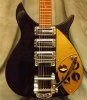
1956 Duo-Jet on Ebay
1956 Duo-Jet Nitron top,what the heck is Nitron?
-
jingle_jangle
- RRF Moderator
- Posts: 22679
- Joined: Wed Dec 22, 2004 6:00 am
- Contact:
Assuming that the seller's description is accurate, Gretsch was using this plastic (a drum covering and the same stuff commonly known as MOP or MOTS) on some of their solidbodies, and still do, for the Sparkle Jet and that lovely 6129 blue pearl Duo-Jet. Why they'd use it in black (is it painted over, perhaps?) is beyond me...no reason to that I can suss.
This is the same stuff that Leo Fender and Magnatone (among others) used to cover their lap steels, and in Maggie's case, amps to match.
It comes in semi-rigid, .030" thick sheets from the manufacturer. It must be softened in order to stretch it over the radii of the soft-edged cases for the lap steels and amps.
This is where the story of how they applied it at Fender in the "old days" came about. There were literally large open pans of a very explosive solvent--methyl ethyl ketone (which is also a serious carcinogen!)--in one part of the Fender factory on Raymond St. in Fullerton. Here's the kicker: the pans were heated by gas burners positioned directly underneath! This was to soften the material--sheets were literally held over the heated solvent so the hot fumes would soften the material. Then two employees would grab the sheet, position it over the case, and pull down firmly. The stuff would wrap over the end of the case, radii and all, and adhere because the cases had previously been sprayed with contact cement. Then the ends would be trimmed with a sharp knife and the remaining pieces stretched in much the same way until the case was covered with the seams in logical and attractive places.
A fire inspector came around one day, spied (and smelled) what they were doing through one of the open roll-up doors. He literally ran away as fast as his feet and car would carry him, and called Forrest White from a pay phone some distance away with orders to immediately shut the plant down...
I suppose they had to re-think their applicatrion methods after that!
This is the same stuff that Leo Fender and Magnatone (among others) used to cover their lap steels, and in Maggie's case, amps to match.
It comes in semi-rigid, .030" thick sheets from the manufacturer. It must be softened in order to stretch it over the radii of the soft-edged cases for the lap steels and amps.
This is where the story of how they applied it at Fender in the "old days" came about. There were literally large open pans of a very explosive solvent--methyl ethyl ketone (which is also a serious carcinogen!)--in one part of the Fender factory on Raymond St. in Fullerton. Here's the kicker: the pans were heated by gas burners positioned directly underneath! This was to soften the material--sheets were literally held over the heated solvent so the hot fumes would soften the material. Then two employees would grab the sheet, position it over the case, and pull down firmly. The stuff would wrap over the end of the case, radii and all, and adhere because the cases had previously been sprayed with contact cement. Then the ends would be trimmed with a sharp knife and the remaining pieces stretched in much the same way until the case was covered with the seams in logical and attractive places.
A fire inspector came around one day, spied (and smelled) what they were doing through one of the open roll-up doors. He literally ran away as fast as his feet and car would carry him, and called Forrest White from a pay phone some distance away with orders to immediately shut the plant down...
I suppose they had to re-think their applicatrion methods after that!
“I say in speeches that a plausible mission of artists is to make people appreciate being alive at least a little bit. I am then asked if I know of any artists who pulled that off. I reply, 'The Beatles did.”
― Kurt Vonnegut
― Kurt Vonnegut

LOL Paul, that's a great story....Just shows how everyone did what they had to do to make things, it was after all a manufacturing environment.
I can remember reading about one of the steps in making a Colt .45 automatic was to wash certain unfinished parts in 'hot gasoline' to remove residue from the metal surfaces...Imagine being the guy in charge of "heating" the gasoline..(!)
It is said that George's Duo-Jet was finished in Nitron, although there was someone who claimed to have painted it in their Liverpool days...
I can remember reading about one of the steps in making a Colt .45 automatic was to wash certain unfinished parts in 'hot gasoline' to remove residue from the metal surfaces...Imagine being the guy in charge of "heating" the gasoline..(!)
It is said that George's Duo-Jet was finished in Nitron, although there was someone who claimed to have painted it in their Liverpool days...