


Kauffman question
Moderator: jingle_jangle
-
karl_teten
- Intermediate Member
- Posts: 552
- Joined: Sun Apr 10, 2005 4:09 pm
Looks like a 60's plate was used to try to make a Kauffman work. End pin hole isn't centered. Early close up V81 photos with Lennon show a much higher set Kauffman the the C58. This tells me his end plate was the taller version. All other '58 325's I have seen show a taller end plate. It's the only way to get the springs off the body unless off-centered and unstable holes are drilled as shown above.
-
karl_teten
- Intermediate Member
- Posts: 552
- Joined: Sun Apr 10, 2005 4:09 pm

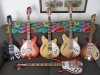
I also have a pic of the body end of a '58 325 which is definitely early 'cause it's a solid top and still orginal blonde, and had a long jackplate from the factory (not Lennon's, y'all should know who owns it, it has a B5 on it now) and the screw holes are drilled lower than on JH's 325 in the pic above. The screw holes match the 'vintage' bracket in the pic Karl sent me to post.
With John's pic, it seems to show that both brackets were used....
I can't post the 325 pic without permission, you guys will have to trust me on this.
With John's pic, it seems to show that both brackets were used....
I can't post the 325 pic without permission, you guys will have to trust me on this.
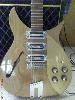
To be fair I've seen more damage to old Rickenbackers with Kauffmans from people trying to keep the arm out of the way, and the opposite end digs into the ramp.....
IMHO it simply depends on where the bracket is fastened, there are other 50's Ricks where the springs are resting but not digging into the ramp, and my own C58 is this way too. In the end it's gonna depend on how the guitar's hardware was attatched....It could be the same now as it was then....
IMHO it simply depends on where the bracket is fastened, there are other 50's Ricks where the springs are resting but not digging into the ramp, and my own C58 is this way too. In the end it's gonna depend on how the guitar's hardware was attatched....It could be the same now as it was then....
All three of the 50's Kauffman equipped guitars I own have the springs touching the body to somewhat different degrees. The functionality of the Kauffman, when compared to modern guitars is indeed marginal but the springs touching the body has nothing to do with it. In fact, raising the Kauffman on the 325 is only going to make the string break angle worse than it already is.
The cosmetic issue is . . . a cosmetic issue and would be a trade-off for authenticity as compared to the majority of guitars from that era. I mean, while we're at it, why don't we just change the shape a little to make it look nicer or make the scale longer to make it play better?
The cosmetic issue is . . . a cosmetic issue and would be a trade-off for authenticity as compared to the majority of guitars from that era. I mean, while we're at it, why don't we just change the shape a little to make it look nicer or make the scale longer to make it play better?
-
karl_teten
- Intermediate Member
- Posts: 552
- Joined: Sun Apr 10, 2005 4:09 pm
You bring up good points John. It is true that Capris and their variations are all over the place. An element of handmade design where no guitar was identical to one another.
My understanding is that the C58 was designed to be a faithful recreation of how Lennon first received his 1958 325 factory spec. Photos of Lennon's '58 325 show more clearance under his Kauffman that the C58. With the taller claw plate Lennon's guitar still had a good string break with the Kauffman's springs floating freely. This was due to the fact Lennon's 325 ramp was deep.
Not all '58 325's had deep ramps but Lennon's did. I have side profile photos of Lennon's '58 after the Bigsby B5 vibrato was attached. You can just make out the top of the B5. This tell's that the ramp was deeper that other '58 325's.
My inclusion in this thread is only to inform those who are interested and enjoy learning the finite details of rare Rickenbackers.
My understanding is that the C58 was designed to be a faithful recreation of how Lennon first received his 1958 325 factory spec. Photos of Lennon's '58 325 show more clearance under his Kauffman that the C58. With the taller claw plate Lennon's guitar still had a good string break with the Kauffman's springs floating freely. This was due to the fact Lennon's 325 ramp was deep.
Not all '58 325's had deep ramps but Lennon's did. I have side profile photos of Lennon's '58 after the Bigsby B5 vibrato was attached. You can just make out the top of the B5. This tell's that the ramp was deeper that other '58 325's.
My inclusion in this thread is only to inform those who are interested and enjoy learning the finite details of rare Rickenbackers.
-
dale_fortune
- Intermediate Member
- Posts: 1241
- Joined: Sat Oct 30, 2004 6:00 am
The reason for the variation in the depth of the Ramps was due to the way it was made. Here were the steps as they were done in the 50's and 70's when I worked at the factory: The body was placed in a jig set up with a template/pattern on the bottom side and clamped down, an overarm pin router was used to cut the rough shape of the ramp, if it were not lined up perfectly it could result in the difference in the Ramp depth. From that stage it went to Dick Burke who hand carved the bevel of the ramp. Dick was the only one allowed to use the carving machine and he was very good at it. After the carving was done an electric drill with a 4 inch soft sanding disc with 100 grit paper was used to take out any and all carving marks. Occasionally the sander would catch an edge and leave a deep cut/mark that required extra sanding to take it out. This resulted in a variation in the Ramp depth. Alder was more of a problem than Maple since it was softer and would cut easier. I sat next to Dick for years as he did this to all instruments that had a Ramp cut in them.