

I'm sure Dave's opinion is based on trying many different pickups with many different bodies and necks. . . just as mine is.
However, a P bass with a RIC pickup (that'd be a P-RIC, right?) sounds nothing at all like a Rick bass, nor does a Rick bass with a Precision pickup sound even remotely like a Fender. Just a fact.
Ric pickups?
Moderators: rickenbrother, ajish4
a P bass with a RIC pickup (that'd be a P-RIC, right?) sounds nothing at all like a Rick bass, nor does a Rick bass with a Precision pickup sound even remotely like a Fender. Just a fact.
I agree - but you're talking about more than construction differences. The scale length is different, and that's a much bigger deal than most people realize. Plus the hardware is completely different, and so is the truss rod system.
Question is, if you put identical pickups in a 4003, set-neck 4000 and bolt-on 2020, would people be able to tell them apart and identify which was which in a double-blind listening test?
Construction and body woods are definitely factors, I just don't think they are as big a factor as pickups, all else being equal.
A bolt on and a neck through sound as different as night and day. When you add in wood, bridge, and string break angle differences, the pickups are down further on the list.
To answer your question, yes, you would hear decided difference, especially with the 4003 and 2020. Been there and done that more than a few times.
To answer your question, yes, you would hear decided difference, especially with the 4003 and 2020. Been there and done that more than a few times.
-
docbass
Well, I may not be the most discriminating person in the world, but my Fender j and Ric 4003 have a lot of similarities in tone especially in the growl department. They are different, but the differences are subtle for sure. Even though they are subtle, I could tell one form the other blindfolded, but hey, I play them both regularly! As for one Ric from another, that's anyone's guess. Can't say myself.
Now, back to my pickup search for a moment. Would I be crazy to put 2 Hi gains in my project bass? I'm thinking one very close to the neck heel and the other very close to the bridge. How might that work? Just a thought.
Now, back to my pickup search for a moment. Would I be crazy to put 2 Hi gains in my project bass? I'm thinking one very close to the neck heel and the other very close to the bridge. How might that work? Just a thought.

William,
You might want to take the polepiece spacing into consideration. The distance between the centers of the E and G polepieces on a bass (neck) high gain is 1 29/32", which is narrower than the 2 1/32" distance of a treble pickup. That means your bass' string spacing has to be identical at both the nut and bridge, which is quite impossible.
With the toaster's 6 polepieces (1 31/32" between the centers of the 2 outter polepices) under the cover, that form a continuous magnetic field across the stings, the string spacing difference between the neck and bridge positions would cause no problem, IMHO.
*Somebody please correct me if I have the wrong reasoning.
You might want to take the polepiece spacing into consideration. The distance between the centers of the E and G polepieces on a bass (neck) high gain is 1 29/32", which is narrower than the 2 1/32" distance of a treble pickup. That means your bass' string spacing has to be identical at both the nut and bridge, which is quite impossible.
With the toaster's 6 polepieces (1 31/32" between the centers of the 2 outter polepices) under the cover, that form a continuous magnetic field across the stings, the string spacing difference between the neck and bridge positions would cause no problem, IMHO.
*Somebody please correct me if I have the wrong reasoning.
Paul, your reasoning is correct, but Doc hasn't told us what the string spacing will be anyway. With blade-type pickups you don't have to worry about the spacing unless your string spread is wider than the rail widths.
This is just personal preference, but I would never put a pickup right by the bridge, too little string excursion to get adequate fundamental for my tastes. Too much midrange predominance.
This is just personal preference, but I would never put a pickup right by the bridge, too little string excursion to get adequate fundamental for my tastes. Too much midrange predominance.
-
jwr2
I think pickups do play a big roll in a bass guitar's sound ...
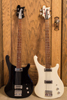
I have 2 4003s5 models ... 1980 and 1990 the main difference between the two is the color and the pickups .... the 1990 sounds different than the 89 ... the toaster neck pickup is basically the same but the bridge pickup is different. The 1989 is brighter and more 4001 Chris Squire sounding. The 1990 is more thunderous and fuller. The bell tone treble highs are sweeter and less harsh than the 89. Also there is a slight difference in the body size ... the 1990 is a fraction of an inch bigger ... a little more massive.
They are both the same model and type of bass ... only a year apart ... but noticeably different sounding ... the main difference ... the pickups ...
I have 2 4003s5 models ... 1980 and 1990 the main difference between the two is the color and the pickups .... the 1990 sounds different than the 89 ... the toaster neck pickup is basically the same but the bridge pickup is different. The 1989 is brighter and more 4001 Chris Squire sounding. The 1990 is more thunderous and fuller. The bell tone treble highs are sweeter and less harsh than the 89. Also there is a slight difference in the body size ... the 1990 is a fraction of an inch bigger ... a little more massive.
They are both the same model and type of bass ... only a year apart ... but noticeably different sounding ... the main difference ... the pickups ...
-
jwr2
quote:
"4005 basses are just like that and they sound great.
As I said, personal preference. I have only played one 4005 and I didn't like the bridge pickup at all. No bottom."
*****************************
There are a lot of players here who absolutely love the bass cut capaciter ... it cancels the bass response from one pickup ...
I like to put a Seymour Duncan 1/4 pound jazz neck pickup in the bridge cavity on a 4003 ... by itself it sounds too shrill but mixed in with the other pickups it adds a little hum canceling and some treble bite ...
as per bolt on necks and ric pickups ...
My 2030 has a bolt on neck and it has more of a "Rickenbacker" sound than my 4004 ... which is neck through ... the reason ... single coil versus humbuckers ... I like my 4004 a lot but it is more p-bass sounding because of the series humbuckers ... they reproduce the high frequencies a little differntly ...
You can make a jazz bass sound like a p-bass by wiring the pickups in series ... or you can make a p-bass sound more like a jazz bass by wiring the pickups parallel.
"4005 basses are just like that and they sound great.
As I said, personal preference. I have only played one 4005 and I didn't like the bridge pickup at all. No bottom."
*****************************
There are a lot of players here who absolutely love the bass cut capaciter ... it cancels the bass response from one pickup ...
I like to put a Seymour Duncan 1/4 pound jazz neck pickup in the bridge cavity on a 4003 ... by itself it sounds too shrill but mixed in with the other pickups it adds a little hum canceling and some treble bite ...
as per bolt on necks and ric pickups ...
My 2030 has a bolt on neck and it has more of a "Rickenbacker" sound than my 4004 ... which is neck through ... the reason ... single coil versus humbuckers ... I like my 4004 a lot but it is more p-bass sounding because of the series humbuckers ... they reproduce the high frequencies a little differntly ...
You can make a jazz bass sound like a p-bass by wiring the pickups in series ... or you can make a p-bass sound more like a jazz bass by wiring the pickups parallel.