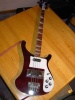
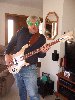
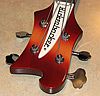
Another indication of how Chris can pick nearly anything up and make "that sound" is illustrated on his Starlicks video from back in '91. He has alot of his collection on hand, starting with the 'ol girl, the Electra-MPC, the Tobias, amongst others, and they really do sound similar, just a hint of different personalities. The constant seemed to be the Marshall amp he had there, the Rotos and the technique.
250k ohm pots are warmer sounding ... they roll more treble off to ground when set at 10 ... 250k ohm pots are usually used with single coil pickups ... 500k ohm pots roll less treble off to ground these will make your bass sound brighter and colder ... the pre 1990 Ric basses had 250k ohm volume pots and 500k ohm tone pots ... 500k ohm pots are usually used with humbuckers ... 1000k ohm pots give you a wide open sound ... I like to install 1000k ohm pots as a tone pot on basses like t-birds and 4004 basses to give them more treble bite ...
Vincent - did Chris tell you much about which amps he was using in the studio for 'The Yes Album' 'Fragile' & 'CTTE?' His studio sound in those days is really what stands out to me as some of the best moments captured. His sound on 'Yessongs' is absolutely amazing too, but very different than the studio albums.
Elys, it may be exact science, but you also have to take into consideration ESR, DF, "memory" effect, and other factors. I have spent over a year ad a half on capacitors and their sonic effects, especially in switched capacitor D/A converters, I/V analog amp stages, and power supplies. I published 3 articles with my findings.
A very simple example is the tantalum input coupling capacitor on a Dynaco Stereo 120. Replace that cap with a good quality poly cap and you will hear a removal of grain and spittiness in the audio.
Take a .047uF 50V ceramic disk (the ones about .3" in diam.) and replace those blue ones on your 60s basses and then listen closely to it and tell me there is not a difference.
I'm not irritated, I'm trying to inform.
(And I didn't even bring up replacing carbon comp resistors with metal film in old circuits. But then you change the characteristics and take away what made the sound of the amp great.)
I thought there might be an audible difference in the components used in the capacitor construct. In your opinion, John, what is the difference in sound between the 'Big Blues' and the 50V ceramic disks?
I agree (for once!) with Elys. If you have two caps that actually measure the same, i.e. eliminating tolerance as a factor, they'll sound the same at the very low voltage, current, and frequency a guitar circuit employs.
But I also agree with John any time you're speaking of circuits with appreciable voltage or current; many more serious considerations come into play. This is REALLY true when the frequency gets up there!
Still, there's other more pragmatic factors to consider. Beyond wild tolerance ranges, ceramic discs do tend to be microphonic, the physical shape tends to collect more ESI, and the mechanical configuration tends to be problematic with vibration.
On all counts, it's hard to beat a molded polyester axial lead capacitor for reliability and consistency in a guitar. For other electronic products, there's better choices, suited to their function.
Now I'm curious, John. How much current are we talking in a pickup tone circuit? I've never thought about that or measured it. In the I/V stages I investigated, we were talking 2 ma. max, usually a lot less.
Man, I gotta get home to bed - I fly in 6 3/4 hours!
John, you'll find that guitar circuits are severely band-limited, so what you see on the scope or hear in a stereo capable of 20 kHz and above is going to be insignificant in a bass guitar hi-Z low-level output. There are no really significant-amplitude Fourier-series spectral components left at those frequencies of interest in a bass guitar's output. A bass guitar's amp won;t even respond outside its upper-bandpass rolloff at 20 kHz, or even 10. In a stereo, there are.
Have a great flight, wish I was going, can't due to health problems for my fifth child, an eight-week old boy. Have a drink for me while you are there
Do unto others as you would have them do unto you, and sit in with the band whenever you can, to keep your chops up!
It was quoting Chris Squire when I mentioned he thought it was the Blue caps in his RM1999 that had a lot to due with the sound of his bass. Those were Chris’s words not my own though I respectfully disagree with Elys and believe that capacitors measuring equal value can sound noticeably different. Still, I believe without Eddie Offord, Chris’s recorded sound may never have been quite as good. I have collected many 60’s Rickenbacker basses. However two weeks ago I performed at the Fuji Rock festival in Japan. The 1963 4001 I took with me for the show was mishandled and did not arrive on Tokyo in time for the show. I had to rush rent a brand new Rickenbacker bass for the show, as that was all that was available. I had not played a new Ric in years. To my surprise the new bass felt great and even more surprising was that I got one of the best bass sounds I have ever gotten in my life.
Scott, it was a brand new 4003. I fiddled for a little while with the set up, put on flat wounds and played it with neck pickup only through an early 60’s Fender Showman with a 15” JBL. Sounded very good and surprised my band mates and me. The feel and balance of that bass is a lot different from what I am used to so at first I was like, oh no, I can’t play this thing. In a very short time though I got very comfortable with it and started to really enjoy it. After the show I offered to buy it from the rental guy but he said it wasn’t for sale.
Mark Walker, I just spoke to Chris to hear from him what he remembers using amp wise for THE YES ALBUM, FRAGILE and CLOSE TO THE EDGE. Chris told me he used a Marshall 100 head (same one he still owns) and a Marshall 4 x 12” cabinet. For CLOSE TO THE EDGE he also used a Vox AC30 with a Guild fretless bass. (I now own the Guild fretless).
 "
"