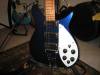
I've recently changed the strings on my 65 1997. I did the full set in one go and had a tough time getting the old rubber stops unsticking themselves from the top of the guitar. Then I had to fit each string to it's slot and slide the tailpiece in a little each time until the next string was in.
From what I could see it would be very hard to change a single string without removing all of them to get the new one in? Has anyone else had this problem or tried to get around this?
I dunno, perhaps the light was on but I was having a senior (now veteran) moment at the time?
I have a new Accent and that's how I change my strings. I haven't had just one break on me, at least not yet. I'm sure there's a way to do it. I just wonder why Rickenbacker has trouble producing a truly easy to string tailpiece, unless the trapeze fits this category. I wouldn't know, as I've never owned a Rick with a trapeze tailpiece.
Bill, have you ever had to change just one string?
I now understand why Pete Townsend had such an aversion to these tailpieces. If he broke a string onstage the guitar would've been out of action for the rest of the night.
I do mine with the guitar laying on its back on my padded workbench, which incidentally is built to a 40" work height, so I minimize bending down when working.
I bend each string end at a right angle to the string proper, using a pair of needlenose pliers and working carefully so as not to nick or kink the string. I remove the string anchor part from the tailpiece (which remains fastened to the guitar) by sliding it and the spring off.
Working from high E to low E, I insert the string ball end into the slot and pull on the string to lock it into place. I make sure it's tucked into the anchor piece, and I use a piece of 1/4" masking tape to hold it in place, burnishing the tape down thoroughly. Then I move on to the next string. In the case of the B and A strings, I often have to slide the spring a bit to one side or other to allow the ball end to pop into place.
When I'm done, I slide the whole assembly, strings and all, into the tailpiece part. Then I separate and arrange the strings and install both E strings into their respective tuning machines, tuning up loosely to hold things in place, but loose enough that I can slide the bridge into place under the two strings. Then I tune not quite to pitch, but tighter.
Then the four inner strings B, G, D, A, are strung into their posts and tightened up, taking care not to tangle them, and making sure they are sitting properly in their saddles. Finally, I tune up, working from low to high. It usually takes three passes to get tuning that works.
To replace one string, you loosen the other five nice and floppy, but leave them attached to their posts. Pull out the bridge. Remove the offending string and replace, then retune partially, replace bridge, then tune back up to pitch.



 but I was having a senior (now veteran) moment at the time?