
Fretboard inlays are currently poured.
We are not locked into this process though and cutting the inlay shapes to glue in was actually discussed recently with one of our engineers. The tolerances that our CNC machines hold would actually allow for this whereas it would have been a dicey proposition in the past.
RIC selling one-of-a-kind experimental finish 4003 on eBay!
Moderators: rickenbrother, ajish4
-
RIC_FACTORY
- RIC
- Posts: 508
- Joined: Sat Dec 08, 2007 7:00 pm
-
jingle_jangle

- RRF Moderator
- Posts: 22679
- Joined: Wed Dec 22, 2004 6:00 am
- Contact:
Re: RIC selling one-of-a-kind experimental finish 4003 on eBay!
Well, there's some accurate stuff mixed in with misperception here.elysrand wrote:I have often heard it said that different processes produce nearly the same thing. The key is how nearly is near, I guess.
Dale said at one point, IIRC, that in 1972 the factory was buying pre-made sheets from some vendor, and then cutting and fitting the sheet pieces into channels cut into the neck on some jig. Then, in the transitional basses in 1973 they were poured with the ground dust mixed in by hand and the ends of the channels taped or otherwise "dammed up" while the two-part acrylic resin cured into solidity. Then, not only did the partial-width routs allow the fingerboard edge to help with neck beam strength/stiffness, they also did away with the need to "dam" up the ends and the process was simplified to just pouring the rout full or acrylic mix.
Paul has said that he mixes the clear resin with pearlescent powder and does the "dam up the ends" method when pouring inlays in his restoration. I also think I have heard Dale and Paul say they buy some pre-made sheets too. Dale also, I think, has said he mixes and pours acrylic resin with flakes embedded to produce something very close to the look of the mid-sixties to early seventies "sparkley" flaked inlays.
Finally, I think I have heard that John cannot find a vendor anymore with pre-made sheet stock that has the exact look of the early "sparkley" inlay material that we all so treasure on our Period Ricks.
Question - if some vendor were to start making the pre-made 12x12 slabs of "sparkley" inlay material , and it looked exactly like that wonderful stuff we saw from the mid-sixties to the early seventies, would there not be a market for it, and would RIC perhaps go back to using the stuff for certain of their guitars?
I've never seen a sparkle-inlay Rick that used the sheet material. But if Dale says that's how they made 'em (I did not see that post), then I guess at least some were done that way. It is the way I do the inlays myself--it's clean, not messy, and gives great results. Close inspection, however, by a knowledgeable Rick-O-Phile, will note a small difference.
It was my understanding that the Factory always used a mix of flakes and epoxy resin, and that is how I thought Dale still does it (from the pictures he's posted on this and other sites).
Would Rick go back to the stuff? I think the material is only a part of the story here. The triangular inlays currently used are easy to CNC and are self-containing for the poured type of inlay. Of course, the sheet material could also be CNC'd to be a perfect fit into those rounded triangles, but frankly would look odd. You need full-width inlay recesses, which require extra steps beyond pouring...the fretboards would have to be made oversized, then inlaid, then final-trimmed to width and taper. The sheet material is very pricey, too.
Re: RIC selling one-of-a-kind experimental finish 4003 on eBay!
"But if Dale says that's how they made 'em (I did not see that post), then I guess at least some were done that way."
I read that in Dale's post, too. He said he was there for the tail-end of the full width inlays. I took that to mean the "transition period" (about March-April 1973?) when the full inlays were more of a pearly plastic instead of sparkles.
I read that in Dale's post, too. He said he was there for the tail-end of the full width inlays. I took that to mean the "transition period" (about March-April 1973?) when the full inlays were more of a pearly plastic instead of sparkles.

Re: RIC selling one-of-a-kind experimental finish 4003 on eBay!
Dale has said many times that he started working in the wood shop at Electro String in 1972, and was there for nearly a year before the sparkleys were done away with in early 1973.teeder wrote:"But if Dale says that's how they made 'em (I did not see that post), then I guess at least some were done that way."
I read that in Dale's post, too. He said he was there for the tail-end of the full width inlays. I took that to mean the "transition period" (about March-April 1973?) when the full inlays were more of a pearly plastic instead of sparkles.
-
jingle_jangle
- RRF Moderator
- Posts: 22679
- Joined: Wed Dec 22, 2004 6:00 am
- Contact:
Re: RIC selling one-of-a-kind experimental finish 4003 on eBay!
...which would indicate that there are a sizable number (a couple of hundred at least?) Ricks with the sheet material used for sparkly inlays. I've seen maybe a dozen instruments from this era (almost all basses), and all had poured inlays. But I'm sure there are Forum members out there with basses from the late sparkle era that have the sheet-sparkle inlays. Anyone want to step forward?
Re: RIC selling one-of-a-kind experimental finish 4003 on eBay!
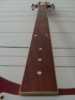
I have a Feb '73 that would probably qualify. Mark G has one too I believe...
Re: RIC selling one-of-a-kind experimental finish 4003 on eBay!
My .02 or less:
To add to what has been said already and maybe a little re-hash, this is what I've seen....
Without doubt there are ' 73 basses with CP inlay, and inlays of the same design, full-width but w/o any pearloid material composition......these basses are generally seen with later 1973 serial numbers, having run out of the previous stock that was used before and a solution was needed to finish instruments that been partially built with the old design.. Then of course the poured type came into being not long after with the basses.
Both full-width styles I'd have to assume were cut-to-fit from sheet stock and fitted/sanded accordingly....I may be wrong but I don't believe that any of the basses with the crushed-pearl material were done in a poured fashion. YMMV...
To add to what has been said already and maybe a little re-hash, this is what I've seen....
Without doubt there are ' 73 basses with CP inlay, and inlays of the same design, full-width but w/o any pearloid material composition......these basses are generally seen with later 1973 serial numbers, having run out of the previous stock that was used before and a solution was needed to finish instruments that been partially built with the old design.. Then of course the poured type came into being not long after with the basses.
Both full-width styles I'd have to assume were cut-to-fit from sheet stock and fitted/sanded accordingly....I may be wrong but I don't believe that any of the basses with the crushed-pearl material were done in a poured fashion. YMMV...
-
RIC_FACTORY
- RIC
- Posts: 508
- Joined: Sat Dec 08, 2007 7:00 pm
Re: RIC selling one-of-a-kind experimental finish 4003 on eBay!
Which is no different from how they are done now. This is the process now:You need full-width inlay recesses, which require extra steps beyond pouring...the fretboards would have to be made oversized, then inlaid, then final-trimmed to width and taper.
***On second thought, I think I'll omit all that from public record. I'll show you in January, Paul!***
The downside: When we start fretboards in CNC production, we have to wait a few days to finish them due to dry time. Plus, if someone screws with the feed rates on the CNC machines, the resin inlays have a nasty tendency to chip. Really, these should be the fastest and easiest parts to make, but I would wager to say that making a fretboard is trickier than making a body from my experience.
Re: RIC selling one-of-a-kind experimental finish 4003 on eBay!
Great info, Ben! Thanks!! And I will bet that you saw-cut the fret-lines after the inlays are poured, and not before. Would that order change, or would it stay the same, if you went over to CNC-milling the pockets and plugging with pre-cut inlay pieces into the fretboard as you had mentioned before?
I have seen luthiers saw all of it at once, and then pour the triangular full-width inlays, though, in onesy-twosey production.
I have seen luthiers saw all of it at once, and then pour the triangular full-width inlays, though, in onesy-twosey production.
Last edited by elysrand on Thu Dec 13, 2007 11:25 pm, edited 1 time in total.
-
markbass99

- Intermediate Member
- Posts: 1267
- Joined: Sun Mar 14, 2004 7:23 am
Re: RIC selling one-of-a-kind experimental finish 4003 on eBay!
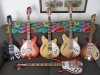
In the first pic of the 73's below, top is Feb, the April, then June. Second pic is the Jan 73 I got from Marc S. I'm not really sure if I can tell if they are from a sheet or not, wouldn't the sheet type be also poured at one time to make the sheet?.....sheet man!


73 Feb 4001, 73 March 4001, 73 April 4001, 73 May 4001, 73 June 4001, 73 July 4001
04 MM Bongo 5HSp, 07 MM Bongo 5HS, 09 MM Bongo 5HS, 09 MM Bongo 5Hp, 11 MM Bongo 5H
04 MM Bongo 5HSp, 07 MM Bongo 5HS, 09 MM Bongo 5HS, 09 MM Bongo 5Hp, 11 MM Bongo 5H
-
RIC_FACTORY
- RIC
- Posts: 508
- Joined: Sat Dec 08, 2007 7:00 pm
Re: RIC selling one-of-a-kind experimental finish 4003 on eBay!
Saw cuts after inlays are poured to avoid seepage into the fret lines, correct.elysrand wrote:Great info, Ben! Thanks!! And I will bet that you saw-cut the fret-lines after the inlays are poured, and not before. Would that order change, or would it stay the same, if you went over to CNC-milling the pockets and plugging with pre-cut inlay pieces into the fretboard as you had mentioned before?
The crucial step is the crown radius because that needs to be done to level the inlays flush with the wood and get it down to size to accomodate the saw-cuts. So to answer your question, no change in order. Just faster production of fingerboards!
Re: RIC selling one-of-a-kind experimental finish 4003 on eBay!
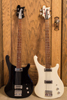
Exhibit A, I think!
-
RIC_FACTORY
- RIC
- Posts: 508
- Joined: Sat Dec 08, 2007 7:00 pm
Re: RIC selling one-of-a-kind experimental finish 4003 on eBay!
Hmmm, those look familiar. Note that gluing in triangle inlays is not so different than gluing the dots inlays in a 330. Just on a larger scale. Now that I think about it, the way we do things now we could even glue them in AFTER the CNC machine finishes with them because fretboards are radius sanded on an edge sander. That may change here in the near future though as the CNC machines are programmed to do more functions, so I'll wait and see how it pans out... 
-
jingle_jangle
- RRF Moderator
- Posts: 22679
- Joined: Wed Dec 22, 2004 6:00 am
- Contact:
Re: RIC selling one-of-a-kind experimental finish 4003 on eBay!
If this is true, and its entirely possible, then the sheet stock would to have to have been something like 3/16" thick in its raw state. Then radiusing the board would have exposed some of the pearl flakes to the atmosphere. Entirely possible, but the sparkle boards I've seen simply look poured to me because of the way the flakes lay. As we know, I've been wrong before.leftybass wrote:My .02 or less:
To add to what has been said already and maybe a little re-hash, this is what I've seen....
Without doubt there are ' 73 basses with CP inlay, and inlays of the same design, full-width but w/o any pearloid material composition......these basses are generally seen with later 1973 serial numbers, having run out of the previous stock that was used before and a solution was needed to finish instruments that been partially built with the old design.. Then of course the poured type came into being not long after with the basses.
Both full-width styles I'd have to assume were cut-to-fit from sheet stock and fitted/sanded accordingly....I may be wrong but I don't believe that any of the basses with the crushed-pearl material were done in a poured fashion. YMMV...
That Jan '73 in the second photo above looks like it was refretted with .102 jumbos.
Ben, I was under the impression that the boards already had their tapers when the inlay recesses were routed. Yes, I look forward to more enlightenment. BTW, our 5-axis Thermwood 60X60X30 is in place, TRAMd and up and running. Not on a daily basis until I get climate and dust control systems installed. 2008 will be an interesting year...
Re: RIC selling one-of-a-kind experimental finish 4003 on eBay!
I have heard 5/32nds from those who worked with them way back then, but have no original sheet stock samples to measure in fact.