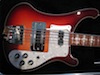
I have a '78 4001 and a Fender Geddy Lee Jazz bass and a 4001v63. I've got a few dead spots on the 4001V63. These dead spots are more noticable than on my 4001 '78 and the Geddy. It quite dissapoints me to have these on such an expensive bass.
I love the v63 though and I was hoping that there would be a solution (i dont wanna sell it )
Would a different bridge(hipshot) help?
I'm not using a compressor, maybe it would help a bit..
Different strings maybe? Right now Rotosound 66LC are installed..
Philip, when was the last time the strings were changed on your V63?
If changing strings does not seem to help, give each truss rod a sligh tweak, maybe a 1/4 turn clockwise. The slight tweak shouldn't really change the neck relief and it might tune out the dead spots.
Maybe a different brand or gauge of strings would help. Try the D'Addario XL170 set or if you prefer the brighter sound of stainless steel strings, try the EPS170 set.
I never could follow any of such "dead spot" discussions, as on all of my Ricks and other basses I never found any fret on the neck that was "dead". Even the harmonics always ringed on all of my basses. WHAT REALLY IS A DEAD SPOT???
heinpete wrote:I never could follow any of such "dead spot" discussions, as on all of my Ricks and other basses I never found any fret on the neck that was "dead". Even the harmonics always ringed on all of my basses. WHAT REALLY IS A DEAD SPOT???
A dead spot is something like a note with hardly any sustain.
wints wrote:Just look on it as making it a little more authentic!
Same problem for me on my '93 V63, although the worst is centered around the D string's 7th fret. Definite deadness noticeable from the G to B notes, 5th to 9th frets. (My mother still has a '66 4005 OS that I learned on as a teen which has the same problem in the same range, too, interestingly.) I've been chasing around with the rods to try to get the neck as flat and low-action friendly as possible, and I've yet to find a position in which the dead notes are noticeably reduced. I'm a confirmed Rotos 66LD user, and have only ever used anything different once (flats for a specific recording - Fender I think), so I've never examined other string choices to see what effect they might have.
Critical listening to the quiet "walking" section "Yours Is No Disgrace" (as well as a couple tracks from Time And A Word) tells me that perhaps our Mr Squire has also had a very slight sustain deficit in the same region, as well! So perhaps we're all in good company.
First post, been lurking around here a long time though....
pacealot wrote:Critical listening to the quiet "walking" section "Yours Is No Disgrace" (as well as a couple tracks from Time And A Word) tells me that perhaps our Mr Squire has also had a very slight sustain deficit in the same region, as well! So perhaps we're all in good company.
First post, been lurking around here a long time though....
Paul
Welcome Paul!
I think in that part of the song (the first time through not the bit near the end) Chris may have had the bridge mutes on......
True - either the mutes, or else he's doing the very tricky business of palm muting in that small space between the bridge and the mute. Either way, that certainly would affect the sustain. It does seem that the notes that die the fastest are the very ones in question, when he goes down the D string to the A and G# notes, though, so there's that for further consideration.
I'd love to minimise my dead spots, but I'm also trying to come to accept them as part of the "limitation" of the instrument, having fought with them for nearly five years now!
Thanks for the welcome! Glad to be taking part in a forum which has taught me very much over the years....
Dead spots or less prominent notes are an unfortunate consequence of most guitar constuction. If you have ever noticed one or two notes that do not sustain very well you have noticed a dead spot. For one reason or another, the instrument absorbs certain frequencies on certain strings more so than others. The problem ranges from very subtle to OMFG what the F is wrong with this bass!!!? Fortunately, most Ricks are of the former type more than the later. When affected, 4000 series basses are usually "dead" at the 3rd to 5th fret on the G string and somewhere between the 7 and 10th frets on the D string. When Fenders have dead spots they are in roughly the same places. Many of the changes made to the 4001 over it's run were done specifically to address the problem. Changes to the headstock shape, neck laminations, the addition of lead weights, and a few other tweaks were attempts to make the instuments more consistent.
What can be done to fix it? First, make sure your tailpiece screws are snug - all 3, 5, or 7 of them depending on the age of the bass. Loose tailpiece screws can seriously F with the sound. While the strings are off, loosen the truss rods all the way then snug them to finger-tight. After that, give them both another 1/4 turn. String it back up making sure to allow for at least 3 windings on each patent head. The windings should start at the top of the patent and spiral downward. Doing this will provide adequate down force at the nut. Check the relief and ajust the rods futher as required. Keep the rod tension balanced as you go. They should be evenly tight to start. Oh, when you put the bridge back in, make sure it is seated properly and not tilted or wedged. New RIC tailpieces don't have that problem so much as the older ones do. If the problem persists, you can try some asymmetric rod adjustments. Altering the neck load can reduce, eliminate or even cause dead spots. Try this: Take a little tension off of one rod (1/8th turn at the most ) and add it to the other. If that does not work try increasing the difference or reversing it. Be aware that if the rod tension differential is too great, the neck will tend to roll (twist) to the side with more tension. There are other things that can be done but this should help get you started.

 )
) 





 Even the harmonics always ringed on all of my basses. WHAT REALLY IS A DEAD SPOT???