

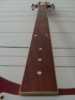
This is probably the first major piece of advice I've needed to ask the brethren, and it is the best place I could think of to go. I've now got a Maplego 4003S that could use a refinish to a new clear coat. The back of the neck is essentially bare wood all the way down, which is the main issue.
The guy (nice fellow) who has done the setups on my other Rics (he's at one of the two Colorado Ric dealers) recommended against this, as he felt it would reduce the value of the bass. He feels that the density of the maple will maintain the wood integrity. I'm worried about too much wood being exposed in the dry Colorado climate, especially on the neck. I've got a bare wood TV stand that I'm supposed to be oiling so it doesn't dry and crack. I've seen that same TV stand cracked in the furniture store because no one oiled it. Including my furnace and recently added additional house plants, in winter I can keep the house at 29% - 32% relative humidity, but that is probably it - maybe 35% tops with a new humidifier screen.
As is the case with my other Rics, I'm not likely to sell this one. It is the closest I'll get to having a "McCartney" model with the Mapleglo and dot inlay, which was its main attraction for me. It would seem that refinishing a Mapleglo would detract from the value less than doing the same thing to a solid color finish. It would also seem odd to only refinish the neck and leave the rest alone as there is some minor buckle rash on the bass (with missing finish) and conversion varnish issues on the front of the body.
What would you recommend? I'm leaning to a complete refinish.
A related question is should I go for another conversion varnish finish to maintain its "Ric-ness", or go with something else? I have acidic sweat (as my trombones can attest) so maybe someone else would be better?
Refinish a Mapleglo 4003S?
Moderators: rickenbrother, ajish4
Refinish a Mapleglo 4003S?
"Practice does not make perfect. Only perfect practice makes perfect." Vince Lombardi

Re: Refinish a Mapleglo 4003S?
Definitely go with a CV refinish. You really need something on the the back of the neck. If it were the back of the body in spots I wouldn't worry as much but I wouldn't leave the neck susceptible to changes in humidity allowing it to possibly twist or warp. Also the unprotected wood will eventually get dark and dirty from the oils in your hand and look ugly. I would definitely go with a total refinish.
Re: Refinish a Mapleglo 4003S?
First, a good humidifier is a must if you have guitars in the house. Also, keep them in their cases with a guitar humidifier when the air is dry. The finish should not be your primary defense against dry air.
With that out of the way, will a re-fin reduce the value of the instrument? Maybe. It depends on the instrument and the quality of the re-fin work. Re-fins should always be approached with caution in the case of rare or otherwise unique instruments. In any case, a high quality re-fin ala Dale Fortune or Paul Wilczynski (I hope I spelled that right) will be more or less indistinguishable from factory finishes.
With that out of the way, will a re-fin reduce the value of the instrument? Maybe. It depends on the instrument and the quality of the re-fin work. Re-fins should always be approached with caution in the case of rare or otherwise unique instruments. In any case, a high quality re-fin ala Dale Fortune or Paul Wilczynski (I hope I spelled that right) will be more or less indistinguishable from factory finishes.

Re: Refinish a Mapleglo 4003S?
Since you are not parting with this bass, I think the question of value change, whether it detracts or adds, is moot. I agree with Steve and Ted. Full refin, and it will be your baby for years to come. With your acidic hand tendency and the dirt that will get into the maple, that really points to getting a finish on the neck. Dirty maple looks like ****.
Re: Refinish a Mapleglo 4003S?
OK, you guys have me convinced. I was leaning heavily to a complete refinish.
Re: Humidity, I will include a link to a Ric corporate forum post by John Hall:
http://www.rickenbacker.com/forum_view_ ... %20dryness
As noted, my house in winter is 29% - 33% ground level, but I keep the basses in their cases in the basement where it is a bit more humid and upper 60's (Deg F). It is probably at least 35% down there though I need to verify. John Hall thought 35% was a good number in the thread above.
I will keep the Mapleglo 4003S in its case down there while I decide on the next step for the refinish. I took a close look at the maple part of the neck and it looks good (dense grain, no cracks), except for that dirt build up factor. It came from a more humid part of the country, which is a good thing. The thing I most don't like is that is needs a truss rod adjust badly (no twist though), but it should be OK if one goes slow.
Re: Humidity, I will include a link to a Ric corporate forum post by John Hall:
http://www.rickenbacker.com/forum_view_ ... %20dryness
As noted, my house in winter is 29% - 33% ground level, but I keep the basses in their cases in the basement where it is a bit more humid and upper 60's (Deg F). It is probably at least 35% down there though I need to verify. John Hall thought 35% was a good number in the thread above.
I will keep the Mapleglo 4003S in its case down there while I decide on the next step for the refinish. I took a close look at the maple part of the neck and it looks good (dense grain, no cracks), except for that dirt build up factor. It came from a more humid part of the country, which is a good thing. The thing I most don't like is that is needs a truss rod adjust badly (no twist though), but it should be OK if one goes slow.
"Practice does not make perfect. Only perfect practice makes perfect." Vince Lombardi
-
jwr2
Re: Refinish a Mapleglo 4003S?
David: Come by and see my oil finish 4003s5 ... it is like mapleglo but it is a little different ... the oil finish changes the tone in a nice way and it protects the wood ... the finish on a bass protects the wood from rapid changes in humidity ... so unless the bass spends its life in a humidity controlled room I say refinish it ... it can help keep the neck straight ... 
-
jingle_jangle

- RRF Moderator
- Posts: 22679
- Joined: Wed Dec 22, 2004 6:00 am
- Contact:
Re: Refinish a Mapleglo 4003S?
An oil finish leaves the grain of the maple open to incursion from moisture, oxygen, and atmospheric pollutants, and must be renewed every so often, depending upon climate. If it is not renewed, it and the surface of the wood will oxidize and dull.
That might sound like an out and out condemnation, but in fact it is by no means unsuitable for refinishing a guitar or bass that's been properly stripped and sanded.
However, if you are concerned about resale value, the oil finish will kill it, period.
The guy who told you that a refinish (in what he probably assumed was a factory finish--nitro) will compromise resale value, was talking through his hat. He's spouting the "company Kool-Aid line", which was begun and is maintained by the core of high-profile collectible instrument dealers, and is subsrcibed to by most of the rest, because they're too lazy, busy, or ignorant to stand up and do their own grading according to value and quality of refinishing.
That having been said, would I buck the trend and refinish an original and nicely-patinaed '54 Strat, just to make it look new? Or a '58 Capri that's stood the test of time and wears its scars proudly? There's absolutely no reason to do this. But a fairly-recent Rickenbacker instrument is another story entirely, and that's because there is a core of Rick enthusiasts who will judge an instrument by its rarity and quality, refinished or not.
The sticking point here is having it done correctly--and that means conversion varnish. Very few people who refinish guitars and basses can do this properly and to factory standard, and those of us who do are usually quite busy. It uses materials that are difficult to work with and quite toxic, and the learning curve is pretty steep.
Most luthiers dislike refinishing because, unlike setups, wiring and even fretwork, refinishing requires a fair amount of continuous experience and practice, and still tends toward unpredictability. And 99.9% of them will either refuse to refinish your Rick (because they're honest, understand that Rickenbacker factory finishes are "different") or will steer you to nitro (because it's easy to spray) and tell you that it'll turn out fine and make no difference, sonically or financially.
The price of a nitro refin is roughly one-half to one-third of what a proper CV refinish will cost. It takes one-quarter of the time or even less, too.
Still, my best advice is: stick with CV.
That might sound like an out and out condemnation, but in fact it is by no means unsuitable for refinishing a guitar or bass that's been properly stripped and sanded.
However, if you are concerned about resale value, the oil finish will kill it, period.
The guy who told you that a refinish (in what he probably assumed was a factory finish--nitro) will compromise resale value, was talking through his hat. He's spouting the "company Kool-Aid line", which was begun and is maintained by the core of high-profile collectible instrument dealers, and is subsrcibed to by most of the rest, because they're too lazy, busy, or ignorant to stand up and do their own grading according to value and quality of refinishing.
That having been said, would I buck the trend and refinish an original and nicely-patinaed '54 Strat, just to make it look new? Or a '58 Capri that's stood the test of time and wears its scars proudly? There's absolutely no reason to do this. But a fairly-recent Rickenbacker instrument is another story entirely, and that's because there is a core of Rick enthusiasts who will judge an instrument by its rarity and quality, refinished or not.
The sticking point here is having it done correctly--and that means conversion varnish. Very few people who refinish guitars and basses can do this properly and to factory standard, and those of us who do are usually quite busy. It uses materials that are difficult to work with and quite toxic, and the learning curve is pretty steep.
Most luthiers dislike refinishing because, unlike setups, wiring and even fretwork, refinishing requires a fair amount of continuous experience and practice, and still tends toward unpredictability. And 99.9% of them will either refuse to refinish your Rick (because they're honest, understand that Rickenbacker factory finishes are "different") or will steer you to nitro (because it's easy to spray) and tell you that it'll turn out fine and make no difference, sonically or financially.
The price of a nitro refin is roughly one-half to one-third of what a proper CV refinish will cost. It takes one-quarter of the time or even less, too.
Still, my best advice is: stick with CV.
Re: Refinish a Mapleglo 4003S?
I still need to get over there, Jeff.
Thanks for the detailed info Paul. I am looking into the various options. I'd love to find someone local who could do it (to not ship the bass again), but I'll ship it if need be.
I do really want to keep it as intended with a CV finish, but am uncertain of the ballpark cost. My assumption has been that nitro is more durable, but I'm not 100% sure about that. My acidic sweat (good name for a song) is a concern of mine. I can re-lacquer one of my trombones on the spots where my left palm touches the slide assembly and the lacquer will eventually wear off. I admit that it is spray on lacquer and not baked on.
From all I've read on the forums, the CV finish can be kept nice as long as one does the wax regimen, and of course a wipe down (something I didn't do when younger). I do wax my other Rics with Turtle Wax, based on a recommendation by John Hall. I use their Carnauba cleaner wax, however.
I must admit that I like the flatwound strings that came it. More "Beatle" sounding than the chromes I've got on the others. I think I'll keep it that way.
Thanks for the detailed info Paul. I am looking into the various options. I'd love to find someone local who could do it (to not ship the bass again), but I'll ship it if need be.
I do really want to keep it as intended with a CV finish, but am uncertain of the ballpark cost. My assumption has been that nitro is more durable, but I'm not 100% sure about that. My acidic sweat (good name for a song) is a concern of mine. I can re-lacquer one of my trombones on the spots where my left palm touches the slide assembly and the lacquer will eventually wear off. I admit that it is spray on lacquer and not baked on.
From all I've read on the forums, the CV finish can be kept nice as long as one does the wax regimen, and of course a wipe down (something I didn't do when younger). I do wax my other Rics with Turtle Wax, based on a recommendation by John Hall. I use their Carnauba cleaner wax, however.
I must admit that I like the flatwound strings that came it. More "Beatle" sounding than the chromes I've got on the others. I think I'll keep it that way.
"Practice does not make perfect. Only perfect practice makes perfect." Vince Lombardi
Re: Refinish a Mapleglo 4003S?
No, nitro is not very durable at all but it is easy to repair when damaged. CV on the other hand is very tough. It is most often used on kitchen and bathroom cabinetry and burial caskets. CV of one type or another is what RIC has used for years. Early on they used some kind of catalyzed varnish which is apparently not the same as conversion varnish.
Last edited by rickfan60 on Fri Jan 11, 2008 2:15 am, edited 1 time in total.

Re: Refinish a Mapleglo 4003S?
I think a burial casket should be FireGlo .
It's too early in the morning to talk about our relationship !
Re: Refinish a Mapleglo 4003S?
With cremation, it would be.VRICKY63 wrote:I think a burial casket should be FireGlo .

Re: Refinish a Mapleglo 4003S?
This is becoming a hot topic. 
-
jingle_jangle
- RRF Moderator
- Posts: 22679
- Joined: Wed Dec 22, 2004 6:00 am
- Contact:
Re: Refinish a Mapleglo 4003S?
RIC has used conversion varnish (which is a generic, furniture industry term for a catalyzing finish) since 1959.rickfan60 wrote: CV of one type or another is what RIC has used for years. Early on they used some kind of catalyzed varnish which is apparently not the same as conversion varnish.

Re: Refinish a Mapleglo 4003S?
So this has probalby been explained here before, but the whole Conversion Varnish dicussion is still a little vague. How does a generic furniture indusrty term like CV apply directly to RIC and what are the products used? How is it different from generic Automotive industry products like catalyzed enamels and Polyurathanes? Are they the same?
-
jingle_jangle
- RRF Moderator
- Posts: 22679
- Joined: Wed Dec 22, 2004 6:00 am
- Contact:
Re: Refinish a Mapleglo 4003S?
Jake sez: RIC uses furniture varnish on its instruments, from industry suppliers like Sherwin-Williams (for example...I think they are using a different supplier now). S-W also makes automotive catalyzing clearcoats. Differences: Automotive clearcoats are much tougher, more expensive, and supposedly not recommended for wood. No doubt RIC has conversations with S-W's application engineers, who steer them toward the furniture side of the line; the S-W product they were using was formulated for very tough applications--specifically, caskets.ricosound wrote:So this has probalby been explained here before, but the whole Conversion Varnish dicussion is still a little vague. How does a generic furniture indusrty term like CV apply directly to RIC and what are the products used? How is it different from generic Automotive industry products like catalyzed enamels and Polyurathanes? Are they the same?
Elwood chimes in: The furniture varnishes are a bit easier to apply, and much easier to sand and buff than automotive products. A good deal of time is spent on each Rick guitar and bass, sanding and buffing the finish. Time=money, etc. There may also be some VOC benefit to using the furniture product.
Automotive catalyzed enamels are polyurethanes, BTW.