
Any new models in 2004 ??
Moderators: rickenbrother, ajish4
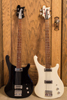
Jeffrey, I have heard of the headless Yamaha basses. They are very rare and seldom show up on eBay. The few reviews on Harmony Central tend to rate them highly. Another bass that is extremely highly rated by owners is the Schecter Stiletto, but it isn't a headless design. It is actually a descendent of the NS Spector bass that Ned Steinberger designed before the stick bass. It has one improvement, the S-Tek bridge that is individualized for each string, so there is less string interaction. The Elite and Studio versions have multi-piece thru-neck design, Deluxe and Custom are bolt-on. In a way they are comparable to the Euro Spectors, but without graphite neck reinforcement. I have only seen one negative review, and that's probably because the idiot had a weak battery in his bass and didn't know it. The sound goes ****** in a Euro Spector with Aguilar OBP-1 preamp before the battery completely dies (to warn you to change the battery before complete shutdown), and the active circuitry is turned on in a Spector or Schecter as long as the cord is plugged into the jack. I once got a nice Olympus OM-2 camera body for $56 delivered off of eBay because the idiot thought the shutter was frozen and mirror hung up. Olympus designed the mirror lockup feature into the OM-2 to prevent owners from taking pictures with a weak battery and ruining countless photos before discovering the low battery. I popped in 2 new batteries and had a classic vintage camera body worth around $200 in a photo shop. Only a vintage Olympus OM camera freak like myself would likely know that. You would think that the owner would use the battery test button now and then. His ignorance was my gain. Same way with a Schecter and Spector bass. Those complaining of bad sound might only have a weak battery (no battery test function is included, as the owner is supposed to KNOW such a simple fact). Time to move in for the bargain of a lifetime! I paid $437 out the door for my Spector ReBop, and it was in new mint condition without even the tuner key plastic scratch protectors being removed. Regular discount price was $899 for a new one. It's my main bass now, and it's a giant killer.
Wasn't that bridge called a 2Tek, that was used on some versions of the Hamer Cruiser bass? Too bad the company went under as the bridge never really caught on.
I'm still waiting for RIC to produce the improved bridge to replace to older 4001 design. Given that JH is a designer by profession, I hope it solves the standard issues with the bridge.
I'm still waiting for RIC to produce the improved bridge to replace to older 4001 design. Given that JH is a designer by profession, I hope it solves the standard issues with the bridge.
The 2 Tek bridges were designed by a Boeing engineer, they were stainless steel and quite a few people swore by them. The biggest drawback was the weight and the fact that you had to remove a large portion of the bass to install it. I've had two basses with the larger 2 Tek bridge and they sounded great.
Jeffrey, my findings are that the major design elements of several brands need to be combined. You can get elements of the Spector/Steinberger and Rickenbacker 4004 bridge combined in the cheap Chinese basses of OLP, Rogue, and Jay Turser (same bridge is used by all those brands on certain models). It also offers the option of thru-body stringing if the body is drilled for it. It does NOT lock all saddles together like on the Spector/Steinberger, but offers easy individual intonation like a 4004 bridge. The S-Tek bridge is interesting, but I would think that a different sized assembly for each string, maybe even differing materials for each assembly, would offer the ultimate performance. Steinberger thought all saddles should be locked together, and the S-Tek separates each saddle completely. Who is to say which is right? Why not allow bridge options on a bass? A lever operated assembly that raises and lowers string dampers into position would also be appreciated on a new hi-tech bridge.
Bass and guitar manufacturers have still yet to offer dual section truss rods that adjust upper and lower neck sections independently for more exact neck relief as the wood ages. The guy I talked to at Spector was rather interested in that idea. It would combat the s-curve neck that plagues many basses, because you can dial in a reverse s-curve to the truss rod. It only takes 2 short dual action truss rods butted end to end to accomplish the task. It is so obvious that I doubt it is patentable. Dual action truss rods that adjust from either end of the neck have been around for decades. Nobody every thought to cut the rod length in half and combine them! At least I've never seen it done. If I were building basses and guitars it would be the first design improvement I made.
Bass and guitar manufacturers have still yet to offer dual section truss rods that adjust upper and lower neck sections independently for more exact neck relief as the wood ages. The guy I talked to at Spector was rather interested in that idea. It would combat the s-curve neck that plagues many basses, because you can dial in a reverse s-curve to the truss rod. It only takes 2 short dual action truss rods butted end to end to accomplish the task. It is so obvious that I doubt it is patentable. Dual action truss rods that adjust from either end of the neck have been around for decades. Nobody every thought to cut the rod length in half and combine them! At least I've never seen it done. If I were building basses and guitars it would be the first design improvement I made.