
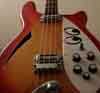
I've been attempting to recapture a bit of my past and have decided to start looking for a 4001 or 4003 to keep my 4005 company. I am thinking about a Seventies-era model because the fellow who first taught me how to play (in the 70's) had a Fireglo 4001—which I assume was also from that era. There are so many different, nice models out there that I don't know what to chase. I also want to consider cost. My beloved 4005 is so valuable now that I am afraid to take it out gigging. I went so far as to buy a cheap $200 bass for that specific purpose. I'd like to have a Rickenbacker that I won't feel quite so paranoid taking out to play.
I've searched though this site's posts and all over the web and get all sorts of conflicting responses concerning primary differences between the basic 4001 and 4003. The best I can figure out is that the 4003's pickups are hotter and that the neck got a bit thicker. I know at one point the neck pickup on 4001's moved half an inch south. That's about it.
If I may be so bold, I would like to impose on the collective RickResource wisdom to answer two questions:
1 - What are the significant differences between a 4001 and a 4003, barring color and instrument variations as a result of Rickenbacker production variances.
2 - Which year(s) 4001/3 do you prefer and, more important, why?
Many thanks in advance.
d
4001 vs. 4003: The definitive comparison
Moderators: rickenbrother, ajish4
Re: 4001 vs. 4003: The definitive comparison
Don't be!danomar wrote:...My beloved 4005 is so valuable now that I am afraid to take it out gigging.

Re: 4001 vs. 4003: The definitive comparison
In that case get a recent or new 4003.danomar wrote:...I'd like to have a Rickenbacker that I won't feel quite so paranoid taking out to play.

Re: 4001 vs. 4003: The definitive comparison
I have both, and both have their pluses and minuses.
Differences:
1. Both have high gain pickups - the 70s 4001 has both pups at about 8.5 - 8.7k - 90s and newer 4003 has 11.4k pups. The lower windings are clearer tonally. The higher windings can really growl but, to me, tend to sound confused on the lower E string.
2. Truss Rods - the 4001 basses have the old folded rod truss system that works by pushing the unthreaded rod against the metal plate across both rods. Each of the two rods are folded in half. Adjusting flexes one of the pair of folded rod to work against the other and the neck woods to work. To adjust, you HAVE to loosen, move and hold the neck where you want it, and then tighten and check the results. The 4003 has the new rods that are each a single rod that is nutted at the body end and with a plate holding both rods at the head end. You adjust the rods with the wrench and do not have to move the neck manually to the intended place.
3. Three pieces of wood for the 4001 neck - has the Shedua stripe between two pieces of maple. The 4003 is one piece of maple.
4. Electronics - the 70s 4001 basses have 250k pots for volume and 500k pots for tone. Makes the bass a little brighter. The 4003 basses began with 250k pots all around (tad darker sound) and now have 250k volume and the bass pup has 330k tone pot and the treble pup has the 500k tone switch pot. You can move from the 4001-type brighter sound to the 4003 fuller tone.
5. Neck dimensions - most 70s 4001 basses have a slimmer neck profile similiar to the 4005 you have. The 4003 basses went through a bit of changes - early 80s have bigger profile necks, late 80s/early 90s have a slim neck, then later 90s up to 2006 have fatter necks again. Sometime in 2006 RIC moved back to the slimmer neck profile, but are still turning out both profiles while stock gets used up.
This is just off the top of my head, there is probably more differences and hopefully someone will add.
Differences:
1. Both have high gain pickups - the 70s 4001 has both pups at about 8.5 - 8.7k - 90s and newer 4003 has 11.4k pups. The lower windings are clearer tonally. The higher windings can really growl but, to me, tend to sound confused on the lower E string.
2. Truss Rods - the 4001 basses have the old folded rod truss system that works by pushing the unthreaded rod against the metal plate across both rods. Each of the two rods are folded in half. Adjusting flexes one of the pair of folded rod to work against the other and the neck woods to work. To adjust, you HAVE to loosen, move and hold the neck where you want it, and then tighten and check the results. The 4003 has the new rods that are each a single rod that is nutted at the body end and with a plate holding both rods at the head end. You adjust the rods with the wrench and do not have to move the neck manually to the intended place.
3. Three pieces of wood for the 4001 neck - has the Shedua stripe between two pieces of maple. The 4003 is one piece of maple.
4. Electronics - the 70s 4001 basses have 250k pots for volume and 500k pots for tone. Makes the bass a little brighter. The 4003 basses began with 250k pots all around (tad darker sound) and now have 250k volume and the bass pup has 330k tone pot and the treble pup has the 500k tone switch pot. You can move from the 4001-type brighter sound to the 4003 fuller tone.
5. Neck dimensions - most 70s 4001 basses have a slimmer neck profile similiar to the 4005 you have. The 4003 basses went through a bit of changes - early 80s have bigger profile necks, late 80s/early 90s have a slim neck, then later 90s up to 2006 have fatter necks again. Sometime in 2006 RIC moved back to the slimmer neck profile, but are still turning out both profiles while stock gets used up.
This is just off the top of my head, there is probably more differences and hopefully someone will add.
Re: 4001 vs. 4003: The definitive comparison
The problem with the question is that there is no 4003. That is the model has morphed considerably over time. The first ones were little more than 4001s with the truss rod adjusters at the body end of the neck. They even have the old style rods. There were several variations of the basic rectangular 4001 neck slab in the early 4003s. Some had a three piece neck with a maple stripe in place of the shedua found in the 4001. Later, the slab was only two piece. Up to this point there is not much of a difference between a 4001 and a 4003. Then around '84 the neck became one piece and with the new truss system in about August of '84 the slab became tapered slightly. The truss rod adjusters stayed at the body end untl late '85 or early '86. The pickups grew slightly hotter over the transition and continued to get hotter into the 90's. There were other small refinements that made the instrument better but the neck and the pickups are at the core of the evolution. When they started CNC production things fit together better in the area of the tailpiece.
-
jwr2
Re: 4001 vs. 4003: The definitive comparison
70s 4001 basses are good gigging basses. I prefer them rewired with all 250k ohm pots and the .0047 capacitor removed and with the original bridge 8k ohm high gain and a neck 6.7k ohm toaster.
60s 4001 basses are rare and very expensive. They have a weaker neck and weak pickups. I prefer a 60s 4001 with the capacitor removed and the original pots intact and 2 4003 11k ohm high gains.
The modern 4003 was established about 1986. The 1986 thru 1989 basses are excellent basses. Some of the pickups from this era were wound to more than the 11k ohm standard for the 4003. Some of the toasters were also overwound. These basses have the modern truss rods. There were some nice colors and options from this era. 4001/4003 basses came stock with 250k ohm volume pots and 500k ohm tone pots from the 60s thru 1989.
1990 thru 1996 4003 basses have all 250k ohm pots. They also have the fatter body wings and shorter headstocks. Fireglos from this era look nice. These basses are warmer sounding than 80s 4003 basses.
1997 to 2005 4003 basses have the 60s shaped headstock and body wings. These basses resonate better than the early 90s models. I like basses from this era a lot.
2006 to now walnut hadwings made a come back and the vintage tone selector made an appearance and the 330 tone pots made an appearance. walnut headwings are too cool.
60s 4001 basses are rare and very expensive. They have a weaker neck and weak pickups. I prefer a 60s 4001 with the capacitor removed and the original pots intact and 2 4003 11k ohm high gains.
The modern 4003 was established about 1986. The 1986 thru 1989 basses are excellent basses. Some of the pickups from this era were wound to more than the 11k ohm standard for the 4003. Some of the toasters were also overwound. These basses have the modern truss rods. There were some nice colors and options from this era. 4001/4003 basses came stock with 250k ohm volume pots and 500k ohm tone pots from the 60s thru 1989.
1990 thru 1996 4003 basses have all 250k ohm pots. They also have the fatter body wings and shorter headstocks. Fireglos from this era look nice. These basses are warmer sounding than 80s 4003 basses.
1997 to 2005 4003 basses have the 60s shaped headstock and body wings. These basses resonate better than the early 90s models. I like basses from this era a lot.
2006 to now walnut hadwings made a come back and the vintage tone selector made an appearance and the 330 tone pots made an appearance. walnut headwings are too cool.
-
gray
Re: 4001 vs. 4003: The definitive comparison
I myself prefer 70's 4001's, although as much for the slim neck as for the sound. I haven't tried out any of the (mentioned in this thread) hot-rodding yet, although I'm planning on it, as soon as I can scratch up some cash for another one, and that way keep one stock and hot-rod the other.
I adore the sound of the modern 4003's. They are fantastic basses. I just don't do as well with the necks, at least as main gigging basses. But it's different strokes for different folks; the best thing to do is to play as many as you possibly can and go with whichever feels the most natural.
I adore the sound of the modern 4003's. They are fantastic basses. I just don't do as well with the necks, at least as main gigging basses. But it's different strokes for different folks; the best thing to do is to play as many as you possibly can and go with whichever feels the most natural.
Re: 4001 vs. 4003: The definitive comparison
Robert, you coming to RIO!!! 
-
bob_atherton

- Intermediate Member
- Posts: 1441
- Joined: Thu Jan 06, 2005 4:47 am
Re: 4001 vs. 4003: The definitive comparison
How about a 4000? It's my favorite gigging bass.
We played last night and one of the numbers is Blowin' Free by Wishbone Ash, the bass comes in with a thundering, growling line, very John Entwistle esq, the guitarist came over and said in my ear "has a plane just landed on this stage?"
We played last night and one of the numbers is Blowin' Free by Wishbone Ash, the bass comes in with a thundering, growling line, very John Entwistle esq, the guitarist came over and said in my ear "has a plane just landed on this stage?"
Re: 4001 vs. 4003: The definitive comparison
Thanks for all the input thus far. It helps quite a bit. Specific year preferences are very useful.
What about the triangular fretboard markers? When did they go from being completely across the board to only partially covering it?
d
What about the triangular fretboard markers? When did they go from being completely across the board to only partially covering it?
d
Re: 4001 vs. 4003: The definitive comparison
1973 was the transition year from the full width inlays to the current factor.danomar wrote:Thanks for all the input thus far. It helps quite a bit. Specific year preferences are very useful.
What about the triangular fretboard markers? When did they go from being completely across the board to only partially covering it?
d
Re: 4001 vs. 4003: The definitive comparison
Mid '73 as my March '73 4001 has FW inlays and my July '73 4001 does not.danomar wrote:What about the triangular fretboard markers? When did they go from being completely across the board to only partially covering it?
d