
Jeff, I quit building my own gear unless it wasn't available commercially. Then I try to get used gear and modify it if the parts and work isn't too extensive. The AVT20B project came about because tube emulating bass PRACTICE amps were almost nonexistent, or too big, loud, and expensive (Roland DB series, Peavey BAM), or unsuitable for guitar as well. I am thinking of restringing my 4004L B-E-A-D, then I will need cabs that go DEEP.
In spite of Bose's claim of portability, It's a 3-section beanpole/stand with 1 or 2 bass pods. Is this REALLY an improvement over simply hauling in a Roland DB500 or other such combo bass amp in a single trip? Guitar and bass players need somewhat different preamp sections, and has this been addressed, or does Bose expect you to run through input devices to adapt to your instrument? Bose is notorious for building something that LOOKS different then using voodoo advertising claims and "bought reviews" to sell to gullible ignoramuses. Their original 901 speaker was a box with 9 little wideband speakers installed and an active equalizer that boosted the highs and lows to try to achieve linear response. There was not one original idea in the whole mess, other than a MARKETING SCHEME that married several different pre-existing devices together. The direct/reflecting speaker idea had been utilized years before (and done better) by Quad, KLH, and any other electrostatic loudspeaker that came before the 901, but the average gullible dude at any of the various Bose 901 factory demonstrations usually knew nothing of the Bose's better competitors. The Dahlquist DQ10 is another speaker of that 901 era that I would have rather owned, as it had an open-backed midrange driver for the direct/reflected sound. Dr. Amar Bose was a master of BS more than anything else, and gave new meaning to the phrase "piled higher and deeper". I see that Bose has not changed their marketing strategy one iota: "find something different that we can claim to have invented, advertise the living daylights out of it, and the ignoramuses will line up to buy it. When the jig is up, we'll move on to our next BS project." The line source speaker is a great idea that needed more exposure, but for bass the column needs deeper extension than Bose has given it. Bass players, and to a lesser extent guitarists, are getting the crumbs of a design that was geared toward vocalists and acoustic instrumentalists. Throwing in a bass pod does nothing to maintain the line source idea across the full bass spectrum, and tears apart the music at the crossover region. They should at least have made it where the beanpole mounted directly to the bass pods like all hybrid electrostatic/dynamic audiophile speakers have done. When you make the crossover as high in frequency as Bose has obviously done, you CAN hear that the pod and beanpole have been separated unless they are placed very closely together. A couple of 6.5" woofers will NOT play a venue of more than a very small size without being overloaded. Many 6.5" woofers should have been mounted in a separate column that's as tall as the mid/tweeter column and mountable together, like Magneplanar had already done in their tall panel speakers. Infinity is a company that had already done this with dynamic drivers in their IRS speaker system years ago. Bose has once again "reinvented the wheel". The older guys like me and Bob have seen this happen before, so you younger guys should hold on to your money. The line source idea is good, but somebody other than Bose will give you a better piece of equipment for your money, as usual. Just give it some time.
Bose vs. Ampeg vs. Marshall vs. Fender
Moderators: rickenbrother, ajish4

-
jwr2
I have been building cabs since the early 80's ... the design takes elements from fender, acoustic, and me ... by chance they are similar to some Trace Elliott cabs ... they are within a couple inches of the same dimensions ... I use Carvin, eminance, and madison speakers ... I have 1x18, 1x15, and 2x10 cabs ... I designed about 50 cabs with a cad program ... but I only built 10 or so ... I enjoy the wood working thing ... they are good midrange componets ... I don't need top end stuff because I mike it into a top end pa system ... I use 3/4" plywood, and put 2x2 in each corner ... I get a lot of hardware from www.partsexpress.com
it makes for a scaleable bass rig ... I can go from one head and one cab to two heads and four cabs ... I can run one head as a power amp slave to the other ... so the front dials of one control both ... or when I play in 2 bands I have one rig at each rehersal space and one at home ...
it makes for a scaleable bass rig ... I can go from one head and one cab to two heads and four cabs ... I can run one head as a power amp slave to the other ... so the front dials of one control both ... or when I play in 2 bands I have one rig at each rehersal space and one at home ...
Thanks for the info. After looking closer I see your cabinets are likely a little larger than the Trace cabinets judging by the distance between the ports and speakers. They are remarkably similar in design none the less.
I have 5 complete bass rigs, speaking of scalablity, but really only use my Trace with or without both cabinets now. For lower volume work I take my GK MB150E.
Here's a Trace 1153:

I have 5 complete bass rigs, speaking of scalablity, but really only use my Trace with or without both cabinets now. For lower volume work I take my GK MB150E.
Here's a Trace 1153:
Jeff, bass reflex and acoustic suspension bass cab designs don't interest me much, as I can usually pick them up used for less than I could build them. Some designs that are rare that are worth experimenting with are the transmission line design as used by Euphonic Audio and Bud Fried. There is the decoupled anti-resonant line technology as used in the old JM Lab Daline series. JM Lab holds the patent, so nobody else has tried it, but it works and is very efficient. I had a pair of Daline 3.1 speakers, and the bass they got down to 30 Hz from a tiny 5" woofer was phenomenal. The Nestorovic bass alignment used in Nestorovic and Vandersteen speakers has never been used by a bass cab manufacturer either. Nobody has ever made a huge bass panel speaker like a Magneplanar either. I was over at the Sound Lab website, and they now have electrostatic panel speakers that go lower (24 Hz) with more efficiency (90 dB) than my Vandersteen dynamic speakers!
It's very clear to me that most bass cab manufacturers are lagging WAY behind in technology compared to other loudspeaker manufacturers. Maybe Acme, Euphonic Audio, and Phil Jones Bass are starting a trend toward catching up. I installed a Scan-Speak aperiodic flow vent in my Marshall AVT20 speaker cab, and it made a noticeable difference. You would think other manufacturers would have tried it as well.
It's very clear to me that most bass cab manufacturers are lagging WAY behind in technology compared to other loudspeaker manufacturers. Maybe Acme, Euphonic Audio, and Phil Jones Bass are starting a trend toward catching up. I installed a Scan-Speak aperiodic flow vent in my Marshall AVT20 speaker cab, and it made a noticeable difference. You would think other manufacturers would have tried it as well.
-
squirebass
- Veteran RRF member
- Posts: 1579
- Joined: Fri Oct 13, 2000 11:05 pm
-
squirebass
- Veteran RRF member
- Posts: 1579
- Joined: Fri Oct 13, 2000 11:05 pm
-
squirebass
- Veteran RRF member
- Posts: 1579
- Joined: Fri Oct 13, 2000 11:05 pm
-
jwr2
Yep ... the b3 is kind of interesting ... the drive knob adds mids, dirtortion, and of course drive ... it works good with the 15's ...
hey here's a pic of my 3rd bass rig ...

Also note our in-ear monitor system box ... this is cool ... there are 5 seperate volume controls ... this keeps down the stage volume and eliminates stage monitors, and mike feedback
hey here's a pic of my 3rd bass rig ...
Also note our in-ear monitor system box ... this is cool ... there are 5 seperate volume controls ... this keeps down the stage volume and eliminates stage monitors, and mike feedback
-
squirebass
- Veteran RRF member
- Posts: 1579
- Joined: Fri Oct 13, 2000 11:05 pm
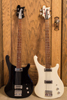
I have a Portabass 250 which I like very much; it is nice and compact and fairly lightweight, though not nearly so as my Walter Woods amp. They make up for the weight of my Sunn Sorado 2-15 cabinet when I take that to a gig. Usually though, I take either my SWR Bass Monitor 12 or a custom made cabinet with an EV 10BX driver in it. The whole rig is very easy to move around and packs a decent punch also. Each of those cabinets weigh around 34 lbs.
Bob, you might want to consider installing the Scan-Speak resistive flow vents into some of your small bass combos, if you have any. It's sort of a cross between a ported cabinet and an acoustic suspension cabinet when you install them, but a partially depressurized acoustic suspension cabinet is how I view it. Almost all acoustic suspension bass cabs are undersized for portability, but it raises the system Q and causes a hump in the midbass while reducing the deepest bass. Basically it's like adding up to 33% more cabinet volume when you do the Scan-Speak vent mod right, without introducing the loose, flabby sound of a ported system. Each Scan-Speak vent costs $7.00 from Parts Express, and you would need one for each 10" driver in your cab, and I would use two for each 15" driver. You should use acoustic suspension speakers in your cabinets for best results with these vents, but I used an Eminence Legend B102 which is usually used in a ported cab with mine, and the two units got along well together. The bass response is smoother in the midbass region and more extended in the lows after adding the vent in the AVT20. Technically speaking, it lowers the system Q of the loudspeaker. Cutting a circular hole in the cabinet was the hardest part of the mod, then I glued the vent in place with Sportsman's Goop. Cheap and easy mod.