
Hello again folks.
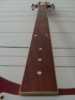
I've had this bass for almost 31 years and today, while giving it some attention, I noticed this crack in the 12th fret inlay. I know it wasn't there 30 years ago and that it probably made its appearance in the last year. The crack doesn't quite cross the entire inlay and there is no sign of impact over the inlay, adjacent fingerboard, or neck. Any ideas on what is happening?
I'll e-mail a much larger image of this if anyone in interested. The small image here is due to me not knowing if larger images are supported.
Thanks in advance for any info that is forwarded.
Cracked Inlay on '74 4001 - What the...
Moderator: jingle_jangle
-
dr_wahnsinn
- Junior Member
- Posts: 131
- Joined: Tue Apr 19, 2005 6:02 pm

Re: Cracked Inlay on '74 4001 - What the...
Hmmm ... plastic usually doesn't crack unless it is stressed. Has the action changed on the instrument?
It is better, of course, to know useless things than to know nothing. - Seneca
-
dr_wahnsinn
- Junior Member
- Posts: 131
- Joined: Tue Apr 19, 2005 6:02 pm
Re: Cracked Inlay on '74 4001 - What the...
Thanks for the reply.
I haven't changed the strings, action, or tuning for a few years. The action appears to be just as it has been and the slightly concave bow to the neck also appears not to have changed.
Have you ever seen another cracked inlay? Any opinions on whether it requires treatment at this time?
I haven't changed the strings, action, or tuning for a few years. The action appears to be just as it has been and the slightly concave bow to the neck also appears not to have changed.
Have you ever seen another cracked inlay? Any opinions on whether it requires treatment at this time?
Re: Cracked Inlay on '74 4001 - What the...
I think that I have seen cracks similar to that on some eBay instruments, but I don't think that any of mine have it.
Hopefully one of the real luthiers will comment shortly.
Hopefully one of the real luthiers will comment shortly.
It is better, of course, to know useless things than to know nothing. - Seneca
-
jingle_jangle

- RRF Moderator
- Posts: 22679
- Joined: Wed Dec 22, 2004 6:00 am
- Contact:
Re: Cracked Inlay on '74 4001 - What the...
Hi, Jocelyn! Looks like you've completed your relocation, and it's good to see you hanging out here again.
This is unreinforced polyester resin. It does crack occasionally--I've seen a dozen instances or so in the last three years.
It's a situation in which an unreinforced, somewhat brittle material in a thin section (the resin) is stressed by a ductile material with a different index of expansion and contraction (wood), gets squeezed and stretched beyond is capacity to absorb this type of shock. Usually, what you'll see is a separation of the inlay from the recess, evidenced by a hairline crack on one or all sides. This happens a lot less with this (routed) style of inlay than in the poured-resin full-width ones, but still it does happen. (The newest inlays will not experience this problem--they are made of a much stronger material than the old.)
The only remedy is to re-rout out the old inlay (not for the faint of heart) and match the new one exactly to the remainder of the old ones--very tricky, involving just the right amount of pearl and occasionally a bit of amber dye to duplicate the aged effect.
This is unreinforced polyester resin. It does crack occasionally--I've seen a dozen instances or so in the last three years.
It's a situation in which an unreinforced, somewhat brittle material in a thin section (the resin) is stressed by a ductile material with a different index of expansion and contraction (wood), gets squeezed and stretched beyond is capacity to absorb this type of shock. Usually, what you'll see is a separation of the inlay from the recess, evidenced by a hairline crack on one or all sides. This happens a lot less with this (routed) style of inlay than in the poured-resin full-width ones, but still it does happen. (The newest inlays will not experience this problem--they are made of a much stronger material than the old.)
The only remedy is to re-rout out the old inlay (not for the faint of heart) and match the new one exactly to the remainder of the old ones--very tricky, involving just the right amount of pearl and occasionally a bit of amber dye to duplicate the aged effect.
Re: Cracked Inlay on '74 4001 - What the...
My BG 73 4001 that I just received has practically the same crack on the same fret!
-
dr_wahnsinn
- Junior Member
- Posts: 131
- Joined: Tue Apr 19, 2005 6:02 pm
Re: Cracked Inlay on '74 4001 - What the...
Paul, thank you very much for your very imformative post. Am I correct in thinking that, unless additional cracks appear and/or inlays pieces begin to loosen, it isn't imperative that I have this repaired?
Yes, I did complete my move, but I have to say that I haven't quite settled in yet. It's been problem after problem since moving back here and I've been a bit behind on acutally living. I left so many e-mails unanswered, that I'll probably never receive a reply when I do get around to responding. Anyway, I'll try to post here a bit more. Thanks for the welcome back.
So, Wints, how about showing a photo of your, er… crack? (The inlay, man, the inlay.)
Yes, I did complete my move, but I have to say that I haven't quite settled in yet. It's been problem after problem since moving back here and I've been a bit behind on acutally living. I left so many e-mails unanswered, that I'll probably never receive a reply when I do get around to responding. Anyway, I'll try to post here a bit more. Thanks for the welcome back.
So, Wints, how about showing a photo of your, er… crack? (The inlay, man, the inlay.)
-
jingle_jangle
- RRF Moderator
- Posts: 22679
- Joined: Wed Dec 22, 2004 6:00 am
- Contact:
Re: Cracked Inlay on '74 4001 - What the...
I've never seen one actually loosen enough to fall out, Jocelyn.
Re: Cracked Inlay on '74 4001 - What the...
To be correct, it's coefficient, not index.jingle_jangle wrote:... index of expansion and contraction ...
A belated welcome back, Jocelyn ... I didn't realize that you haven't been around for a while!

It is better, of course, to know useless things than to know nothing. - Seneca
-
jingle_jangle
- RRF Moderator
- Posts: 22679
- Joined: Wed Dec 22, 2004 6:00 am
- Contact:
Re: Cracked Inlay on '74 4001 - What the...
Thank you for your correction, Doctor. I seem to be promoting Seneca. 
Re: Cracked Inlay on '74 4001 - What the...
Well Dr J....seeing as you asked....So, Wints, how about showing a photo of your, er… crack? (The inlay, man, the inlay.)

-
rickaddict
- Senior Member
- Posts: 6163
- Joined: Mon Mar 29, 2004 7:46 am
Re: Cracked Inlay on '74 4001 - What the...
I have a '76 4001FG in otherwise beautiful condition that has 5 out of 8 inlays cracked. That's the way it came to me and the inlays are very stable. It came from the original owner in Saskatchewan so I just assumed it was subjected to some extreme temps/drastic temp change.
As Paul said different materials have different expansion/contraction rates with regard to temperature changes.
And you moved recently? Maybe the inlay got cracked in one of the temperature changes related to your move.
As Paul said different materials have different expansion/contraction rates with regard to temperature changes.
And you moved recently? Maybe the inlay got cracked in one of the temperature changes related to your move.
-
dr_wahnsinn
- Junior Member
- Posts: 131
- Joined: Tue Apr 19, 2005 6:02 pm
Re: Cracked Inlay on '74 4001 - What the...
Paul, Thanks again for your help.
Thanks to DoctorWho for the welcome back!
Wints, thanks for the photo. The crack on your '73 is very similar to the one on mine, but the inlays on yours are nicer.
Rickaddict, I did move recently but the '74 4001 was the first to come out of storage (climate controlled) and I'll swear that I didn't notice that crack upon the first inspection after taking it out of the box. The journey up was cold but my instruments shouldn't have been exposed to temperatures any colder than any other instrument being shipped in the winter to the northeast U.S. or Canada. Still, it's the most plausible explanation.
As long as the injury is purely cosmetic, I'll have no problem enjoying this bass for the remainder of my life. It's been a great bass.
Thanks to DoctorWho for the welcome back!
Wints, thanks for the photo. The crack on your '73 is very similar to the one on mine, but the inlays on yours are nicer.
Rickaddict, I did move recently but the '74 4001 was the first to come out of storage (climate controlled) and I'll swear that I didn't notice that crack upon the first inspection after taking it out of the box. The journey up was cold but my instruments shouldn't have been exposed to temperatures any colder than any other instrument being shipped in the winter to the northeast U.S. or Canada. Still, it's the most plausible explanation.
As long as the injury is purely cosmetic, I'll have no problem enjoying this bass for the remainder of my life. It's been a great bass.

Re: Cracked Inlay on '74 4001 - What the...
Polyester resin (which I believe is the main ingredient in the inlays) often has a shrinkage rate of up to 7%-8% of it's original cast size. The vast majority of this shrinking happens as it originally hardens from liquid to a solid form, but there is sometimes a bit more shrinkage as it ages. There are hundreds of different resin foumulas for polyester and they don't all react the same (some even contain additives which expand as it cures to offset the shrinkage of the resin their mixed into) but it's quite possible that the cracks in these inlays are simply caused by shrinkage, rather than any type of temperature, humidity or other environmental issues. They could shrink and pull away at the edges, delaminate from the base coat or simply crack if that spot happens for some reason to be the weakest point. Nearly all polyester resins (especially the clear, casting variety) are also pretty brittle. When you make a product like a fiberglas boat or ski which has to flex from polyester resin, you have to carefully control the mixture of resin to reinforcing fibers, with maximun fiber content and minimum resin content or it will turn out weak and brittle and simply break. The "monkey dust" that's mixed into resin for a fingerboard inlay and gives it that pearly look adds no real strength or reinforcement at all, so the resin is on it's own. If it shrinks a bit, post-cure, it either has to pull away from the base or split. The sheer strength of the bond between the resin and the base material (bubinga covered with grey paint or similar) is not going to be strong enough to stop this from happening. We see post-cure shrinkage all the time in the boat industry, most notably where polyester/fiberglass bulkheads are installed cross-wise (athwartships for you nauti-types) in a fiberglass hull. The boat may be perfectly smooth and fair when built and sold, yet several years later, you may see creases forming on the outside of the hull where the bulkheads are shrinking and forming visible depressions as they pull the hull inward. They're so common that they have a name - "suck lines".
I don't know for certain that shrinkage is the problem on these inlays, but after 40 years of working with resins and fiberglass, I think it's much more likely as a cause than anything that the guitar's owners had anything to do with in terms of care, storage, etc. The cracks could likely be filled if you could match the pearly look, but considering how much work it would be to do so, clean them up and then fix the CV topcoat, it would probably be a much better bet to have one of our resident luthiers replace them properly.
I don't know for certain that shrinkage is the problem on these inlays, but after 40 years of working with resins and fiberglass, I think it's much more likely as a cause than anything that the guitar's owners had anything to do with in terms of care, storage, etc. The cracks could likely be filled if you could match the pearly look, but considering how much work it would be to do so, clean them up and then fix the CV topcoat, it would probably be a much better bet to have one of our resident luthiers replace them properly.