First off, let me apologise if this query has been answered by you previously. I really did do a search of this section using several combinations of keywords, but couldn't find anything that fits my problem.
I have a 2004 4003 JetGlo. A couple of years back, I had the misguided urge to move the rear strap button several inches up the side of the body (don't ask about the reasoning behind this decision: suffice to say that it didn't have the desired effect). Ever since, my bass has had a small screw hole. Owing to its position, most people don't know it's there, but I do, and it bugs me.
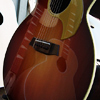
Here's the damage (apologies for the ****** mobile phone picture)
Could you recommend a method of filling the hole and painting/finishing it to match the JetGlo again? BTW: In case you're going to recommend the use of Scratch-X or Zymol, I must tell you that I live in the UK, and I've never heard of these products. I wonder what the nearest equivalent British/European products would be?
Many thanks,
Ken
2004 4003 JetGlo
Epiphone Jack Casady
Ovation Magnum 1
Mania VTB-4BS
Dean Stylist w/ John Birch Magnum II pups
Yamaha BB414
Trace Elliot VA350/GP11 Mk1
Peavey TB-Raxx
2 BFM Omni 10.5 crossfire cabs
Roland Bass Cube 100
Halfords it is, then: time my baby had a good seeing-to!
P.S.: "Fixing a hole..." Rather an apt song title, what?
2004 4003 JetGlo
Epiphone Jack Casady
Ovation Magnum 1
Mania VTB-4BS
Dean Stylist w/ John Birch Magnum II pups
Yamaha BB414
Trace Elliot VA350/GP11 Mk1
Peavey TB-Raxx
2 BFM Omni 10.5 crossfire cabs
Roland Bass Cube 100
An easy way to fill a screw hole is to use a toothpick and wood glue. if the hole is so small tthe toothpick won't fit down into it, you may have to drill the hole slightly larger. You want the toothpick to just fit. Put some yellow wood glue in the hole, and insert the toothpick. When dry, the excess toothpick can be cut off with a pair of diagonal clippers, then the area sanded flush. It's now ready for refinishing.
I've used this method to repair stripped out screwholes. Once filled, a new pilot hole can be drilled for the screw.
The toothpick method is an old standby if you're miles from nowhere.
But, there's more than one way to skin a cat. My method is (of course) a bit more involved but yields a permanent repair, and I've used it hundreds of times now.
First off, toothpicks have two issues. They are tiny--small enough to fill a #4 screw hole--maybe. If the hole is enlarged or stripped out, or from a larger-sized screw, a toothpick will be a very loose fit. Second, toothpicks are made of birch wood, which is a soft wood as far as hardwoods go, and definitely a lot softer than the maple most Ricks are fashioned from. Any carpenter or cabinetmaker will tell you that the weakest place to drive a wood screw is into the end grain of soft wood. So driving a screw into the end-grain of a bit of skinny birch surrounded by air and soft vinyl glue will only serve to give you a weak joint. About the best you can hope for is that the screw will push the toothpick to one side and wedge it there, where it will get tighter as the screw is driven fully into the hole.
Next wood glue (the vinyl emulsion [VE] type like Elmer's, which is white in color in the bottle, or aliphatic resin [AR] type like Titebond, which is yellowish in the bottle) are great for laminating and joining larger wood surfaces, especially when clamped so that the glue film itself is only a thousandth or less, thin. But use it to fill a hole (which is what you're doing every time you shove a tiny toothpick into a bigger hole with glue taking up the slack) and you have little strength and a false sense of security.
You need to address both of these issues when filling holes. It might not matter if it's just a pickguard hole, but if you're re-setting a bass bridge or doing anything structural like fixing a stripped tuner hole, or re-setting an acoustic pin bridge, you want the most strength possible.
OK, here we go...Most dowel rod that you can buy at places like Ace Hardware and Home Depot are the same soft wood as toothpicks--birch. I start with 1/4" diameter maple dowel rod, available from Woodworker's Supply, Inc. It's nice and hard, much closer-grained than birch, and (after all) the same stuff most Ricks are made from. I do not use a water-based glue for this sort of repair. Although I am not a big fan of CA glue (superglue) for guitar repairs, there are a few exceptions, and this happens to be one of them.
Wish I'd taken pictures the last time I'd done this, but here's the verbal description. Follow the bouncing ball, folks:
Cut the dowel into short lengths (4" is about right). If you have eight holes to fill, cut four lengths, etc. You will use both ends of the dowel.
Next, you can sharpen the dowel like a pencil in an electric pencil sharpener. (Don't push it too hard--it will cut slowly, as pencils are made of very soft cedar--that's why pencil shavings smell soooo good.) Put a nice point on each end of the dowel. You can also practice your whittling skills with a penknife instead of using the pencil sharpener. Just get a nice point on the end--it doesn't have to be Swiss precision.
Next, cut the dowel in half again, so you have a 2" piece with a stumpy end and a sharpened end. Apply some gap filling super glue onto the point, insert it into the hole, and push it into place. Before the glue has a chance to grab, drive it into place firmly with a few taps of a hammer. It will wedge into place, pushing the wood fibers of the guitar out of place and filling the hole absolutely solid. After five minutes or so, the glue will have set and the remaining dowel can be cut off using a very sharp side-cutter. I grind one set of side cutters so that the cutting edge is flush with the jaw face. This improves bite and minimizes finish sanding.
As they say, "Presto". Now you can re-drill the hole, drive in a screw and it will hold as good as new.
Paul, thank you for taking the time to give such a clear and comprehensive reply! I'm going to copy the entire answer and keep it in a text file so I'll always have it to hand.
However, as this particular hole was a stupid mistake to begin with and I'm never going to use it again - indeed, I would very much like it to disappear without trace, I also need to ask...
admin wrote:Paul: Perhaps just a follow-up to the original question.
How would you then refinish the area that you have patched on the Jetglo finished instrument?
...what Mr. MacCormack said.
2004 4003 JetGlo
Epiphone Jack Casady
Ovation Magnum 1
Mania VTB-4BS
Dean Stylist w/ John Birch Magnum II pups
Yamaha BB414
Trace Elliot VA350/GP11 Mk1
Peavey TB-Raxx
2 BFM Omni 10.5 crossfire cabs
Roland Bass Cube 100
I don't know whether it's the done thing around here, but....
BUMP?
2004 4003 JetGlo
Epiphone Jack Casady
Ovation Magnum 1
Mania VTB-4BS
Dean Stylist w/ John Birch Magnum II pups
Yamaha BB414
Trace Elliot VA350/GP11 Mk1
Peavey TB-Raxx
2 BFM Omni 10.5 crossfire cabs
Roland Bass Cube 100
Yeah, it's done. Sorry I've been mostly absent, but I'm moving house this week--a daunting task. So I'm offline for long periods.
Refinish by touching up with some black nail polish, (got any Goths in your neck of the woods?). After applying several droplets onto the area in question, let dry HARD (several days to a week), then flatten with a small hard block wrapped with #1000 Wet or Dry. You can use #1500 or #2000 if it's available, its even better the finer you go. Then polish with fine white polishing compound, and Scratch-X and Zymol the heck out of it.
2004 4003 JetGlo
Epiphone Jack Casady
Ovation Magnum 1
Mania VTB-4BS
Dean Stylist w/ John Birch Magnum II pups
Yamaha BB414
Trace Elliot VA350/GP11 Mk1
Peavey TB-Raxx
2 BFM Omni 10.5 crossfire cabs
Roland Bass Cube 100