
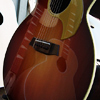
So I recently bought yet another 12 string acoustic. It isn't a Ric unfortunately, but I am going to ask this here anyway. I received it a few days back, and the first thing I noticed was that it has a custom compensated nut installed. Does this actually work? I understand having a compensated saddle, which also effects the fretted string length as well as the open, but wouldn't a compensated nut do nothing to correct intonation past the first fret? I am not extremely savvy when it comes to intonation adjustments so I am hoping someone might explain whether this is actually a solution?
The intonation is pretty close, it has individual plastic saddles set into a one piece solid saddle laying over the piezo. And the individual saddles are fairly worn, so that could also be what is throwing it off a hair. The guitar sounds and plays excellent regardless, was just hoping someone could shed some light on the concept of a compensated nut.
Compensated Nuts and Saddles
Moderator: jingle_jangle
-
jingle_jangle
- RRF Moderator
- Posts: 22679
- Joined: Wed Dec 22, 2004 6:00 am
- Contact:
Re: Compensated Nuts and Saddles
It would seem that way, yes. However, tests with good strobes on these systems, indicate that it effects the entire string length.
Here's what Earvana (Buzz Feiten's competition) has to say about it. No theory explanation here, however.
http://www.earvana.com/technology.htm
Here's what Earvana (Buzz Feiten's competition) has to say about it. No theory explanation here, however.
http://www.earvana.com/technology.htm

Re: Compensated Nuts and Saddles
And here's a very detailed article written by Steven Delft in 1992, which predates both Feiten and Earvana:
http://www.mimf.com/nutcomp/
http://www.mimf.com/nutcomp/

Re: Compensated Nuts and Saddles
If you look closely at the Earvana site they picture a Peterson 590 tuner but made the measuremnets with a 490ST. The 490ST is a stretch tuner that is used more typically for pianos. The most that the uncompensated nut was off is 4 cents (4/100th of a step). I doubt most people can here that. In fact unless you are using a strobe tuner I doubt most other digital tuners are that acurate in the hands of the majoity of people. I do understand the idea behind the Buzz Feiten system, but it has more to do with the instrument staying in tune when fretting at the first fret or so. I would imagine that the compensated nut works in the same way.
A company that has taken this kind of thinking further is the Novax fanned fret system. Link: http://www.novaxguitars.com/
A company that has taken this kind of thinking further is the Novax fanned fret system. Link: http://www.novaxguitars.com/
"The best things in life aren't things."
-
jingle_jangle
- RRF Moderator
- Posts: 22679
- Joined: Wed Dec 22, 2004 6:00 am
- Contact:
Re: Compensated Nuts and Saddles
Still, nobody has explained to me why this can affect anything but open string intonation. Sure, total string length is modified so open strings sound properly alongside fretted strings, but how does shortening string length affect anything but open strings?
-
tennis_nick

- Intermediate Member
- Posts: 1476
- Joined: Mon Dec 18, 2006 9:56 am
Re: Compensated Nuts and Saddles
jingle_jangle wrote:Still, nobody has explained to me why this can affect anything but open string intonation. Sure, total string length is modified so open strings sound properly alongside fretted strings, but how does shortening string length affect anything but open strings?
Well, for that open string to remain in tune, you're also affecting the tension of the string, since you're changing the length of the vibrating string. I'm sure that all plays into a more in tune experience. Basically, an Earvana nut would change your nut positioning + string tension or something like that, I dunno.

Re: Compensated Nuts and Saddles
An interesting topic and a cogent reminder that we are saddled with a number of new nuts these days as we expand our knowledge of the world.
As with many theories, the question for me is how they play out in the practical sense. As I listen to my guitars and those of friends from the 1960s and compare them to the latest buzz from Feiten and others, I hear tones from both eras that are acceptable to my ear. While I admit my hearing is not what it used to be and maybe this is a good thing, I cannot tell the difference in listening or playing instruments from the pre and post Feiten days.
As our ability to monitor and measure life's events increases we can now watch tenths of miles or kilometers pass by as we travel the roads being reminded of when we should turn. The temperature is now displayed in tenths of degrees and now we can know how many steps we have taken each day.
My phone no longer "rings" but "warbles" and when the power goes so too does all its features. I do not turn off my stove anymore, I "cancel" it. When my engine fails on the back roads the only adjustment I can make is an emotional one. Remember the old tree-fort days with the secret password. How many do you have today?
In this age of information and digital obsession we have learned so many new things but at the end of the day how much have we benefited from our new found precision.
My guitars, Rickenbacker and alike, suit me perfectly. I still like using my brain to tune my own instrument. Rickenbacker and Fender got it right the first time.
I measure therefore I am.
As with many theories, the question for me is how they play out in the practical sense. As I listen to my guitars and those of friends from the 1960s and compare them to the latest buzz from Feiten and others, I hear tones from both eras that are acceptable to my ear. While I admit my hearing is not what it used to be and maybe this is a good thing, I cannot tell the difference in listening or playing instruments from the pre and post Feiten days.
As our ability to monitor and measure life's events increases we can now watch tenths of miles or kilometers pass by as we travel the roads being reminded of when we should turn. The temperature is now displayed in tenths of degrees and now we can know how many steps we have taken each day.
My phone no longer "rings" but "warbles" and when the power goes so too does all its features. I do not turn off my stove anymore, I "cancel" it. When my engine fails on the back roads the only adjustment I can make is an emotional one. Remember the old tree-fort days with the secret password. How many do you have today?
In this age of information and digital obsession we have learned so many new things but at the end of the day how much have we benefited from our new found precision.
My guitars, Rickenbacker and alike, suit me perfectly. I still like using my brain to tune my own instrument. Rickenbacker and Fender got it right the first time.
I measure therefore I am.
Life, as with music, often requires one to let go of the melody and listen to the rhythm
Please join the Official RickResource Forum Facebook Page https://www.facebook.com/groups/379271585440277
Please join the Official RickResource Forum Facebook Page https://www.facebook.com/groups/379271585440277
-
Darkhollow

- Member
- Posts: 261
- Joined: Thu May 29, 2008 10:55 am
Re: Compensated Nuts and Saddles
The problem with acoustic guitars is and always has been a fixed saddle. Once the bridge is set, you have very little control over the intonation on them without re slotting the bridge for the saddle. Although I admit I have not done the research to truly understand the physics in the scale length, I have always assumed that the nut and frets are a fixed location. And the saddle is really the only adjustable option available to correct the scale length, most acoustic guitars you see now have compensated nuts installed to slightly increase the length of the B string.
When I got my Martin, the first thing I did was have a custom bone nut made by my luthier to get the action I wanted and to correct the intonation from the generic plastic or micarta saddle that was installed on it. You see some guitars like Takamine that have a 2 piece saddle, one for the high E & B, and another for the G through low E.
When thinking in terms of fret spacing for the scale length, I had assumed that the corrections made to the instrument would be done at the bridge so that it compensates the correct string length for the scale not only to the nut but also to each individual fret as well. When you shorten the scale length from the top or nut it seems that the proportion of the fret spacing would be thrown off.
This guitar does indeed sound very good. Intonation problems are usually a lot more noticeable to the ear on a 12 string than a 6. As each string can have individual intonation issues and be sharp or flat the further up the neck you go. A compensated nut is indeed an interesting concept, I was looking to understand more how it worked as noted by Paul.
Thanks for the thoughts and links guys, very much appreciated.
When I got my Martin, the first thing I did was have a custom bone nut made by my luthier to get the action I wanted and to correct the intonation from the generic plastic or micarta saddle that was installed on it. You see some guitars like Takamine that have a 2 piece saddle, one for the high E & B, and another for the G through low E.
When thinking in terms of fret spacing for the scale length, I had assumed that the corrections made to the instrument would be done at the bridge so that it compensates the correct string length for the scale not only to the nut but also to each individual fret as well. When you shorten the scale length from the top or nut it seems that the proportion of the fret spacing would be thrown off.
This guitar does indeed sound very good. Intonation problems are usually a lot more noticeable to the ear on a 12 string than a 6. As each string can have individual intonation issues and be sharp or flat the further up the neck you go. A compensated nut is indeed an interesting concept, I was looking to understand more how it worked as noted by Paul.
Thanks for the thoughts and links guys, very much appreciated.
Re: Compensated Nuts and Saddles
It's always seemed to me that when you play a fretted instrument like a guitar or bass (or a valve instrument, for that matter), you are accepting some inherent intonation limitations. It could even be considered part of the characteristic sound of the instrument, and the reason different keys have different "feels". While compensated nuts and saddles may help, the fret system will never be able to achieve just intonation, so I can't see getting too worked up about minor improvements to a few notes. I could see this being more valuable for a non-fretted string instrument (violin, fretless bass) where the player has control over the intonation of every note save the open strings.
I guess what I'm saying is that these are minor tweaks that can't address 95% of the intonation issues caused by using fixed fret positions -- on top of that, most people can't perceive the difference anyway. Embrace the intonational compromises!
Pardon the philosophical tangent, it's in my contract with RickResource that I make one or two posts like this per month.
I guess what I'm saying is that these are minor tweaks that can't address 95% of the intonation issues caused by using fixed fret positions -- on top of that, most people can't perceive the difference anyway. Embrace the intonational compromises!
Pardon the philosophical tangent, it's in my contract with RickResource that I make one or two posts like this per month.
-
jingle_jangle
- RRF Moderator
- Posts: 22679
- Joined: Wed Dec 22, 2004 6:00 am
- Contact:
Re: Compensated Nuts and Saddles
Yeah, Nick, I think you're touching on something that begins to explain it. String tension. Since the pitch of the string is a combination of 3 factors: scale length, weight of string, and tension, modifying one of these would affect the others. So the miniscule modification of scale length should increase or reduce the tension when tuned to a given pitch, and this tension should go on to affect the pitch of any fretted note in a small way.tennis_nick wrote:jingle_jangle wrote:Still, nobody has explained to me why this can affect anything but open string intonation. Sure, total string length is modified so open strings sound properly alongside fretted strings, but how does shortening string length affect anything but open strings?
Well, for that open string to remain in tune, you're also affecting the tension of the string, since you're changing the length of the vibrating string. I'm sure that all plays into a more in tune experience. Basically, an Earvana nut would change your nut positioning + string tension or something like that, I dunno.
OK. Makes sense. But, I'm with Peter on this. It may be a mechanical and sonic change that a small minority of folks can hear, and a percentage of them would regard as an improvement. I'm OK with things the way they are, though.
Re: Compensated Nuts and Saddles
well something like microfrets micro nut should be microable to micro manage all the micro changes - well seriously - i used to have one early microfrets with micronut in the past and while it can be adjusted for all strings in a manner discussed here i found myself not doing much with it since the constant temperature and humidity changes about nullify all the fine adjustments anyway. i do have buzz feinten equiped guitar - a- washburn nv300 and to be completely honest about it - it is not such a big improvement after all too. it is nice in theory but not so much in real life for the very same reasons.
dusan palka who is also known as grazioso on infamous auction web site
if you want to reach the man and expect an answer please make sure you remove this email address ([email protected]) from your spam block if you have one.
if you want to reach the man and expect an answer please make sure you remove this email address ([email protected]) from your spam block if you have one.