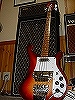
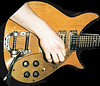
This pin-up is from Japanese Magazine called "Player" (IS there same mag in US?).
That is very serious one,under the photo there must be good explanations in Japanese.
If I can find this one, I can translate about the originality.
But I don't know when the 4001s' Pin-up issued...
I think that we put our collective heads together and determined that
the Rick 4001s pictured in the poster would not be 100% original, as
manufactured in 1963.
Pointing to the horseshoe pickup surround and pickguard, plus the FG
finish lead us to conclude this.
We sincerely thank you for your reply to this topic.
The 63 FG is similar, but as John pointed out, with a genuine RM case in the background, that makes it highly unlikely. It could be a 63 4000 with the added p/up, and if we could only see if the TRC had the extra screw in middle....
A thing to remember is that you can't really compare a 63 4001S to a 64 RM1999.
In fact,no two RM1999s are exact either...
With that thought process, you could compare a 65 4001 with Graham's 63 and say one was bogus.
There are quite a few differences in hardware.
If you're looking at FG hues, well, my 61 365 is just as orangey.
The PU surround is just lie the one I saw on the Fossen/Lull 4001
and it touched th PG in the same way. As I had said earlier, my 64 4001
didn't have a tug bar either, but it had the shorter PU surround.
The part I wonder about is the TP; it's a 3 screw, but the slots look too
squared off....
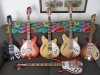
John Fay is correct in pointing out the fact that 63-68 basses vary in many ways. This includes basses produced the same year and month. Andy Winter's point about color variations based on year produced holds true often but not 100% of the time, more so with basses than guitars. Andy knows well that the 64 and 67 RM basses can be almost always determined by the color hue. One of the many reasons I went nuts collecting 50's/60's basses was that each one is so individual. The 63 bass in the photo posted smells a bit fresh but it could easily have had a new part or two replaced to clean it up a bit. I purchased the 60's maple glow from the other magazine spread. Many vintage Rickenbacker basses I have inspected in Japan were bogus in some way or another. There are a few Rickenbacker super experts there but none who compare to any of the top-level guys on this forum. Mostly the Japanese collectors like the Beatles and thus their Rickenbacker jones. A lot of doctored vintage instruments of many brands end up in Tokyo shops.
Two of the biggest vintage guitar collections came up for sale in the past 15 years. One was Tsumura’s collection, which featured many high level arch top guitars made by D’Angelico, Stromberg and Gibson. In 1995 Akira Tsumura, Japans biggest guitar collector, got into some type of family trouble and the family forced him to sell his ten million dollar home in Beverly Hills along with his famous guitar collection. Four years earlier a book had been published with beautiful pictures of this collection. I dreamed night after night of owning or at least playing a few of the most beautiful guitars in the book. One day in 1995 along with Norm Harris and the guys from Guitar Center, I was invited to view and make offers to purchase guitars from the collection. Prices were set below market value. I brought $150,000 of borrowed money with me, ready to pounce on my dream arch tops. When I arrived I began inspecting every guitar and noticed 60% were in some way messed with—re-necked, over sprayed, refinished, etc. I purchased 20 guitars from the nearly 500 there and felt like the other 480 were in many ways not worth owning even as players. I left there shocked. Four years ago Scott Chinery’s collection went up for sale. Chinery was the most famous of the American collectors, but upon viewing his collection I noticed Chinery had been brutally taken advantage of by many less than honest dealers as his collection was embarrassing. Still I was able to purchased 10 or so nice pieces that wound up in his collection by luck. Most of my collecting was done during my dishwashing or construction days when I earned my money one penny at a time. I needed to be fully versed in what I was buying to avoid any mistakes. Though i have never been a great player I am able to pick guitars with above average feel and tone and I am very lucky to have seen thousands of vintage guitars up close My Rickenbacker bass collection was put together over 35 years, mostly during a time when money was tight. I have sat for hours and hours studying every inch of my basses and have been lucky enough to be able to examine several together so that I could really notice the minutiae between them. This forum is my favorite place to visit when I have spare time as there a several guys here who have really paid attention and have a lot of insight to offer.
There is no substitute for "hands-on" experience, and there is a lot of that on the forum. Seeing as how the only vintage Rick I have laid my hands on is a '68 4001, I read as much as I can on these others I will probably never own. Thanks so much, everyone, for sharing your experiences.
"They make great f***'n basses". - Lemmy, NAMM 2009
I still tend to lean towards a 67, with replaced parts.
It does have the shorter surround, but it's thicker at the top, and is generally bigger looking than the original version. The guard looks a little shorter than the original, to meet the fatter upper part of the surround. The FG seems to have just a little more yellow in the middle than the 63's I have seen, although Vincent correctly points out, being hand sprayed, they do all vary a little. Still, it resembles more a 67 shade than a 63 to these eyes...
The RM case makes you think later, rather than earlier also...