
As tube amps get older, the electrolytic caps wear out. They wear out faster with non-use so tube equipment should be powered on a couple times a year. Eventually electrolytic caps lose the ability to function up to their specs. When this happens, they will blow up, or stop filtering which causes lots of hum, or leak some of the electrolyte out of them, or leak DC voltage, etc. There are quite a few failure modes, and without a cap checker that can check at the rated voltage of the cap, there is no way to know what is quite wrong with them. Best bet if they are old is to replace them with new ones. This goes for any electrolytic cap in the amp. Which ones are the electrolytics you ask? Well, the electrolytics that are used in tube amps are polarized, which means that one side is positive and one is negative. Some caps have a + at one end and others have arrows pointing to the negative end. Your schematic will show these caps also. All the ones under the pan should be replaced, and there are several others, usually 25uf caps, but there is also a bias cap in there, and they should all be replaced. Any electrolytics. Aside from those, the coupling caps can sometimes leak DC and should be replaced too, but that requires some testing to figure out. You could start with the electrolytics. There are suppliers in Europe for this stuff too. In the US, www.tubesandmore.com is hard to beat. I stay away from the Illinois brand but like Xicon, F & T and others. Sprague Atoms are greatly overpriced and aren't any better than anything else, so I stay away from those too.
Greg
Fender Bassman 1968 silverface
Moderator: jingle_jangle
-
soundmasterg

- RRF Consultant
- Posts: 1923
- Joined: Tue Oct 01, 2002 1:06 pm
-
thebassman
- New member
- Posts: 22
- Joined: Fri Jun 20, 2008 7:29 am
Re: Fender Bassman 1968 silverface
thanks very much for that soundmasterg. Have you any names of companies in europe that stock these items, i have spent ages online looking to no avail.
-
thebassman
- New member
- Posts: 22
- Joined: Fri Jun 20, 2008 7:29 am
Re: Fender Bassman 1968 silverface
Hi
i have managed to get old of most of the caps etc. that i need.......... thanks all you guys with help on suppliers.
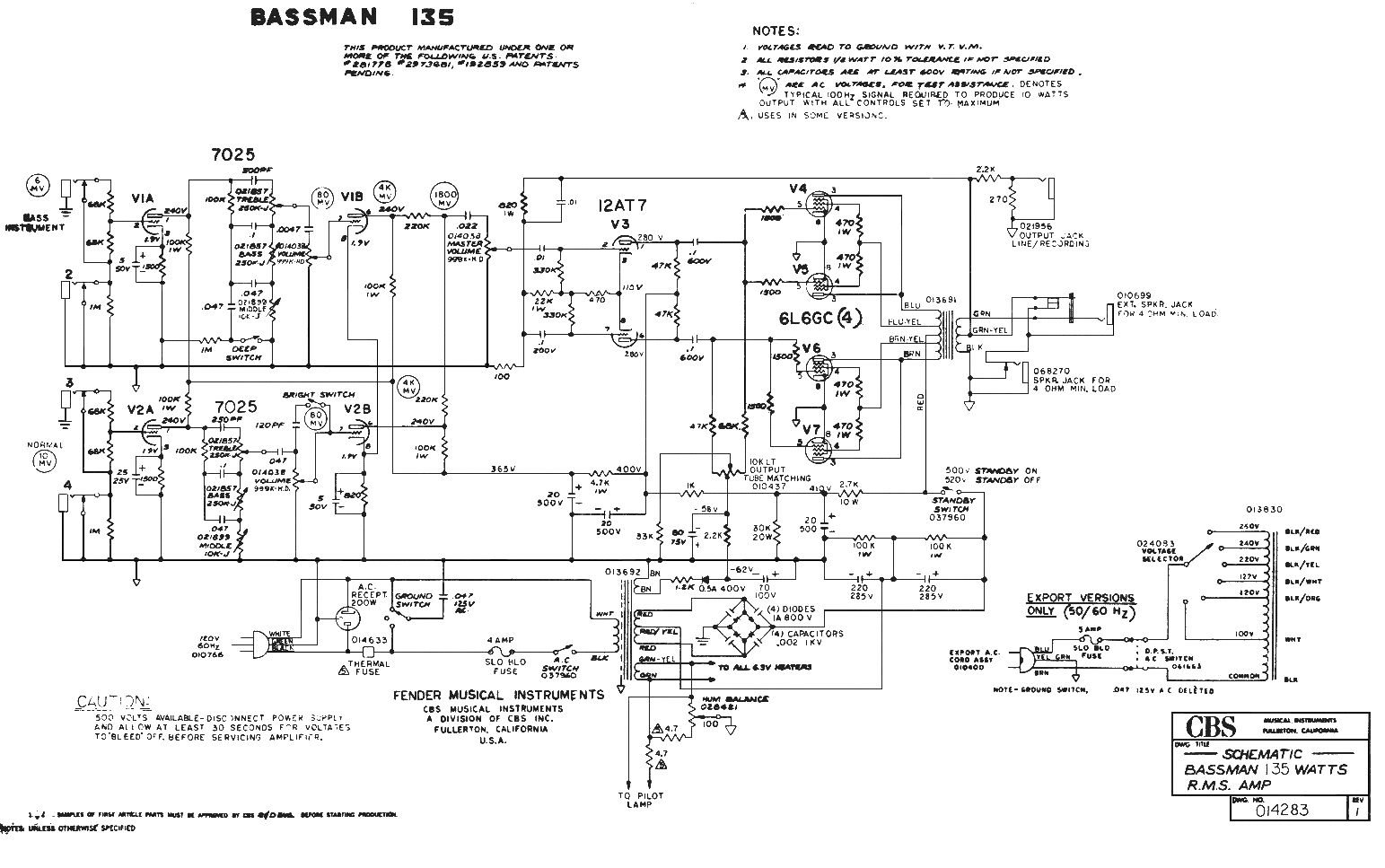
i am a bit stuck on one bit. underneath the capacitor pan that holds all the big caps there is one that on mine is 80 ohm 100v, the schematic looks like it says 50 ohm 75v. Does anybody know what this value actually is.
btw. i have a bassman 135 silverface made in 1978.
i have managed to get old of most of the caps etc. that i need.......... thanks all you guys with help on suppliers.
i am a bit stuck on one bit. underneath the capacitor pan that holds all the big caps there is one that on mine is 80 ohm 100v, the schematic looks like it says 50 ohm 75v. Does anybody know what this value actually is.
btw. i have a bassman 135 silverface made in 1978.

Re: Fender Bassman 1968 silverface
Martin, I've been waiting for Greg to post, but it's been days since you asked. Here is what I found:
First, it is a capacitor, so it is rated in microfarads (uF) and not ohms, but that is just semantics. I found a schematic and printed it out on 11 x 17 paper and it sure looks to me like it is an 80uF 75V capacitor. So your amp is correct. The fact yours is rated to 100V is just extra protection against overvoltage conditions.
http://www.drtube.com/schematics/fender/bassman135.gif
That capacitor is for hum reduction on the 6L6 tubes - part of the balance circuit. Probably why they went from 50 to 80 uF.
First, it is a capacitor, so it is rated in microfarads (uF) and not ohms, but that is just semantics.
I found a schematic and printed it out on 11 x 17 paper and it sure looks to me like it is an 80uF 75V capacitor. So your amp is correct. The fact yours is rated to 100V is just extra protection against overvoltage conditions.http://www.drtube.com/schematics/fender/bassman135.gif
That capacitor is for hum reduction on the 6L6 tubes - part of the balance circuit. Probably why they went from 50 to 80 uF.
-
soundmasterg
- RRF Consultant
- Posts: 1923
- Joined: Tue Oct 01, 2002 1:06 pm
Re: Fender Bassman 1968 silverface
Thanks for posting the answer John...been a bit busy here.
Greg
Greg
-
thebassman
- New member
- Posts: 22
- Joined: Fri Jun 20, 2008 7:29 am
Re: Fender Bassman 1968 silverface
Hi guys, thanks for your replies.
I have changed 99% of the caps and most of the resistors......... i still need to get hold of a 80uF 75V cap.
I have still got lots of background noise not sure if its a hum or buzz, but it's still noisey even without a guitar plugged in.
I have also changed all the power and pre-amp tubes.
Any ideas???????
I have changed 99% of the caps and most of the resistors......... i still need to get hold of a 80uF 75V cap.
I have still got lots of background noise not sure if its a hum or buzz, but it's still noisey even without a guitar plugged in.
I have also changed all the power and pre-amp tubes.
Any ideas???????

Re: Fender Bassman 1968 silverface
A couple of 40uf or 47uf caps in parallel would be fine and a higher voltage cap ~80uf would be fine. I buy parts from Mouser, Digikey and Ted Weber and you might find a resistor you want from partsconnexion.com.
Your noise may come from a bad connector or lead dress. Pictures of the guts would be helpful.
Keeping your heaters routed together and away from everything else, avoiding parallel routing of other lines and keeping inputs away from output wires may help in the obscure.
Your noise may come from a bad connector or lead dress. Pictures of the guts would be helpful.
Keeping your heaters routed together and away from everything else, avoiding parallel routing of other lines and keeping inputs away from output wires may help in the obscure.
Re: Fender Bassman 1968 silverface
Even a 100uF cap would work. That value would be easier to find. If this cap is still in circuit, and original, it could be the reason things are still noisy.
-
thebassman
- New member
- Posts: 22
- Joined: Fri Jun 20, 2008 7:29 am
Re: Fender Bassman 1968 silverface
Hi guys
thanks for that info.
i will take some pics of the guts of my amp and post them on here.
thanks for that info.
i will take some pics of the guts of my amp and post them on here.
-
thebassman
- New member
- Posts: 22
- Joined: Fri Jun 20, 2008 7:29 am
Re: Fender Bassman 1968 silverface
Hi Sharkboy
Here are some pics of the inside of my amp.
Let me know if they are not clear enough and i will upload some more.
cheers
Here are some pics of the inside of my amp.
cheers
Re: Fender Bassman 1968 silverface
If you could post full-size pictures up on a Flickr site or something, that would be easier to see than with the size restrictions here. It's a little hard to see things with my old eyes.
I will take a closer look later and may be of help or not. I have access to the schematic, I think and I'll try to pay close attention to the obvious things.
-Markg
I will take a closer look later and may be of help or not. I have access to the schematic, I think and I'll try to pay close attention to the obvious things.
-Markg
-
thebassman
- New member
- Posts: 22
- Joined: Fri Jun 20, 2008 7:29 am
Re: Fender Bassman 1968 silverface
Hi sharkboy
i have uploaded all the hi-res pics to my skydrive, here is the link:
http://cid-29ce5e9e524ac54a.skydrive.li ... blic?uc=10
please let me know if you see anything dodgy.
cheers
i have uploaded all the hi-res pics to my skydrive, here is the link:
http://cid-29ce5e9e524ac54a.skydrive.li ... blic?uc=10
please let me know if you see anything dodgy.
cheers
Re: Fender Bassman 1968 silverface
Thanks for the big pictures. A few things after a couple of looks (Greg or others can probably help more):
The wiring may be older than you are, but still worth a gander:
1. Please check all connections to ground. Input and output jacks are often the culprit here. Then consider the grounding path- for audio signals, the path of least resistance really is the return, so sometimes that has to be controlled. (I'm not a Fender whiz, I didn't figure out which of the Bassman schematics at schematicheaven.com matched yours- so I couldn't assure myself I was guessing circuits.) Kevin O'Connor says in his TUT series of books that 20+db of noise can be taken out of an older Fender just by changing the grounding scheme.
2. Your heaters appear to be close to other lines and occasionally parallel to them. This will impart noise (hum) to other lines. They might use some room: pull them away from the other signals and/or pull the other signals away from them. Also, heaters radiate more when they are loosely twisted than if they are a bit tighter.
3. I see some clusters of wiring that leads me to believe that some higher voltage lines are close to lower voltage lines.
4. Higher voltage stuff: There are places where a twisted pair of wires comes through the chassis and is split widely, and I need to look at your power supply card a little more.
A trick that the pros use is to invert the open chassis and turn on the amp (edit: WITH THE SPEAKER PLUGGED INTO IT), carefully WITH THE OTHER HAND IN THEIR POCKET probing with long, all wooden chopsticks to see if they can isolate the problem or improve it or make it worse by gently moving wires. This is only something I would recommend to you if you are really comfortable with doing that. You can't forget that if you make a circuit across your heart by manually touching the chassis and a wire or having something arc to your watch and through you it could be really bad.
The wiring may be older than you are, but still worth a gander:
1. Please check all connections to ground. Input and output jacks are often the culprit here. Then consider the grounding path- for audio signals, the path of least resistance really is the return, so sometimes that has to be controlled. (I'm not a Fender whiz, I didn't figure out which of the Bassman schematics at schematicheaven.com matched yours- so I couldn't assure myself I was guessing circuits.) Kevin O'Connor says in his TUT series of books that 20+db of noise can be taken out of an older Fender just by changing the grounding scheme.
2. Your heaters appear to be close to other lines and occasionally parallel to them. This will impart noise (hum) to other lines. They might use some room: pull them away from the other signals and/or pull the other signals away from them. Also, heaters radiate more when they are loosely twisted than if they are a bit tighter.
3. I see some clusters of wiring that leads me to believe that some higher voltage lines are close to lower voltage lines.
4. Higher voltage stuff: There are places where a twisted pair of wires comes through the chassis and is split widely, and I need to look at your power supply card a little more.
A trick that the pros use is to invert the open chassis and turn on the amp (edit: WITH THE SPEAKER PLUGGED INTO IT), carefully WITH THE OTHER HAND IN THEIR POCKET probing with long, all wooden chopsticks to see if they can isolate the problem or improve it or make it worse by gently moving wires. This is only something I would recommend to you if you are really comfortable with doing that. You can't forget that if you make a circuit across your heart by manually touching the chassis and a wire or having something arc to your watch and through you it could be really bad.
-
thebassman
- New member
- Posts: 22
- Joined: Fri Jun 20, 2008 7:29 am
Re: Fender Bassman 1968 silverface
thanks for the diagnosis sharkboy.
i am awaiting a couple of parts from TAD, namely a capacitor, some resistors, deoxit d5 and a new bright switch.
After i have done these last few mods i will fire it up again............ fingers crossed no hum.
Anyone else got any ideas looking at my uploaded pictures.
i am awaiting a couple of parts from TAD, namely a capacitor, some resistors, deoxit d5 and a new bright switch.
After i have done these last few mods i will fire it up again............ fingers crossed no hum.
Anyone else got any ideas looking at my uploaded pictures.