
Rickenbacker Detractors
Moderators: rickenbrother, ajish4
-
shamustwin
- Senior Member
- Posts: 5287
- Joined: Tue Apr 29, 2003 5:00 am
Rickenbacker Detractors
There's another thread here about what folks like most about Rickenbackers. I don't read the trades or music mags, nor talk with a lot of other musicians. But I assume there are people with a less than stellar view of them. What if anything has anyone here heard, read etc. or themselves feel regarding what they dislike, percieved flaws, etc. Even if based on misinformation or prejudices it might be interesting. And don't get me wrong, I like Ricks, I am simply curious why some might not. I am most curious about the opinions of non owners. BTW, though I've had at least one almost continually since the early '70's, I knew close to nothing about them until I discovered this forum.
The big rag on the basses use to be that they were too trebly. That they were one dimensional, only had one sound, and I must admit that a Ric 4001 with Rotos and the intact cap does pretty much have one certain sound, a great classic sound, but only good in certain applications. People thought they were one trick ponies as has been repeated here before. Elimination of the cap has greatly dispelled that and now that flatwounds are coming back that opens up the sound of them even more. I realize there are people here who swear by the cap, but I think elimination of the cap was the best thing that ever happened to them. The first time I (I found that out here) bypassed a cap in one of my 4001's it was like: wow! what a diffence! Why in the hell did they put that stupid thing in there in the first place, all these years and I didn't know this!? The funny thing is that I had bought a 78 4001 that unbeknowst to me had had the cap bypassed (before I knew anything about it) and I always thought why does this bass sound so full and warm compared to my other 4001's? I would like to see them put the caps back in maybe but with an inconspicous switch to turn them off and on.
Well they are like a real oddity of design....you either love em or hate em.....especially the basses. They are not your typical "workhorse" well known widely used make like Fender or Gibson, and they are not what i call "arty" makes like warwick or ... alembic etc.
They are normal, functional, yet highly individual and frankly bizzare looking instrments (in a good way)
I saw a 4003 at the london bass center, and the salesguy commented that the only people that show any interest in it are Beatles/Jam freaks.
They are normal, functional, yet highly individual and frankly bizzare looking instrments (in a good way)
I saw a 4003 at the london bass center, and the salesguy commented that the only people that show any interest in it are Beatles/Jam freaks.
The email address shown is down, you can email me at [email protected]
John Entwistle would not have been bothered by the trebly tone too much, as he played lead on the bass a lot, and many early bass players used big guitar amps (hence the cap to roll off the bass and prevent damage. You could always remove it). His bad experience was when his 4001 fell over and the fretboard popped off, I believe. He believed the necks to be too fragile for his use. Almost any bass probably had a neck too fragile for his use. Don't forget that he also dumped Fender and Gibson along with Rickenbacker. He even dumped Alembic and Warwick as gig basses, and settled on the Status Graphite Buzzard Bass with graphite neck. He even smashed a couple of the Buzzard Basses that would not setup low enough without rattling. I've seen how low he kept his action, and he always plays with some fret buzz, but hardly any bass will go as low as he likes it without major fret buzz. He also likes the G string to be closer to the fretboard edge than the E string, if you ever noticed, and no Rickenbacker comes set up that way. My OLP SB4 came set up that way (happy coincidence, I presume), and it keeps you from rolling the E string off the edge if you get wild, so it's a setup style that works, but I can't get the action as low as John does without buzzing (and how I've tried), and my 4004L won't come close either. My ReBop comes the closest, but still no cigar. I think John was right, Rickenbackers don't have the strongest necks and aren't designed for really low action, especially when compared to something like a solid grapite or grapite reinforced neck (it is quite noticeable that the ReBop neck is stiffer and more stable than the 4004L).
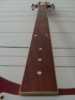
I think the basses are still one of the best looking instruments out there, especially the 70,s MOP/Checker models. The styling and sound is very individual, but always instantly recognizable...Not to everyone,s taste, but they all know what it is!! The sign of a true classic. The sound has been said by many to be one dimensional, but as Bob says with flats and just the toaster, one can get a very different sound from the traditional Ric clank. The playability is second to none on those thin necks too... I think like most things in life most people want to fit in and be part of the perceived crowd. It,s easier to be in with the gang than stand alone. So apart from 1964 and the early 70,s, when Rics were in vogue they have been fringe players. Most still want their Fender/Gibson thing. Rics of course are very cool...Most of the people over the years I,ve met view Ric owners as a little different, but always cool, and that,s probably right in most cases. We,re not your bread and butter gang. Owen I took my 4001 to the bass center in wapping some 14 years ago to have them service it. It came back worse than when I left it. Maybe things have improved, but when it comes to Rics I doubt it...

In regards to basses, the nut area on my Rick is thicker than at the 1st fret, whereas, on a Fender it's thinner. It's a clunky feeling you have to get used to. A 4001/3 is a lot of maple and it's on the heavy side. Admittedly, a lot of the booteek basses are boat achors in comparison.
With the guitars, I can't do much string bending, and I want that in an electric guitar. The lacquered fretboard may have something to do with it. I don't know about the Dakota models, but the newish 330 I babysat for a year could have used an unfinished pau ferro fretboard and slightly bigger frets. I found the neck pickup to be useless because it was too bassy. The middle position didn't do much for me, however, the bridge pickup has *that* sound.
With the guitars, I can't do much string bending, and I want that in an electric guitar. The lacquered fretboard may have something to do with it. I don't know about the Dakota models, but the newish 330 I babysat for a year could have used an unfinished pau ferro fretboard and slightly bigger frets. I found the neck pickup to be useless because it was too bassy. The middle position didn't do much for me, however, the bridge pickup has *that* sound.

From guitar techs, the most frequent complaint seems to be related to the truss rod adjustment. They are a bit skidish when it comes to two rods. Why I don't know.
From players, and I live in a Fender/Gibson town, there is this misconception that a Rickenbacker is a rhythm instrument only.
Both of these common misconceptions or "beefs" stem largely from the fact that Rickenbackers are rare above the 49th parallel. Once people see and play a Rickenbacker their whole view changes. Unfortunatley, There is a limit to how many guests I can have over to my home to jam on weekends, but I am doing my best to get the word out.
From players, and I live in a Fender/Gibson town, there is this misconception that a Rickenbacker is a rhythm instrument only.
Both of these common misconceptions or "beefs" stem largely from the fact that Rickenbackers are rare above the 49th parallel. Once people see and play a Rickenbacker their whole view changes. Unfortunatley, There is a limit to how many guests I can have over to my home to jam on weekends, but I am doing my best to get the word out.
Life, as with music, often requires one to let go of the melody and listen to the rhythm
Please join the Official RickResource Forum Facebook Page https://www.facebook.com/groups/379271585440277
Please join the Official RickResource Forum Facebook Page https://www.facebook.com/groups/379271585440277
-
spencer
-
melibreits

- Senior Member
- Posts: 4081
- Joined: Wed Mar 12, 2003 6:00 am
- Contact:
It is interesting that you guys mention that about guitar techs and the double truss rods--I just had our local luthier do some minor adjustments and repairs on a couple of my Rics, and he only had good things to say about the Ric truss rod system; he felt that it lent a lot more stability to the neck when making adjustments.... And now that they've been tweaked, they play like butter, even my 360-12 that had always felt a little stiff!
"Once I've held and played the best, baby, I won't settle for less!"
-
jeff_ulmer
- Intermediate Member
- Posts: 873
- Joined: Sat Jan 18, 2003 6:00 am
- Contact:
The biggest complaint I hear about the guitars is the narrowness of the necks, which for people with big fingers, makes them more difficult to play. The 12 strings are a little difficult to set up if you don't know how to do it, and restringing isn't the easiest either. I only own one 6 string Ric at the moment, a 480, which I find good for chording, but less so for leads due to the radius of the fretboard.
With the basses, some just don't like the shape. I didn't at first, but I'm cured now. With the cap in they are lacking in the low end - easily fixed. Some of the necks feel a little odd, especially when you are used to Fenders, but that is something that can be gotten used to.
The sound of all the guitars may not be suitable for all styles of music, and the size and shape of the pickups doesn't allow for swapping them out easily. The look of the guitars is also a matter of taste - you don't see many mosh bands playing 360s.
Every instrument has its quirks. I try to use those to my advantage these days, and also use the uniqueness of the sound to stand out in a mix. The mechanical designs could use some updating in some areas, but then Ric would get complaints from those who insist on keeping things as they were in the past.
With the basses, some just don't like the shape. I didn't at first, but I'm cured now. With the cap in they are lacking in the low end - easily fixed. Some of the necks feel a little odd, especially when you are used to Fenders, but that is something that can be gotten used to.
The sound of all the guitars may not be suitable for all styles of music, and the size and shape of the pickups doesn't allow for swapping them out easily. The look of the guitars is also a matter of taste - you don't see many mosh bands playing 360s.
Every instrument has its quirks. I try to use those to my advantage these days, and also use the uniqueness of the sound to stand out in a mix. The mechanical designs could use some updating in some areas, but then Ric would get complaints from those who insist on keeping things as they were in the past.
IMHO the older instruments can really get on your nerves if your someone who cant/wont do their own adjustments and checkups on the guitars. I think this applies to the basses more so. The guitars , whilst unique, are just electric guitars, but the basses are very different. Narrower spacing, the mute thumb screws, pickup covers, thin necks etc etc - for some people thats too much to adapt to. I learned to play on a Squire Jazz and a MIM Precision and i managed . A lot of repair people dont like them, and unfortunately it may be to do more with the fact that they personally dislike them- rather than Rickys being hard to work on.
The email address shown is down, you can email me at [email protected]


-
mortivan
John, if he moans about setting intonation on a 4003, never bring him a Steinberger or Spector with the Steinberger bridge. The Steinberger isn't really that bad when you learn the trick, which is to loosen the locking nut just enough to allow you to drift the saddle into position with a hammer and small wood dowel after you loosen the string, then bring the string up to tension and work on the next saddle. The newer RIC 4004 basses are a piece of cake to set up. They need a bit more thickness in the neck at the heel and a bit less width in the neck at the nut to feel "right on" and give the perfect bend to the neck for the lowest possible action. I guess they are the antithesis to the J-bass in this regard. That includes their very bass heavy sound, especially the early model 4004L like Jeff and I own. The neck pickup overpowers the bridge pickup (which is nowhere near the bridge) and you need a V-V-T control setup to get a perfect blend if you run both pickups simultaneously. It's sort of a P-bass sound with rolling thunder added by the neck pickup, if that makes any sense. Not a bass for J-bass fans.
-
mortivan
