
I have found the turret boards available on TAD, do you know which circuit or style i would need?BlueAngel wrote:I have a Silverface Bassman 70 here with the same problem - not just scratchy when turning the pots, but constant pop-and-crackle background noise too, only on the Bass channel. There is some slight measurable DC on the tone stack, but not much. I've tried changing the coupling caps, of course. It's not the plate resistors either, which are a common cause of noise problems on old Fender amps. I suspect it's the increasingly common and very nasty Eyelet Board Conductivity Problem.
This occurs where the fiber eyelet board - which is waxed to keep out moisture, but often not very well - begins to degrade and develop very slight conductive paths through the material which like all organic substances is carbon-based. You won't be able to measure the resistance - it's extremely high - but under several hundred volts of the B+ supply it will leak tiny currents between some of the eyelets and cause all sorts of problems, including noise but also sometimes just odd tone and occasionally instability.
Sometimes it's caused by the insulating layer under the eyelet board itself (which touches the eyelets underneath) and if so you can fix it by inserting a new layer of insulating material - plain cardboard works well - between the two. It's not that with this one though. At this point there's no solution other than replacing the board - I've even tried reheating it (with a hairdryer!) and adding more wax, but actually that made it worse, which pretty much confirms it's the problem.
Fender Bassman 1968 silverface
Moderator: jingle_jangle
-
thebassman
- New member
- Posts: 22
- Joined: Fri Jun 20, 2008 7:29 am
Re: Fender Bassman 1968 silverface
-
BlueAngel
Re: Fender Bassman 1968 silverface
That's the bias circuit rectifier diode. Any modern rectifier diode with a voltage rating of 200V or better will do (not 100V - the peak reverse voltage in a half-wave rectifier circuit is double the final DC voltage, which is around 60V). A 1N4003 (1A, 200V) is fine, although I just use 1N4007s (1A, 1000V) throughout in most amps, it saves keeping more than one type and the excessive voltage rating makes no difference. Make sure you get it the right way round! Bias voltage is negative.thebassman wrote:The only item i could not re-source was the little silver can, just by the rectifier diode group. i think on the schematic it is stated as 0.5A diode.
Whatever is the correct one for the amp circuit model you have. You could probably adapt one that's close, if you can't find the exact one - or be more creative, and "de-evolve" the amp to an earlier and more desirable circuit.thebassman wrote:I have found the turret boards available on TAD, do you know which circuit or style i would need?
-
soundmasterg

- RRF Consultant
- Posts: 1923
- Joined: Tue Oct 01, 2002 1:06 pm
Re: Fender Bassman 1968 silverface
I can't look at a schematic right now so I can't tell you offhand which cap could be the culprit. Scratchy pots usually indicate DC on the pots, and that could be a bad cap, or a bad board as John mentioned, or some other things too. If you have a DMM, you can measure to see if there is any DC on the pots, and trace that back to the surrouding circuit to see where it begins and ends, but you would be doing this on a live amp, so please be very careful. If you've changed all teh caps in the amp, it could very well be a bad cap still, as sometimes they are bad off the shelf, but it could be other things too. These type of problems are the real head-scratchers are are sometimes even hard for techs to disagnose, and they always take time to solve. Stick with it and try some testing unless you don't have any of the equipment necessary like a digital multimeter for instance.thebassman wrote:Mine does sound the same as the normal (channel 2) side is virtually silent, all the pots are silent when moved, but the Bass instrument (channel 1) side is very noisy when static and all the pots are scratchy when moved.
Which is the coupling cap, what is it's value? the only reason i ask is that i am pretty sure i have changed every single cap in the last month.
The only item i could not re-source was the little silver can, just by the rectifier diode group. i think on the schematic it is stated as 0.5A diode.
Greg
-
thebassman
- New member
- Posts: 22
- Joined: Fri Jun 20, 2008 7:29 am
Re: Fender Bassman 1968 silverface
Whatever is the correct one for the amp circuit model you have. You could probably adapt one that's close, if you can't find the exact one - or be more creative, and "de-evolve" the amp to an earlier and more desirable circuit.[/quote]thebassman wrote:I have found the turret boards available on TAD, do you know which circuit or style i would need?
Hi
i have thought about changing my amp to a more desireable circuit. I just don't know where to get hold of the correct circuit diagram. The other ones i have seen online seem to be for less powerfull amps, mine is the bassman 135.
Is it possible to change my amp??
-
BlueAngel
Re: Fender Bassman 1968 silverface
No, not completely - the 135 is a slightly different design. The power section is an 'Ultra-Linear' type and you should probably leave this alone, as converting it properly to an earlier circuit is a really big job, and actually (for a bass amp) this circuit is probably more useful anyway because it has significantly more headroom and punch, although at the expense of a much harder transition to distortion and being a bit hard on the tubes when it does. In fact, although the voltages and power output are at the upper limit of what 6L6 tubes will take - especially modern-production ones - you can directly fit 6550s instead which will increase power and improve tone and reliability. This is a drop-in swap, you don't even need to rebias since the 6550s are running well within their rating.thebassman wrote:i have thought about changing my amp to a more desireable circuit. I just don't know where to get hold of the correct circuit diagram. The other ones i have seen online seem to be for less powerfull amps, mine is the bassman 135.
Is it possible to change my amp??
You also can't take the preamp back as far as an AA864 or AB165 (the more desirable Bassman 50W circuits) because those use an extra tube - which was actually configured with a large amount of negative feedback to try to squeeze as much clean power out of a 50W bass amp as possible. But the Super Bassman or Bassman 100 are possibilities since they also only use three preamp tubes. The schematics for these are easily available online, just do a search.
Now I am thinking about this I will have another look at my noisy Bassman 70 (which is just a lower-powered 135) and see if I can come up with anything. Don't wait up, it will be at least a few days before I can get to it
 .
.
Re: Fender Bassman 1968 silverface
Hithebassman wrote:Whatever is the correct one for the amp circuit model you have. You could probably adapt one that's close, if you can't find the exact one - or be more creative, and "de-evolve" the amp to an earlier and more desirable circuit.thebassman wrote:I have found the turret boards available on TAD, do you know which circuit or style i would need?
i have thought about changing my amp to a more desireable circuit. I just don't know where to get hold of the correct circuit diagram. The other ones i have seen online seem to be for less powerfull amps, mine is the bassman 135.
Is it possible to change my amp??[/quote]
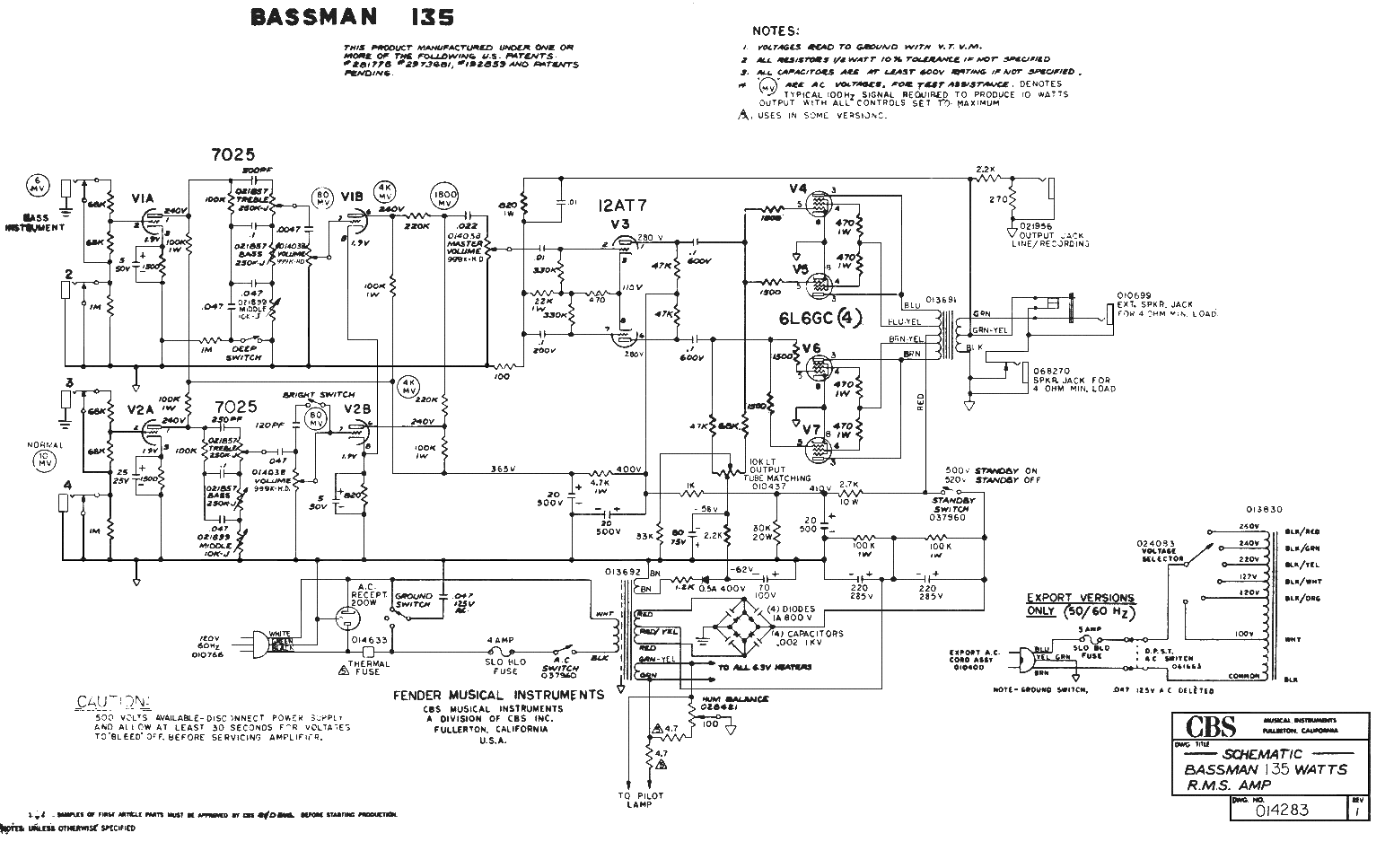
http://www.drtube.com/schematics/fender/bassman135.gif
-
thebassman
- New member
- Posts: 22
- Joined: Fri Jun 20, 2008 7:29 am
Re: Fender Bassman 1968 silverface
This occurs where the fiber eyelet board - which is waxed to keep out moisture, but often not very well - begins to degrade and develop very slight conductive paths through the material which like all organic substances is carbon-based. You won't be able to measure the resistance - it's extremely high - but under several hundred volts of the B+ supply it will leak tiny currents between some of the eyelets and cause all sorts of problems, including noise but also sometimes just odd tone and occasionally instability.
Sometimes it's caused by the insulating layer under the eyelet board itself (which touches the eyelets underneath) and if so you can fix it by inserting a new layer of insulating material - plain cardboard works well - between the two. It's not that with this one though. At this point there's no solution other than replacing the board - I've even tried reheating it (with a hairdryer!) and adding more wax, but actually that made it worse, which pretty much confirms it's the problem.[/quote]
As my particular configuration fibre board is no longer available.
Is there a more "modern" board or technique i should be using??
Sometimes it's caused by the insulating layer under the eyelet board itself (which touches the eyelets underneath) and if so you can fix it by inserting a new layer of insulating material - plain cardboard works well - between the two. It's not that with this one though. At this point there's no solution other than replacing the board - I've even tried reheating it (with a hairdryer!) and adding more wax, but actually that made it worse, which pretty much confirms it's the problem.[/quote]
As my particular configuration fibre board is no longer available.
Is there a more "modern" board or technique i should be using??
-
BlueAngel
Re: Fender Bassman 1968 silverface
OK, today I got into the Bassman 70 and fixed it, without needing to replace the board or anything major.
It was just one eyelet that was causing the problem. I identified it by building a "cat's cradle" circuit above the board by undoing each all the components from each eyelet but tacking them back together floating in space - this is tricky! I left a few connections which I knew couldn't be part of the problem (grounds mainly) so the whole lot would just stay in place. I had a good idea of where to start so it didn't take long.
The culprit was the double eyelet joined by a piece of plain wire where the B+ voltage comes up from the cap tray and is then distributed to the preamp; the two 100K plate resistors for the bass channel (one of which has a bypass cap) also come off this connection. It was actually specifically the other one of the pair, where the B+ wires go, that was doing it. Once this one was lifted the noise stopped entirely. It's probably not too surprising it was one of these two because the highest voltage in the preamp is here.
To fix it, I found a small piece of terminal strip with one ground tag and one isolated. I cleaned out the solder from the eyelet nearer the tubes, fitted the terminal strip to it using a small brass screw through the ground tag, then soldered it down thoroughly. Then I connected both B+ wires, the two plate resistors and the bypass cap to the isolated terminal, which is now electrically separate from the board. Sorted! It's now as quiet as any amp this age with mostly original components can be expected to be.
Hopefully yours will be the same, or at least this will give you some help to fix it at very little cost or work.
I may be leaving this forum for reasons not connected with this thread or amps, so I probably won't be able to answer any more questions, sorry.
It was just one eyelet that was causing the problem. I identified it by building a "cat's cradle" circuit above the board by undoing each all the components from each eyelet but tacking them back together floating in space - this is tricky! I left a few connections which I knew couldn't be part of the problem (grounds mainly) so the whole lot would just stay in place. I had a good idea of where to start so it didn't take long.
The culprit was the double eyelet joined by a piece of plain wire where the B+ voltage comes up from the cap tray and is then distributed to the preamp; the two 100K plate resistors for the bass channel (one of which has a bypass cap) also come off this connection. It was actually specifically the other one of the pair, where the B+ wires go, that was doing it. Once this one was lifted the noise stopped entirely. It's probably not too surprising it was one of these two because the highest voltage in the preamp is here.
To fix it, I found a small piece of terminal strip with one ground tag and one isolated. I cleaned out the solder from the eyelet nearer the tubes, fitted the terminal strip to it using a small brass screw through the ground tag, then soldered it down thoroughly. Then I connected both B+ wires, the two plate resistors and the bypass cap to the isolated terminal, which is now electrically separate from the board. Sorted! It's now as quiet as any amp this age with mostly original components can be expected to be.
Hopefully yours will be the same, or at least this will give you some help to fix it at very little cost or work.
I may be leaving this forum for reasons not connected with this thread or amps, so I probably won't be able to answer any more questions, sorry.
-
soundmasterg
- RRF Consultant
- Posts: 1923
- Joined: Tue Oct 01, 2002 1:06 pm
Re: Fender Bassman 1968 silverface
The one thing that I'd add to this is that if you decide to change to 6550's instead of the 6L6GC's, the filament requirements are higher for the 6550, so they may not be a direct swap. There would be some testing that would have to be done after the swap to see if it would be ok. The other thing I'd add is that UL amps like this particular one and Sunns can sound very nice for guitar if the negative feedback loop is disconnected. I prefer these types of amps for bass myself.BlueAngel wrote:No, not completely - the 135 is a slightly different design. The power section is an 'Ultra-Linear' type and you should probably leave this alone, as converting it properly to an earlier circuit is a really big job, and actually (for a bass amp) this circuit is probably more useful anyway because it has significantly more headroom and punch, although at the expense of a much harder transition to distortion and being a bit hard on the tubes when it does. In fact, although the voltages and power output are at the upper limit of what 6L6 tubes will take - especially modern-production ones - you can directly fit 6550s instead which will increase power and improve tone and reliability. This is a drop-in swap, you don't even need to rebias since the 6550s are running well within their rating.thebassman wrote:i have thought about changing my amp to a more desireable circuit. I just don't know where to get hold of the correct circuit diagram. The other ones i have seen online seem to be for less powerfull amps, mine is the bassman 135.
Is it possible to change my amp??
You also can't take the preamp back as far as an AA864 or AB165 (the more desirable Bassman 50W circuits) because those use an extra tube - which was actually configured with a large amount of negative feedback to try to squeeze as much clean power out of a 50W bass amp as possible. But the Super Bassman or Bassman 100 are possibilities since they also only use three preamp tubes. The schematics for these are easily available online, just do a search.
Now I am thinking about this I will have another look at my noisy Bassman 70 (which is just a lower-powered 135) and see if I can come up with anything. Don't wait up, it will be at least a few days before I can get to it
Hopefully you don't have to leave! I've found your help in answering some of these questions helpful, and it is great to have another knowledgeable person here too.I may be leaving this forum for reasons not connected with this thread or amps, so I probably won't be able to answer any more questions, sorry.
Greg
Re: Fender Bassman 1968 silverface
A big +1.soundmasterg wrote:Hopefully you don't have to leave! I've found your help in answering some of these questions helpful, and it is great to have another knowledgeable person here too.BlueAngel wrote:I may be leaving this forum for reasons not connected with this thread or amps, so I probably won't be able to answer any more questions, sorry.
Greg

Re: Fender Bassman 1968 silverface
I'll add my vote for leaving the ultralinearity in place -- it'll sound great and afford a lot of headroom as long as the rest of the circuit is voiced well. Before deleting the negative feedback outright, you might try increasing the feedback resistor or replacing it with a pot in order to dial in a sound you like.
Use good tubes, as those are some scary voltages!
- Scott
P.S. +2 on staying here if you can, John. I've always dug your insight and advice, here and at the TDPRI.
Use good tubes, as those are some scary voltages!
- Scott
P.S. +2 on staying here if you can, John. I've always dug your insight and advice, here and at the TDPRI.
-
BlueAngel
Re: Fender Bassman 1968 silverface
It's fine in the Bassman 70 and 135 - the extra filament draw is not that big, and these amps share common power transformers with the Twin Reverb and Pro Reverb, which have double the number of preamp tubes (and draw a little more B+ current for them too, especially to drive the reverb). I've done this swap in quite a lot of Bassmans and everything seems to check out.soundmasterg wrote:The one thing that I'd add to this is that if you decide to change to 6550's instead of the 6L6GC's, the filament requirements are higher for the 6550, so they may not be a direct swap. There would be some testing that would have to be done after the swap to see if it would be ok.
I wouldn't do the same thing in a Twin or Pro - partly because of the filament current but mainly because the tone and headroom change is in the wrong direction for guitar... if anything these amps need to go the other way, towards softer and lower headroom, and will sound much better sticking with 6L6s. If you're in Europe or Australia there's a really simple trick you can do with them to make them much more friendly to modern tubes - the Export models have a voltage selector with 220, 240 and 260V settings, and although no country I know of ever used 260V (so I have no idea why it was provided!), if you set the amp to this in the UK with our 240V supply (or to 240V in continental Europe with 220V), that's exactly the same as using a Variac to drop the line voltage by about 10%. The result is that the B+ goes down to around 475V, right in the best range for reliability with modern 6L6s, and the tone gets a little fatter and warmer too. (For what it's worth, Mesa use this same trick on their amps with either the 'Tweed' or 'Spongy' settings - that uses an extra section of primary winding to give a 15% reduction in effective supply voltage.) If you don't have that option and don't want to do away with the Ultra-Linear circuit, it may be a good idea to try increasing the screen resistor values significantly, since screen failure seems to be mostly the problem with new-production 6L6s and 6V6s at high B+, rather than outright plate failure. This will also soften the tone and reduce the headroom a bit.
I may stay, at least on this page. Thank you for you kind commentsHopefully you don't have to leave! I've found your help in answering some of these questions helpful, and it is great to have another knowledgeable person here too.
.-
thebassman
- New member
- Posts: 22
- Joined: Fri Jun 20, 2008 7:29 am
Re: Fender Bassman 1968 silverface
Well i spent the weekend measuring, marking, drilling and fixing new tube rivets to my new epoxy fibre board.
I meticuously removed every component from the old fibre eyelet board and transferred to my new afore mentioned board.
Connected it all back up to the input/ outputs and it is exactly the same as before....... although it does look a very nice neat job.
I am at my witts end with this amp. Could anyone explain how to check for DC leakage on the pots ( i am not sure where abouts to check with the DMM) or other possible solutions.
cheers in advance.
Martin
Has anyone heard any more from blueangel, his profile looks dead?
I meticuously removed every component from the old fibre eyelet board and transferred to my new afore mentioned board.
Connected it all back up to the input/ outputs and it is exactly the same as before....... although it does look a very nice neat job.
I am at my witts end with this amp. Could anyone explain how to check for DC leakage on the pots ( i am not sure where abouts to check with the DMM) or other possible solutions.
cheers in advance.
Martin
Has anyone heard any more from blueangel, his profile looks dead?
-
soundmasterg
- RRF Consultant
- Posts: 1923
- Joined: Tue Oct 01, 2002 1:06 pm
Re: Fender Bassman 1968 silverface
So channel 1 still has scratchy pots when you move the controls?
Does the volume control for channel 1 make any difference?
If the pots are scratchy, then a DC voltage is on the pots. You can measure this with a DMM. Hook one lead to ground and the other to the pot leads and turn the amp on in operate mode. If you CAREFULLY touch the positive meter probe to the pot leads, if you have a DC voltage greater than about .3v on any of the tone pots, or the volume pot, then there is a bad cap somewhere that is letting the DC voltage get past it. If you follow the circuit back from the tone stack and volume control, you should be able to find the bad cap by process of elimination.
Let me kno the exact symptoms and what affects/changes them, and I can see if I can help more.
Greg
Does the volume control for channel 1 make any difference?
If the pots are scratchy, then a DC voltage is on the pots. You can measure this with a DMM. Hook one lead to ground and the other to the pot leads and turn the amp on in operate mode. If you CAREFULLY touch the positive meter probe to the pot leads, if you have a DC voltage greater than about .3v on any of the tone pots, or the volume pot, then there is a bad cap somewhere that is letting the DC voltage get past it. If you follow the circuit back from the tone stack and volume control, you should be able to find the bad cap by process of elimination.
Let me kno the exact symptoms and what affects/changes them, and I can see if I can help more.
Greg

Re: Fender Bassman 1968 silverface
I have been following this thread with great interest as I have a amp with a scratchy volume pot. I changed it last year because it seemed to come on abruptly after turning it a bit (cleaning didn't help & neither did the new pot). The amp was used but new to me when I did this. I didn't remember the old pot being noisey but I am not sure. The new pot is scratchy even after cleaning it so I guess I need to follow the same procedure.
"The best things in life aren't things."