
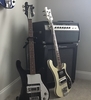
Ok guys, both rods out, both straight as an arrow.
Proceeding with bending.
Luthier NJ area
Moderator: jingle_jangle

Re: Luthier NJ area
Don't forget, always bend at the knees.nov_1981 wrote:Ok guys, both rods out, both straight as an arrow.
Proceeding with bending.

-
jingle_jangle

- RRF Moderator
- Posts: 22679
- Joined: Wed Dec 22, 2004 6:00 am
- Contact:
Re: Luthier NJ area
Some of those rods have knees right about where flamingos have ankles.
Re: Luthier NJ area
Paul, when re-inserting the rods the peak of the arch
points toward the fret board, correct?
points toward the fret board, correct?
-
jingle_jangle
- RRF Moderator
- Posts: 22679
- Joined: Wed Dec 22, 2004 6:00 am
- Contact:
Re: Luthier NJ area
Yes, arch on top.
Re: Luthier NJ area
Well, rods bent arch up, re-strung, tuned up, adjusted neck
and still the same old buzz from 3rd to 7th frets on A, D & G strings.
I have to keep the action too high to stop the buzzing.
Whats strange is when the rods were out, both sides of the neck were straight
but with the rods in and tuned the treble side remained straight as it did before
with just the nut snug but the bass rod again needed to be tightened a lot to get
it straight.
This is extremely frustrating
Thanks again for your advice everyone
and still the same old buzz from 3rd to 7th frets on A, D & G strings.
I have to keep the action too high to stop the buzzing.
Whats strange is when the rods were out, both sides of the neck were straight
but with the rods in and tuned the treble side remained straight as it did before
with just the nut snug but the bass rod again needed to be tightened a lot to get
it straight.
This is extremely frustrating
Thanks again for your advice everyone

Re: Luthier NJ area
If you can measure it flat with no strings and rods, then the rods needing to bring the neck back straight under string tension has to be the cause for the hump at the frets you mention, or the bow in the rod itself. I had that with my 4003S and I put the rods back in straight and never had the hump again. With just the rods back in and no strings, is the hump at those frets? With curved rods though, there will be a backbow to the neck with just the rods..... hmmmm.
What tension strings are you using?
What tension strings are you using?
Re: Luthier NJ area
TI flats JF344 and yes this is the 1989 4003s we're talking about
Re: Luthier NJ area
Rereading, if you have a flat neck with no strings and no rods, I would straighten the rods completely and then insert them, string up to full tension, then adjust the rods for flat or any relief if you need that. I had to have straight rods on mine to not get the hump.
TI flats are very low tension so that isn't a contributor, unless we consider the curve of the rods as unnecessary because of the light load of the strings.
TI flats are very low tension so that isn't a contributor, unless we consider the curve of the rods as unnecessary because of the light load of the strings.
-
jingle_jangle
- RRF Moderator
- Posts: 22679
- Joined: Wed Dec 22, 2004 6:00 am
- Contact:
Re: Luthier NJ area
You will get a better range of adjustment if the rods are pre-curved. Essentially, what you're doing is anticipating the stress put on the straight neck by the strings, which are bending it forward. And although we can't perfectly match things up right off the bat, preload does help.
Even so-called low tension strings exert a lot of force on a bass neck, although I don't have figures for the T-Is.
Even so-called low tension strings exert a lot of force on a bass neck, although I don't have figures for the T-Is.
Re: Luthier NJ area
Paul, how do you explain the hump the neck gets when the rods are inserted? He stated it is there with the rods and strings on. My 4004 and 4003S were doing this, at different places for each one, and the only solution I could use to make the necks flat under tension was to straighten the rods. And on the 4004, the truss nuts are only snugged to eliminate rattle of the rods with higher tension D'Addario Chromes on it. That experience with both necks was the reason for my post to consider straight rods.jingle_jangle wrote:You will get a better range of adjustment if the rods are pre-curved. Essentially, what you're doing is anticipating the stress put on the straight neck by the strings, which are bending it forward. And although we can't perfectly match things up right off the bat, preload does help.
Even so-called low tension strings exert a lot of force on a bass neck, although I don't have figures for the T-Is.
-
jingle_jangle
- RRF Moderator
- Posts: 22679
- Joined: Wed Dec 22, 2004 6:00 am
- Contact:
Re: Luthier NJ area
I would explain humps in bass necks as yhou might think, John--they're due to various unresolved stresses. In most cases, the wood of the neck has a consistent density, the rods are appropriately tightened to counteract the asymmetrical string tension, and everything is hunky-dory.
Anomalies occur with neck wood of varying density, uneven string tension, and improperly-adjusted rods, and by definition take some time to become obvious.
My suggestion to curve the rods merely speaks to a concept of having things at equilibrium when the strings are tuned to pitch. A "soft" area in the neck wood, while not immediately evident, would cause the wood to distort in a specific location. This could be helped by curving the rods; it could be helped by keeping them straight. My suggestion of curving them was not in the nature of a cure-all or even as a cure in this specific case. It was, however, suggested as a way to get back to a baseline "setting", so the effect on the hump could be "read", either positive or negative. It might even be decided that one straight rod and one curved would work...
In my experience, the most reliable cure for neck hump is to heat-straighten (in many cases) or shave the fretboard and partially refret (in others). The criteria for choosing method would depend upon an in-hand inspection, though.
Anomalies occur with neck wood of varying density, uneven string tension, and improperly-adjusted rods, and by definition take some time to become obvious.
My suggestion to curve the rods merely speaks to a concept of having things at equilibrium when the strings are tuned to pitch. A "soft" area in the neck wood, while not immediately evident, would cause the wood to distort in a specific location. This could be helped by curving the rods; it could be helped by keeping them straight. My suggestion of curving them was not in the nature of a cure-all or even as a cure in this specific case. It was, however, suggested as a way to get back to a baseline "setting", so the effect on the hump could be "read", either positive or negative. It might even be decided that one straight rod and one curved would work...
In my experience, the most reliable cure for neck hump is to heat-straighten (in many cases) or shave the fretboard and partially refret (in others). The criteria for choosing method would depend upon an in-hand inspection, though.
Re: Luthier NJ area
Okay. I was just confused. When he stated the neck was straight with no strings and rods out, but had the hump when curved rods were inserted and strung up, this paralleled my experience and the solution was straight rods which when inserted, and the neck strung up, resulted in a straight neck with just a tad of tightening of the rods.
-
jingle_jangle
- RRF Moderator
- Posts: 22679
- Joined: Wed Dec 22, 2004 6:00 am
- Contact:
Re: Luthier NJ area
I suppose I wasn't clear enough...but I think we can agree that the problem is probably an anomaly with the wood.