
Ricky Redemption: Confessions of a Erstwhile 4001 Vandal
Moderators: rickenbrother, ajish4

Re: Ricky Redemption: Confessions of a Erstwhile 4001 Vandal
Troy welcome to the forum - great tale! Please keep us posted.
The Good, The Bad, and The %#$!ing Unthinkable
Wow, thanks to all for the great replies! Let's see, we've got lots of warm welcome, some commiseration from fellow ex-offenders, plenty of encouragement to move forward with my project -- all sorts of good stuff. Okay, this seems like license to press on to today's topic:
The Good, The Bad, and The %#$!ing Unthinkable
Most readers of my original post have seen this poor creature by now, but of course the RickResource Register quite rightly limits me to the standard set of poses. So, for your consideration, I submit the following additional crime scene photos with accompanying notes.
The Good:
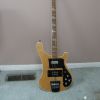
It was a 4001. From everything I can see, finish color and quality, cavity markings, dual truss rods, narrow skunk stripe and nice wood grain, etc., this was once a genuine Rickenbacker 4001 bass guitar. I've even chosen to believe that the jack plate/serial number is original, primarily based on a careful examination of the beautiful pictures of #MJ4730 in the Register. These basses would have been twins in October of '73; obviously mine has had the harder life. Check out the Body - Front poses of both basses side by side; they look like before and after pics. Note especially those non-full-width inlays made from some weird material that is practically clear, like the white onyx stone they carve animal figurines from in Mexico. I actually had never seen Rick triangle inlays done in anything but ***** ** ****** **** or the older crushed pearl material, and I was a little dubious until I saw pics of some other '73 models that had similar inlays.
It is a complete 4000. As Paul B. observed, someone has downgraded this to a 4000 model. I can confirm that this conversion is essentially complete. It appears that everything that was attached to the front side of the bass with a wood screw was removed and replaced with the same components from a 4000. The pot codes are from 1976, and everything under the guard seems to be complete and not really messed with. The stereo jack was removed from the jack plate, presumably because the 4000 electronics had nothing to connect to it. The Model 4000 TRC is in quite decent shape, and may well have come from the same '76 vintage 4000 that the pickguard and electronics came from. Also, there is a bag of parts in the zip pouch of the gig bag that appears to contain a full set of wavy Grovers (plus one in pieces), as well as the saddle assembly and a top nut cut for the original 4 strings. So if I can get a few of the major problems cleared up, I think I have everything I need to make a 4000, and can work my way back up to a 4001 as budget permits (for second pickup and controls, new pickguard, new TRC, etc.).
The neck seems good. I can see no cracks in the wood anywhere, and it seems pretty straight. The attached photo isn't a great angle, but I can see no noticeable bowing or twisting in any direction.
The finish isn't bad. It's weird that Tony C. somehow read that Burgundy wasn't my favorite. I didn't write anything like that that I can see in my original post. The weird thing is that it's true, and he must have read my mind. I was not terribly excited about the color when I first saw it, but it has grown on me, mostly because it's very translucent and shows nice grain. There's some buckle rash, a little thumb wear, and some side chips, including a big one by the jack plate, but I think buffing and perhaps some touch-up is the way I'm going to go with this one. I don't think they'll let me back into my old dorm to do the full refin again anyway. Heck, if I tried to buy something from the Fender Custom Shop with a finish that looked like this, it'd cost me $15,000. If I do decide to refin it at some point in the future, though, it will be to Mapleglo.
The Bad:
Neck pickup carnage. There's already a good pic of this in one of my Free Images in the Register. I don't have much else to say about it. Some people like to put aftermarket pickups on guitars, and I guess I can understand that; I just wish they wouldn't use a Pulaski and a vegetable peeler to do the routing. I'm not terribly concerned about this, as I'm sure I'll be able to get a Ricky pickup to fit back in there someday, and the pickguard covers it all up in any case.
Tailpiece carnage. The tailpiece was severely mutilated as part of the aborted 5-string conversion attempt. It has almost no chrome left on it, which isn't a huge problem, but enough of the structural metal has been removed that I'm concerned about its integrity. I expect I'll be in the market for another tailpiece at some point.
The %#$!ing Unthinkable:
The $*%#ing HOLE!!!
I have no words.
Okay, I do have a couple, and they're probably not allowed in forum posts. I try to imagine what goes through someone's head as they're pressing a madly-spinning paddle bit into the headstock of a vintage Rickenbacker 4001 bass. The mind boggles. The only thing I can maybe come up with is the twisted mindset that Edward Norton's character confesses to in Fight Club after he beats Jared Leto's face in: "I felt like destroying something beautiful."
Plug it up seems to be the consensus here, and I'm inclined to agree, though I expect it'll be quite the refinishing task to touch up a hole that big.
The @&#^$&%ed fingerboard!!! I'm surprised that no one noticed/mentioned the fact that there are no frets on this bass. Apparently not satisfied with his travesty of a 5-string conversion, Mr. Fight Club decided to go fretless as well, and yanked all twenty frets out with a Vise-Grip and/or flat-bladed screwdriver. There are a number of noticeable chips missing from the fretboard as well as two or three neck binding cracks to attest to this. Then, he slapped several sloppy layers of clear poly over the fretboard, over the missing chips, and down into the fret slots. Not enough to actually fill the fret slots and give him a smooth fretless fingerboard, mind you, just enough so that I'm guessing it'll have to be picked/filed/sawn out before frets can be put back in. Also, the poly he used seems to have caused serious yellowing of the already strange-looking inlays. This is Jack's complete lack of regard for master craftsmanship.
====================
Next steps and advice needed:
1) I'm not prepared to learn how to do fret work by refretting this bass. Can anyone provide recommendations for luthiers in the Minneapolis metro area who have experience with 4001 refrets and truss rod adjustments? What is the ballpark amount I can expect to pay for a refret of this nature? Would I be likely to save any money by stripping the fingerboard and/or cleaning poly out of the fret slots myself, or will that just make my luthier's job more difficult?
2) How difficult will it be to trade my 4000 TRC for a 4001 TRC? Any chance I can get a black one? Will RIC do it? Any forumites out there who could benefit from such a trade, for either color TRC?
3) How expensive and/or difficult will it be to try to retouch the finish on spots like the extra headstock hole plug or the larger (a square inch or so) side chips?
Thanks again for giving me a place to think out loud about this project, and thanks in advance for any advice you offer. I'm really looking for a good player (especially since any collector value this bass once had is pretty much gone), but I want it to look decent as well.
TVB
____________________________________________________________________________
Note: ***** ** ****** **** is a moderator edit. Let's cool it with the derogatory terms - Joey
____________________________________________________________________________
The Good, The Bad, and The %#$!ing Unthinkable
Most readers of my original post have seen this poor creature by now, but of course the RickResource Register quite rightly limits me to the standard set of poses. So, for your consideration, I submit the following additional crime scene photos with accompanying notes.
The Good:
It was a 4001. From everything I can see, finish color and quality, cavity markings, dual truss rods, narrow skunk stripe and nice wood grain, etc., this was once a genuine Rickenbacker 4001 bass guitar. I've even chosen to believe that the jack plate/serial number is original, primarily based on a careful examination of the beautiful pictures of #MJ4730 in the Register. These basses would have been twins in October of '73; obviously mine has had the harder life. Check out the Body - Front poses of both basses side by side; they look like before and after pics. Note especially those non-full-width inlays made from some weird material that is practically clear, like the white onyx stone they carve animal figurines from in Mexico. I actually had never seen Rick triangle inlays done in anything but ***** ** ****** **** or the older crushed pearl material, and I was a little dubious until I saw pics of some other '73 models that had similar inlays.
It is a complete 4000. As Paul B. observed, someone has downgraded this to a 4000 model. I can confirm that this conversion is essentially complete. It appears that everything that was attached to the front side of the bass with a wood screw was removed and replaced with the same components from a 4000. The pot codes are from 1976, and everything under the guard seems to be complete and not really messed with. The stereo jack was removed from the jack plate, presumably because the 4000 electronics had nothing to connect to it. The Model 4000 TRC is in quite decent shape, and may well have come from the same '76 vintage 4000 that the pickguard and electronics came from. Also, there is a bag of parts in the zip pouch of the gig bag that appears to contain a full set of wavy Grovers (plus one in pieces), as well as the saddle assembly and a top nut cut for the original 4 strings. So if I can get a few of the major problems cleared up, I think I have everything I need to make a 4000, and can work my way back up to a 4001 as budget permits (for second pickup and controls, new pickguard, new TRC, etc.).
The Bad:
Neck pickup carnage. There's already a good pic of this in one of my Free Images in the Register. I don't have much else to say about it. Some people like to put aftermarket pickups on guitars, and I guess I can understand that; I just wish they wouldn't use a Pulaski and a vegetable peeler to do the routing. I'm not terribly concerned about this, as I'm sure I'll be able to get a Ricky pickup to fit back in there someday, and the pickguard covers it all up in any case.
Tailpiece carnage. The tailpiece was severely mutilated as part of the aborted 5-string conversion attempt. It has almost no chrome left on it, which isn't a huge problem, but enough of the structural metal has been removed that I'm concerned about its integrity. I expect I'll be in the market for another tailpiece at some point.
The %#$!ing Unthinkable:
The $*%#ing HOLE!!!
I have no words.
Okay, I do have a couple, and they're probably not allowed in forum posts. I try to imagine what goes through someone's head as they're pressing a madly-spinning paddle bit into the headstock of a vintage Rickenbacker 4001 bass. The mind boggles. The only thing I can maybe come up with is the twisted mindset that Edward Norton's character confesses to in Fight Club after he beats Jared Leto's face in: "I felt like destroying something beautiful."
Plug it up seems to be the consensus here, and I'm inclined to agree, though I expect it'll be quite the refinishing task to touch up a hole that big.
The @&#^$&%ed fingerboard!!! I'm surprised that no one noticed/mentioned the fact that there are no frets on this bass. Apparently not satisfied with his travesty of a 5-string conversion, Mr. Fight Club decided to go fretless as well, and yanked all twenty frets out with a Vise-Grip and/or flat-bladed screwdriver. There are a number of noticeable chips missing from the fretboard as well as two or three neck binding cracks to attest to this. Then, he slapped several sloppy layers of clear poly over the fretboard, over the missing chips, and down into the fret slots. Not enough to actually fill the fret slots and give him a smooth fretless fingerboard, mind you, just enough so that I'm guessing it'll have to be picked/filed/sawn out before frets can be put back in. Also, the poly he used seems to have caused serious yellowing of the already strange-looking inlays. This is Jack's complete lack of regard for master craftsmanship.
====================
Next steps and advice needed:
1) I'm not prepared to learn how to do fret work by refretting this bass. Can anyone provide recommendations for luthiers in the Minneapolis metro area who have experience with 4001 refrets and truss rod adjustments? What is the ballpark amount I can expect to pay for a refret of this nature? Would I be likely to save any money by stripping the fingerboard and/or cleaning poly out of the fret slots myself, or will that just make my luthier's job more difficult?
2) How difficult will it be to trade my 4000 TRC for a 4001 TRC? Any chance I can get a black one? Will RIC do it? Any forumites out there who could benefit from such a trade, for either color TRC?
3) How expensive and/or difficult will it be to try to retouch the finish on spots like the extra headstock hole plug or the larger (a square inch or so) side chips?
Thanks again for giving me a place to think out loud about this project, and thanks in advance for any advice you offer. I'm really looking for a good player (especially since any collector value this bass once had is pretty much gone), but I want it to look decent as well.
TVB
____________________________________________________________________________
Note: ***** ** ****** **** is a moderator edit. Let's cool it with the derogatory terms - Joey
____________________________________________________________________________
Last edited by Machead on Sat Jan 10, 2009 6:03 am, edited 1 time in total.
A few more pics...
Why stop at five? Looks like there was plenty of room for seven strings on the tail!
Frets? We don't need no stinkin' frets! No need to fill the fret slots either; bada bing, bada boom -- now it's a fretless!
Re: Ricky Redemption: Confessions of a Erstwhile 4001 Vandal
I wish I had the idiot that did this to such a beautiful bass!! I would like to hit him on the head with it. Sorry don't want to promote hatred on the forum. lets just say he was misguided. A good fret job will cost some $$ if you need some guidance
get in touch with Paul (jingel-jangel) on this forum an excellent luthier and rick specialist or Dale Fortune. they can give you sage advise.
also you can go the Rickenbacker forums to get email addresses for them
Good luck again, just keep thinking how beautiful its going to look when you finish it.

get in touch with Paul (jingel-jangel) on this forum an excellent luthier and rick specialist or Dale Fortune. they can give you sage advise.
also you can go the Rickenbacker forums to get email addresses for them
Good luck again, just keep thinking how beautiful its going to look when you finish it.
Re: Ricky Redemption: Confessions of a Erstwhile 4001 Vandal
Thanks to Patrick N. for reminding me that this started out with my forgiving the misguided individual who did this. The last couple paragraphs didn't sound very forgiving. No more past-midnight forum posts for me.
My eyes are very much on the prize here, and not so much on what happened in the past that can't be undone.
My eyes are very much on the prize here, and not so much on what happened in the past that can't be undone.
Mea culpa
I'd like to apologize profusely for using the term that was moderated out of my earlier post. It was not my intention to be in any way derogatory to RIC or its products, and certainly not to be disrespectful towards any of the people responsible for these beautiful instruments. I reread my post this morning, and I was a little meaner than I meant to be to the poor fool who was responsible for the current condition of my bass, but I have to plead ignorance/stupidity about the words that were edited out. I first heard that term when I sent some pics of this bass around another mailing list/forum a few years ago, and I got a response from a guy who said he had worked at RIC in the 70's. I was very concerned that either the inlays on my bass were not original or that it wasn't really a Rickenbacker; he responded that he had looked at the pics of my cavity markings and inlays and could assure me that it was a real 4001. He told me that in 1973, RIC was making all sorts of changes to various aspects of production, and that for a while they were using a number of different inlay materials including the translucent white stuff mine has, the leftover crushed pearl stuff until it was gone, and various other pearloids including something he referred to as "mother-of..." (I'll edit myself here). I thought it was just a funny phrase, and in the context of our discussion he seemed to be using it a) almost as a term of endearment, as well as b) a genuinely descriptive term of certain runs of pearloid material that had very prominent swirl and figuring.
I feel rather stupid and insensitive for not even considering that it might actually be an offensive or derogatory term; it seems painfully obvious in hindsight, and I just wanted to offer an apology to the forum and anyone reading it who I might have offended. I'm new here, and I meant this to be a light-hearted discussion/status thread about a bass project I'm very excited about. I'll try to move it back in that direction.
I feel rather stupid and insensitive for not even considering that it might actually be an offensive or derogatory term; it seems painfully obvious in hindsight, and I just wanted to offer an apology to the forum and anyone reading it who I might have offended. I'm new here, and I meant this to be a light-hearted discussion/status thread about a bass project I'm very excited about. I'll try to move it back in that direction.