
2006 360 Showing lines
Moderators: rickenbrother, ajish4
-
btomlinson
- Junior Member
- Posts: 105
- Joined: Wed Feb 22, 2006 9:44 am
2006 360 Showing lines
When I look at my 2006 Jet Glo head stock I see the wood lines through the jet glo finish on the back and front. I cannot feel the lines. Is this normal? I do not see the lines in my AFG 660. The guitar lives in it's case and has never been exposed to extreme humidity and or dryness.

Re: 2006 360 Showing lines
This is normal ... IIRC, my 360 Turquoise has lines like that ... I'll see if I can find a picture.
It is better, of course, to know useless things than to know nothing. - Seneca

Re: 2006 360 Showing lines
if they are like this,this is normall
http://www.rickresource.com/register/us ... llsize.jpg
http://www.rickresource.com/register/us ... llsize.jpg

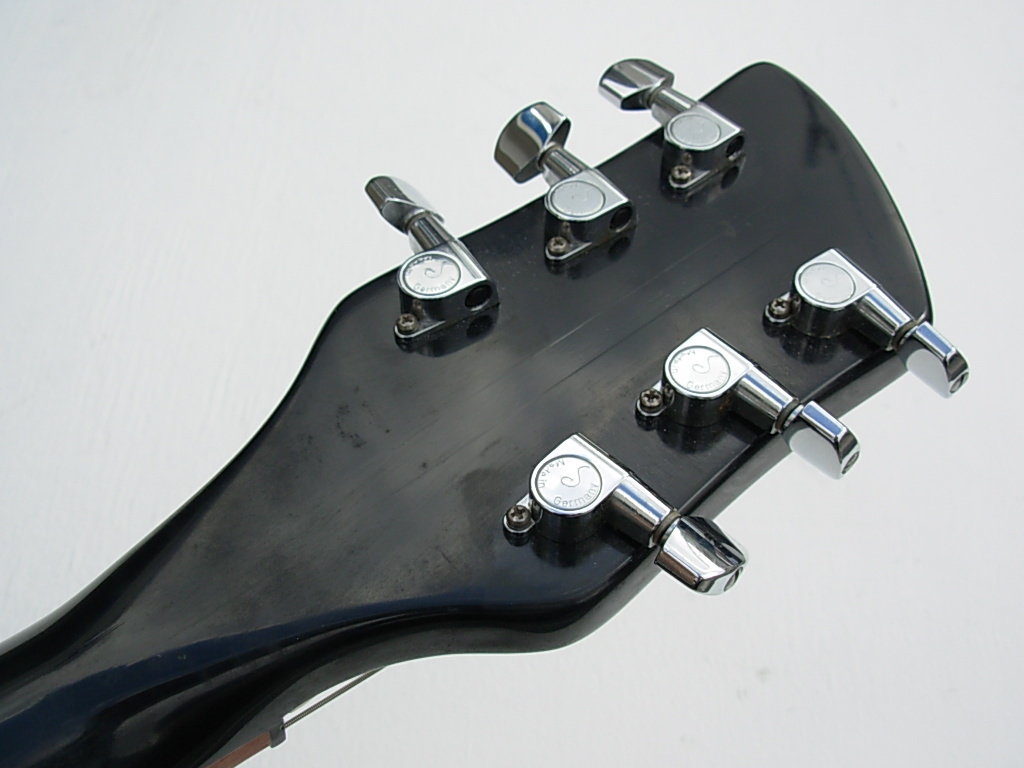
Re: 2006 360 Showing lines
I have seen that on many solid color Ricks. I suppose it's difficult to completely raise the grain and sand-and-seal the maple, particularly flame maple. I have only noticed this on instruments from the first half of this decade. I wonder if Eric B's team has ironed this out (pun not intended). Hopefully he'll chime in and complement (not to be confused with compliment) my uneducated observations.
-
btomlinson
- Junior Member
- Posts: 105
- Joined: Wed Feb 22, 2006 9:44 am
Re: 2006 360 Showing lines
It does look like the ones in the picture.
Thanks
Thanks
Re: 2006 360 Showing lines
Brett my 360 08 MID had this also.no worries 
-
jingle_jangle

- RRF Moderator
- Posts: 22679
- Joined: Wed Dec 22, 2004 6:00 am
- Contact:
Re: 2006 360 Showing lines
I wrote out a long and detailed response to the OP, very early this AM on my laptop. Somehow I hit the wrong key with my right pinky and the whole darned thing was deleted (not really that much a fan of Windows, and it's a SONY VAIO...)jdogric12aolcom wrote:I have seen that on many solid color Ricks. I suppose it's difficult to completely raise the grain and sand-and-seal the maple, particularly flame maple. I have only noticed this on instruments from the first half of this decade.
So now I'll try to reconstruct thus:
All wood grows at varying rates. This is the source of the annual rings you see in those nature book photographs of a tree stump with some guy's finger pointing to the rings on the stump...
The varying rates of growth lead to varying densities in the wood. Soft wood like pine and spruce show the most variations in density, and hard woods like maple the least. Perhaps the most variation can be seen in fast-growth, farm-grown builder's dimension lumber like 2 X 4s and like items. The slower growth is generally darker in color because the individual cells are packed closer together.
As wood gains and releases moisture, it settles. This is unique for each piece of wood, and largely unpredictable, except in very general terms. Over time, a piece of maple finished on one side, as we find in a Rickenbacker guitar, will often shrink more in the areas of lesser density, and less in denser areas. This can show up at any time and to varying degrees. After all, wood is organic, and while it stops growing once cut and shaped, it still reacts to environmental factors.
Extremely hard woods like old-growth walnut, and vermilion, shedua, padauk, and other tropical varieties are mostly very dense and don't show a lot of variations in density, due to their very slow growth during all seasons. In the case of tropical woods, factors such as moisture, temperature, and sunlight don't vary, so these woods grow with a very consistent density and exhibit little selective shrinkage across annual rings. Additionally, a tropical tree's biggest enemy in the survival struggle is very aggressive boring insects, so they grow very dense, aromatic wood to assist them in keeping the bugs at bay.
What you're seeing is a typical wood behavior. My own Carl Wilson (one of the rippliest believe-it-or-not grain patterns in RIC production!) was undoubtedly mirror-smooth after leaving the RIC plant, but now, some years later, having undergone some climatic adjustments, and despite being very well-pampered, is quite bumpy on the top due to the grain pattern beneath.
I don't really expect anyone to expect to defeat this natural tendency of wood, so the best thing to do is to live with it as a "given". This shows up, incidentally, least, in flat-sawn planks or billets, which, not coincidentally, have the straightest grain patterns.