So my buddy bought the thing, for $580. Then he did some research on how much parts would cost, and decided to sell it. I've always wanted a Rick. I already have lots of guitars, but no Ricks. It seemed like a pretty simple way to get into a Rickenbacker. Then I started buying parts, and realized how expensive this thing would turn out to be.
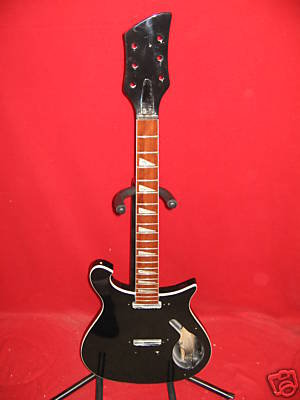
So I get everything in for the guitar, and set about assembling it. I started with just the naked guitar:


The body is in brand new shape.

Here's the serial number:

I bought a bunch of parts, some from Pick 'O The Ricks (which has awesome customer service!) and RIC themselves (who also has awesome customer service!).

I started off with the pickguard. I had a good time assembling this; I've always had a hand at electronics and I love soldering. What struck me was how expensive this gaggle of parts was: $35 for some knobs, $10/each for the pots, $25 for the switch....wow!


Here we see the only non-RIC part in the guitar: the blend pot, which is a generic 500K I had laying around. Can you spot my initial wiring errors?


Once I was done with that I installed the bridge ground wire.

Here's the lovely mint-condition bridge I sourced from Japan. Wrong screws, but I figured it out. Oh, and yeah, I actually bought screws from RIC.

The plate goes on!

Next I put the pickups in. My aforementioned friend had purchased a Harmony guitar some time ago with these toasters in it. He is "loaning" them to me in case I want to try out some Hi-Gains. Note that one pickup is missing a screw - doesn't seem to be a problem.

My buddy measured each pickup, and they rang in at 8.16k and 8.20k, respectively. I put the 8.20k in the bridge.

The pads go on. These were five dollars each, so I was very careful to apply them properly.


Now the tuners go on. These are Schallers, same as what RIC puts on these guitars, only purchased through Stewart Macdonald for considerably less dough.


Now I put in my official Rick-O-Sound jacks. They are a tight fit, and I wound up having to do some minor bending to get them to fit properly, but they work.


Now we wire in those pickups....

I can think of no better amp for this guitar to be born again with! Aside from wiring the blend knob backwards (whoops!), and putting wiring the tone pots to the wrong pickups (whoops again!), everything checks out.

Okay, this thing is starting to look like a guitar.


Finally, time for a tailpiece. The guitar was drilled for an "R" tailpiece - which I will eventually replace the trapeze with - but my drill made short work of it. Allow me to briefly complain about Rickenbacker not making these parts available - I understand the desire to stomp out cheap copies, but people, the market for an "R" tailpiece has them upwards of $200. That's ridiculous. It's the same for the truss rod cover and the damned jackplate, which I'll harp on about in a moment.


Last but not least - a truss rod cover. I sourced it off Ebay, paying $122.50 for a tiny bit of plastic that ought to cost $5. But now, the guitar is complete!

Epilogue:
I still haven't put a jack plate together. I emailed the New Jersey Butcher about it, but he didn't have it, and said that these guitars are parted out around the same time and the plate was most likely gone. Of course, if some good soul on these forums happens to have it, let me know, and I'll pay you bank for the doggone thing. Why Rickenbacker chooses to serialize one tiny part of the guitar as opposed to the guitar itself - like any other instrument maker - is beyond me. So for now, I am plugging into the mono jack which is held in place by friction. Yes, it's ghetto. Okay, enough harping. How's it play/sound?
I strung it up with my usual gauge - 10-52. I play in a few extra tunings, mostly just drop D, DADGAD, or open D, and find that this gauge of string helps considerably. It was a pain in the posterior to string up! That tailpiece reminds me of just why other instrument makers improved their bridge designs. Sure is pretty, though.
I did some basic adjustments just for action and whatnot, and fired up an amp. Wow! Once I intonated it, and stretched the strings a bit, I was able to get some really nice tones out of the guitar. I wouldn't call it bright, but I also wouldn't call it dark, either. The tone is somewhere in between a Tele and a Les Paul, sorta, with something entirely unique in there - I think some folks call it "chime". The guitar responds really well to strummed rhythms, but can also play single-note lines very nicely.
On a clean tone with a touch of reverb, the guitar sounds heavenly. String balance is really nice, with each string ringing out pretty much the same low to high. On a dirtier tone, I can get nice moderately overdriven sounds, especially if I'm pushing the power amp section of a tube amp. The guitar doesn't do really well with high gain preamp tones - it's way too noisy, which is probably due to the fact that neither the control cavity nor the pickups are really shielded against hum. But that's okay - I have other guitars which are far more suited to metal styles.
The controls work fine, although the Blend knob is a little weird - it seems like all the travel for that knob is in the final 90%. Going below 9 on this knob results in all bridge pickup, and the blend of the neck is from 9 to 10. It's no biggie, but it makes me wonder if I screwed up the wiring somehow. Perhaps I should have used a genuine RIC pot
All told I have about $1200 into the guitar - which is about what I would have paid for a used 620 in this finish. The project was super fun, though, and I don't regret a dollar spent. Hope you enjoyed the story! Finally, here's my cost sheet.
Neck/Body: $600
Tuners: $72
Pots: $40
Caps: $10
Pickup Pads: $10
Misc Screws/Grommets: $34
Pickguards: $35
Switch: $25
Ric O Sound assembly: $25
Tailpiece: $60
Bridge: $114
Truss Rod Cover: $125
Knobs: $33
Total: $1183