
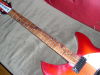
The Wikipedia page for the Rickenbacker 330 states:
"One idiosyncrasy of the guitar is its dual truss rods, which allow for the correction of problematic and unwanted twists, as well as curvature, of the guitar's neck."
Is this true? My luthier told me that, despite this conventional wisdom, a twisted neck cannot be corrected through adjustment of the truss rods. If he is correct, then what is the purpose of having two?
Truss rods and neck twist
Moderator: jingle_jangle
Truss rods and neck twist
1988 360 JG, 2008 660-12 AFG, 2009 330 FG
-
jingle_jangle
- RRF Moderator
- Posts: 22679
- Joined: Wed Dec 22, 2004 6:00 am
- Contact:
Re: Truss rods and neck twist
This is not an issue that can be addressed with a "sound bite" answer.miltric wrote:The Wikipedia page for the Rickenbacker 330 states:
"One idiosyncrasy of the guitar is its dual truss rods, which allow for the correction of problematic and unwanted twists, as well as curvature, of the guitar's neck."
Is this true? My luthier told me that, despite this conventional wisdom, a twisted neck cannot be corrected through adjustment of the truss rods. If he is correct, then what is the purpose of having two?
To my mind, there's always a problem with absolutes, as there are all sorts of shades of gray here, instead of black and whites. I think that the Wiki statement must be viewed in a relative light, not as an all-cases-scenario. And your luthier shouldn't make absolutist statements, either.
Without casting aspersions on any individuals, I'd like to pose this question as an aside: Has anybody noticed the tendency of some people to (when faced with something they are not sure about, yet needing to sound authoritative) overstate their case, or speak in absolutes? Gotta take this with a grain of salt...it's often how outrageous rumors get started, and once the absolute die is cast by an "authority", there's a chance it will be further distorted in day-to-day repetition.
Back to the Wiki statement vs. reality: I think it's acceptable to observe that Rickenbacker necks are the most responsive in branded factory-built guitars. This makes the neck/body structure very sensitive to minor tweaking, whereas it makes much more adjustment to affect a Strat or LP neck, for example. Luthiers or players who are accustomed to never having to adjust a neck (and my Fenders seldom need any), are likely to overshoot the mark or follow the wrong procedure when faced with a Rick needing tweaking, as they occasionally do (and this varies from instrument to instrument). It is safe to say that the necks of the great majority of Rick instruments, once properly adjusted, will only need re-adjusting in the case of major climatic change, or a change in strings to a higher or lower tension brand.
Warped or twisted necks are extremely rare ex-factory (and ex-factory, would usually occur in shipping due to climatic changes) and are occasionally the result of a dealer's tech setting up the rods improperly, or simply storage, although there hasn't been a lot of in-stock storage over the past four years. In the case of a used instrument which has passed through many hands, who's to say what caused the twist?
A certain degree of twist can be adjusted out by a Rick tech who knows what he's doing. Severe twist needs more drastic methods (clamping under heat to re-set the wood and the fretboard-to-neck glue).
Re: Truss rods and neck twist
Thanks for the thoughtful reply.
1988 360 JG, 2008 660-12 AFG, 2009 330 FG