
I recently acquired a 1961 model 460 FG in very nice shape, and for what I feel was an attractive price. When the guitar arrived, I examined it closely to see that the overall condition agreed with that stated by the seller. I was pleased to see that all parts appear to be original with the exception of a couple of the knobs which were recently replaced. However, when examining the back of the guitar I have noted two round 'dots' (for lack of a better term) which are placed symetrically in the through-neck.....one in the upper section of the body and the other near the bottom. At first I was afraid that this represented some modification to the guitar which had not been disclosed by the seller. Upon closer examination, these 'dots' appear to have been there for quite some time, and in fact appear to be under the clear coat on the body. Moreover, in looking at photos (where available) of 460's which are registered on the RRF, I have found another from the same year which also appears to have at least one...and perhaps two identical markings. I could pose this question directly to Rickenbacker, but I am afraid that an email containing photos might be 'filtered' out. Moreover, I am not sure that they would be willing or able to answer my question as to whether these were applied at the factory, or whether this represents an attempt by a previous owner to cover up screw holes or some other type of modification/blemish in the body.
So...to the owner of the 61' FG 460 or anyone else who has noted this type of marking on a vintage Rick, can you shed any light on this? Is it possible this was an attempt at the factory to cover up a knot hole or other blemish in the wood.....or something else. Right now I am still leaning towards someone other than the factory doing this, but the similarity of these markings on the other 61 460 give me some pause.
I would appreciate any comments or suggestions.
Rickenbacker Model 460
Moderators: rickenbrother, ajish4
Re: Rickenbacker Model 460
Lean the other way...Right now I am still leaning towards someone other than the factory doing this
-
guitar-murph
- New member
- Posts: 95
- Joined: Thu May 22, 2008 8:11 am
Re: Rickenbacker Model 460
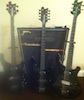
OK......whew. Yep.......this is exactly what I am talking about. The 'dots' on the MG guitar pictured appear light colored, while the ones on my FG are dark. But the real question is....what the heck are these and why were they placed there?

Re: Rickenbacker Model 460
Very interesting, Terry. Thanks for this observation. There is nothing like a good Rickenbacker mystery to get the discussion going.
Life, as with music, often requires one to let go of the melody and listen to the rhythm
Please join the Official RickResource Forum Facebook Page https://www.facebook.com/groups/379271585440277
Please join the Official RickResource Forum Facebook Page https://www.facebook.com/groups/379271585440277
-
guitar-murph
- New member
- Posts: 95
- Joined: Thu May 22, 2008 8:11 am
Re: Rickenbacker Model 460
In reviewing photos from other guitars in the 400 series from this era, I have spotted at least two more which seem to have this 'feature.' Perhaps an old hand from Rickenbacker, or even Mr. Hall, will have some insight as to how and why these 'dots' were applied.
Re: Rickenbacker Model 460
Certainly a great feature to catalog in the Register.
Life, as with music, often requires one to let go of the melody and listen to the rhythm
Please join the Official RickResource Forum Facebook Page https://www.facebook.com/groups/379271585440277
Please join the Official RickResource Forum Facebook Page https://www.facebook.com/groups/379271585440277
Re: Rickenbacker Model 460
I'll suggest two theories:
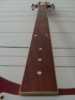
1) They're covering screws, such as the screws seen on the mid-late '50's Combo 400 &/or Combo 450's (Tulips) - which aren't covered. (Said screws are in the same position as the plugs in the above photo.)
2) The necks were tapped for those screws, the screws weren't used on the cresting waves, and these were plugs for the unused holes.
This isn't a rare feature in my experience; I can't say I've ever seen a late '50's - 1961 cresting wave that DIDN'T have those plastic plugs.

1) They're covering screws, such as the screws seen on the mid-late '50's Combo 400 &/or Combo 450's (Tulips) - which aren't covered. (Said screws are in the same position as the plugs in the above photo.)
2) The necks were tapped for those screws, the screws weren't used on the cresting waves, and these were plugs for the unused holes.
This isn't a rare feature in my experience; I can't say I've ever seen a late '50's - 1961 cresting wave that DIDN'T have those plastic plugs.
Re: Rickenbacker Model 460
Jesus H Christ, two JSM postings in a day! 
Good to see you here John...
Good to see you here John...
-
guitar-murph
- New member
- Posts: 95
- Joined: Thu May 22, 2008 8:11 am
Re: Rickenbacker Model 460
[quote="jsm610"]I'll suggest two theories:
1) They're covering screws, such as the screws seen on the mid-late '50's Combo 400 &/or Combo 450's (Tulips) - which aren't covered. (Said screws are in the same position as the plugs in the above photo.)
2) The necks were tapped for those screws, the screws weren't used on the cresting waves, and these were plugs for the unused holes.
This isn't a rare feature in my experience; I can't say I've ever seen a late '50's - 1961 cresting wave that DIDN'T have those plastic plugs.
Your theory as to why these plugs might exist sounds reasonable, but I have seen other models from this era which did not have them. Some examples can be found in photos used on the registry. Moreover, there is a 61' 460 listed on oliviasvintage.com which is one number removed from the serial number of my guitar (AL735 versus my AL734) and it does not have these plugs.
As to your point about whether this is a rare feature or not...I certainly could not say, nor do I believe it necessarily adds to or detracts from the value of a guitar which has them. It is simply an oddity which I noted. I would add that my model also has the mis-matched pickguard and truss rod cover which sometimes ocurred in 1961. In my case I have a white guard with a gold TRC. Again, probably not significant in terms of value but simply another example of the variation that exists in these vintage models.
1) They're covering screws, such as the screws seen on the mid-late '50's Combo 400 &/or Combo 450's (Tulips) - which aren't covered. (Said screws are in the same position as the plugs in the above photo.)
2) The necks were tapped for those screws, the screws weren't used on the cresting waves, and these were plugs for the unused holes.
This isn't a rare feature in my experience; I can't say I've ever seen a late '50's - 1961 cresting wave that DIDN'T have those plastic plugs.
Your theory as to why these plugs might exist sounds reasonable, but I have seen other models from this era which did not have them. Some examples can be found in photos used on the registry. Moreover, there is a 61' 460 listed on oliviasvintage.com which is one number removed from the serial number of my guitar (AL735 versus my AL734) and it does not have these plugs.
As to your point about whether this is a rare feature or not...I certainly could not say, nor do I believe it necessarily adds to or detracts from the value of a guitar which has them. It is simply an oddity which I noted. I would add that my model also has the mis-matched pickguard and truss rod cover which sometimes ocurred in 1961. In my case I have a white guard with a gold TRC. Again, probably not significant in terms of value but simply another example of the variation that exists in these vintage models.
Re: Rickenbacker Model 460
I owe you a drink - sorry for being out of touch!Good to see you here John...
I only see that one - am I missing others? I'd be curious if there are any pre-mid '61 without the dots...Some examples can be found in photos used on the registry.
I didn't mean rare with regard to value, just rare with regard to occurrence. A '61 460 is worth some $$ - dots or no!As to your point about whether this is a rare feature or not...I certainly could not say, nor do I believe it necessarily adds to or detracts from the value of a guitar which has them
-
guitar-murph
- New member
- Posts: 95
- Joined: Thu May 22, 2008 8:11 am
Re: Rickenbacker Model 460
I only just took possession of this guitar yesterday, and we have hardly gotten to know each other. One thing that I have noted is that the tuners seem a bit stiff. I'm going to clean up a bit of the grime, replace the two modern knobs with some vintage ones, string it up and then give it a whirl. Does anyone have a suggestion as to what I can do to loosen up the tuners so that they will turn a bit more freely? I don't really want to use a petroleum based product like wd40 as I am afraid getting any on the finish and causing damage. Is there a graphite spray which would work better? Needless to say, I don't want to use excessive pressure here given the guitar's age or value.
Re: Rickenbacker Model 460
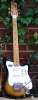
i would guess that those dots are plugs from routing template. wd40 is not the best - i wouldguitar-murph wrote:I only just took possession of this guitar yesterday, and we have hardly gotten to know each other. One thing that I have noted is that the tuners seem a bit stiff. I'm going to clean up a bit of the grime, replace the two modern knobs with some vintage ones, string it up and then give it a whirl. Does anyone have a suggestion as to what I can do to loosen up the tuners so that they will turn a bit more freely? I don't really want to use a petroleum based product like wd40 as I am afraid getting any on the finish and causing damage. Is there a graphite spray which would work better? Needless to say, I don't want to use excessive pressure here given the guitar's age or value.
take them off and flush them out with mineral oil and syringe & needle through the grease hole in the back and than re_grease them with lubricant of your choice. get ready for lot of dirt coming out.
dusan palka who is also known as grazioso on infamous auction web site
if you want to reach the man and expect an answer please make sure you remove this email address ([email protected]) from your spam block if you have one.
if you want to reach the man and expect an answer please make sure you remove this email address ([email protected]) from your spam block if you have one.
Re: Rickenbacker Model 460
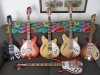
IMO these were plugs used to fill holes when the neck blank was on a jig or something to that effect....just part of a manufacturing process of the day.
My '61 450 had them, The '61 Tenor Guitar has them, in fact most older 425s/450s/460s I've observed/handled from 1962 and earlier have had them.
Early 50's Fender Tele/Esquire bodies have doweled holes on their backsides as well.
My '61 450 had them, The '61 Tenor Guitar has them, in fact most older 425s/450s/460s I've observed/handled from 1962 and earlier have had them.
Early 50's Fender Tele/Esquire bodies have doweled holes on their backsides as well.
Re: Rickenbacker Model 460
Don't know for sure, but +1 on router jig.
Dealing with a through neck has its difficulties. Are the wings cut before or after attached to the body, the neck must stay centered, etc.
Dealing with a through neck has its difficulties. Are the wings cut before or after attached to the body, the neck must stay centered, etc.