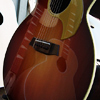
A few more things about Tru Oil.
First of all, everyone seems to have their own technique. Here's another one.
http://falcon.jmu.edu/~dehartcg/finish.htm
The other problem is that all the work goes into the wood preparation. I sand down to 600 grit and then finish with fine steel wool. Then I put in the sealer. I usually use several coats of sealer and while each coat is still wet, rub down the guitar vigorously with a paper towel (which is slightly rough) to keep the surface smooth. I don't bother to seal the surface unless I use the sealer to add color to the grain. In fact, as long as you want a uniform color, you can put the stain in the sealer. (This is how, back in the '50's, Gibson used to put the red color into the mahogany on the back of their Les Paul 'Bursts.) If it needs further staining, you can add it later. I apply the tru oil directly to that.
Many people recommend using fine steel wool between coats of Tru Oil. I don't. I tried that and found that it was too easy to go through the finish into the color. Instead when I apply every coat, I first of all apply the coat to a small part of the guitar, and remove it immediately. I then give the guitar a vigorous rubdown with a paper towel. This seems to smooth the surface sufficiently. Four or five coats is usually enough. Because I work, I usually apply one before I leave for work in the morning, and then another when I get home in the evening.
Also you read things, (for example on the Lmii site - that's Luthiers Merchantile International) that you should touch the guitar while finishing. I originally tried to follow that, but then I forgot once, and couldn't see any difference, so I don't bother now.
As usual, your mileage may vary.
You may like it or might not. Just like on furniture, the oil really brings out of the beauty of the wood. I'm not a big fan of really shiny guitars anyway, so the finish looks great to me.