
This may need to go to another thread and/or forum, but I'm going to ask for some peer-reviewed scientific backup for that statement.
Damaged, peeling, chipped, etc. lead paint can pose a direct contact risk and/or an inhalation risk if the material is made air-borne, but just having it on the wall or window frame, etc. is not necessarily cause for alarm.
SAFELY removing lead paint from pickup cavities
Moderator: jingle_jangle
-
FretlessOnly

- Advanced Member
- Posts: 1605
- Joined: Sat Feb 21, 2009 9:00 pm
Re: SAFELY removing lead paint from pickup cavities
Can we have everything louder than everything else?

Re: SAFELY removing lead paint from pickup cavities
Yeah. I, Mark Walker, sure know what time it is. Sorry about that, Todd. I must have seen the 'teb' in your moniker and been thrown.walker wrote:To your point, Ted... Caution well heeded, Ted!
So this is the pay-off moment - the reason why I took on this project in the first place:

When I scraped away the first few strokes which revealed the green writing under the gray, I think I caught a glimpse of how an archeologist feels when he hits a fossilized treasure. It may seem nuts to get excited about this kind of stuff, but it really made my day to finally see what's in this cavity. Been curious for years, and cool to see more evidence of the assembly standard from the '60s - over 40 years ago!

At first I thought it said '4001 - Z' but in tiny pencil above the green marker, it looks more like '4001 - 2'. And look - a quality inspector by the name of 'NAT' signed his approval in the cavity, too. Yeah, yeah... I know. 'NAT' stands for the Natural finish. Nat the QC inspector makes for a better story, though. But it's cool to see the NAT as evidence that this is indeed an original Mapleglo and not a refin. The age cracks pretty much tell that tale themselves, but it's still cool.
Re: SAFELY removing lead paint from pickup cavities
Incidentally, when titling this thread, I was stressing the "SAFETY" of the bass, not really thinking much about the application of safe practices when dealing with lead paint. Go figure I put basses before people in my priority set.

Re: SAFELY removing lead paint from pickup cavities
If you'd written "I put Rick basses before people in my priority set." I would agree heartily!walker wrote:Incidentally, when titling this thread, I was stressing the "SAFETY" of the bass, not really thinking much about the application of safe practices when dealing with lead paint. Go figure I put basses before people in my priority set.

Great work, Mark.
Re: SAFELY removing lead paint from pickup cavities
Well, I figured the RICK part would be a given, considering my company!
Re: SAFELY removing lead paint from pickup cavities
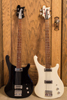
I've gotten most of the mystery substance (graphite, lead, other kind of conductive paint?) out of the cavities, and soon I'll be ready for reassembly and a good buffing. What buffing compound is best recommended for a bass with Nitros finish? (And if I've got the finish type wrong, someone please correct me on that. It's the finish that leaves a lot of stress cracks and comes off in your hands.)
Re: SAFELY removing lead paint from pickup cavities
If your bass has it's original finish on it then it will be CV, yours is too new to be nitro.
Re: SAFELY removing lead paint from pickup cavities
Aaah. OK. Good to know. 2 things - what is "CV," and when was Nitro used?
Re: SAFELY removing lead paint from pickup cavities
Oh... Any buffing compound suggestions?

Re: SAFELY removing lead paint from pickup cavities
CV is Conversion Varnish - a two part catalyzing polyurethane material. Nitro was phased out somewhere around 1959-1960...walker wrote:Aaah. OK. Good to know. 2 things - what is "CV," and when was Nitro used?
I have NO idea what to do with those skinny stringed things... I'm just a bass player...
Re: SAFELY removing lead paint from pickup cavities
Thanks, CJ! Good to know. Got any buffing compound recommendations?
Re: SAFELY removing lead paint from pickup cavities
There are folks who are far more experienced on this subject than I, but I'll start by saying, "it depends". If you've got very minor scratches/hazing, something like what Paul W. recommends should work fine, the original Meguire's Scratch-X (now called Swirl-X I think), or Nu-Finish Scratch Doctor. For nastier scratches, you'll need to move up to more aggressive compounds and finish off with the finer stuff.walker wrote:Thanks, CJ! Good to know. Got any buffing compound recommendations?
As I said, I'm nowhere near an expert on this stuff, I've never buffed out a guitar, only automotive finishes, and even then nothing even close to approaching "show car" finishes...
I have NO idea what to do with those skinny stringed things... I'm just a bass player...
-
jingle_jangle
- RRF Moderator
- Posts: 22679
- Joined: Wed Dec 22, 2004 6:00 am
- Contact:
Re: SAFELY removing lead paint from pickup cavities
You can use up all your milk money on polishing stuff, Mark...
Generally, you should work from coarsest (for deepest surface scratches) to finest (to remove swirls from the coarser grades of compounds). Note that compou8nds are only to remove the shallowest of surface defects; nothing short of a touchup will cure chips or scratches down to the wood or through thick coats of CV. The average CV thickness on a flat surface like the top or back of a guitar or bass varies somewhat according to vintage; thinnest are the older (60s) CV applications at .003" approx; newer will be thicker by a factor of two. Some areas will see much thicker CV; I've seen up to .020" on some neck heels and even thicker on some factory-finished acoustics.
I will start with #1000 grit wet or dry sandpaper, wetted with Windex, to flatten a surface. Stay away from sharp edges and corners.
Then a cloth diaper charged with white polishing compound will get it up to a reasonable gloss. You can move on to Perfect-It III compound, and then a swirl remover as mentioned above.
Following this, the surface should be very shiny; it then should be protected with a good quality wax, and Zymol is my recommendation.
Generally, you should work from coarsest (for deepest surface scratches) to finest (to remove swirls from the coarser grades of compounds). Note that compou8nds are only to remove the shallowest of surface defects; nothing short of a touchup will cure chips or scratches down to the wood or through thick coats of CV. The average CV thickness on a flat surface like the top or back of a guitar or bass varies somewhat according to vintage; thinnest are the older (60s) CV applications at .003" approx; newer will be thicker by a factor of two. Some areas will see much thicker CV; I've seen up to .020" on some neck heels and even thicker on some factory-finished acoustics.
I will start with #1000 grit wet or dry sandpaper, wetted with Windex, to flatten a surface. Stay away from sharp edges and corners.
Then a cloth diaper charged with white polishing compound will get it up to a reasonable gloss. You can move on to Perfect-It III compound, and then a swirl remover as mentioned above.
Following this, the surface should be very shiny; it then should be protected with a good quality wax, and Zymol is my recommendation.
Re: SAFELY removing lead paint from pickup cavities
Thanks, Paul. I'm not really dealing with any scratches or swirls - just lightly dulled areas of the CV were the denatured alcohol rubbed over it. I'm guess I could start with the Tuggies full of "white polishing compound." Does Perfect-It 3 do the same thing as white polishing compound?
-
jingle_jangle
- RRF Moderator
- Posts: 22679
- Joined: Wed Dec 22, 2004 6:00 am
- Contact:
Re: SAFELY removing lead paint from pickup cavities
White polishing compound cuts more aggressively than Perfect-It III.