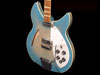
8mileshigher wrote:Since joining the Double Bound club, I'm a little unclear about some of our references to Double Bound models ... OS and WBs, etc.

For starters, I'm not sure I understand the difference between a WB and WBBS ??

The original, original 360 models, say, up until mid-1964, so every 360 model up until that time was bound on both sides; the "OS", for "Old Style" designation did not come about until the 360 "New Style" or "NS". . . or "Toilet Seat" (TS) as some of the factory folks called it, was put into production. Once the NS 30s came out, the two modles were differentiated by "OS" bfor the "Old Style" double bound models, and the latter guitlar.
An OS model has 21 frets, toaster pickups, and an unbound sound hole, unless someone special ordered one with sound hole binding, which I have yet to see an example of. Why the the OS models did not have the sound hole bound is a mystery to me, since the NS 360s have bound sound hole.s I dunno, maybe the guys in the wood shop were too tired to other with sound hole binding after applying binding to every other edge of the guitar body and neck.

WBBS models stand for "white binding, both sides" and are 24 fret, double bound models. Curiously, except for maybe a few early 70s models, nmost of the six string examples, yours being one of the excepions, Rich, have bound sound holes, while most of the 70s and early, early 80s models (say maybe up to `82, IIRC) have unbound sound holes. The WBBS and WB models are the same, it's just that at some point, RIC dropped the latter two letters from the model designation. . . so one could order a WB, without any BS. . . .

I'm not sure if WB without the BS still means "White Binding", or if the designation changed to "with binding", or as I'm prone to react, "WOW!!! BINDING!!!"

8mileshigher wrote:Aren't all WB's Bound on both sides ?
All WBs are indeed bound on both sides.

8mileshigher wrote:Or does a WBBS have a lighter shade of Binding than the traditional Binding which yellows with age ?
Nope, same stuff, basically, unless RIC changed the binding material. Even if RIC did, the change in designation has nothing to do with it... no BS!
8mileshigher wrote:In the same vein, does an OS WB differ from an OS WBBS ?

There is no OS WBBS; a 21 fret, double bound model is an "OS", while a 24 fret, double bound model is either a "WBBS", or a "WB", depending on what RIC was designating the model as tha year. Somewhere along the line in the mid 70s, the inlays also went from the 50s and 60s full-width type to the smaller, poured inlays.
8mileshigher wrote:I know many WBs came standard with High Gains, but are all OS models standard with Vintage Pickups or not necessarily ?
Hard to say "all" in the case of either model; generally, OS models came with 21 frets and toasters, while the WBBS/WB models came with 24 frets and hi gains. During the transition from 21 frets to 24 frets, and the transition from toasters to hi gains, one might find an OS-equipped withhi gains, or a WBBS equippped with toasters, but I have yet to see that, IIRC.
In the early 80s, RIC reintroduced "toasters", which were called "vintage chrome bar pickups" whenintroduced. These were the "hot" 12K ohm toaster pickups, rather thanthe muchmore recent "Scatterwound" 7.4K ohm toasters.
8mileshigher wrote:Would both C63 and V64 360 models be correctly identified as OS or not ?
One could call them "OS" style models because they look like OS models due to the 21 frets, vintage pickups, unbound sound hole, and vintage style, full witdh inlays, but the original 60s models had internal "X" or "cross" bracing, while the 360 V64 models do not. The V64 models have the current type Rick guitar internal routing. the 360 C63 models, in both the available 12 string model, as well as the limited to 60 units for Japan Shinsedo limited edition models have the same "X" bracing that the OS models have, but they're probably best described as OS replicas or OS reissues, though I suppose they could qualify as "new" OS models, since they are constructed faithfully according to OS style specs (though the specs wrt dimensions and neck size for the original OS models varied depending on who was cutting and shaping the guitars back then).
FYI, there are a couple or a few bound soundhole 360 V64s out there IIRC, because soundhole binding was available as an extra cost option. Also, Scott Baillie has a magical proces for introducing soundhole binding to V64s, but I cannot reveal the secret.
8mileshigher wrote:Which Double Bound 360 models have a Bound Sound Hole ? Does it depend upon manufacture year ??
Pretty much, or on the person applying the finding, o if the model was a six or 12 string. Why? I don't know. See above, though it appears that not until `83 or so that a bound sound hole became FIRMLY standard for both the 12 and 6 dstring WB models.
8mileshigher wrote:Any other aspects of OS to consider for understanding the differences ?
I think you've asked all the right questions, and I've covered it as thoroughly and correctly as I can.... and maybe as exhaustively as I can. Anyone still awake out there? I don't think I made any mistakes in my answers, but if I did, Paul W or John Hall will probably be along shortly to set me straight, and apply the deserved ribbing. . .