
Has anyone else looked into this, and what is your opinion?
Ok, Capri experts: what kind of wood is this?
Moderators: rickenbrother, ajish4
Ok, Capri experts: what kind of wood is this?
I sometimes see this distinctive flame on certain Capri's and it's just a heartstopper. It's so different from your typical flamed maple. I have heard it described as flamed alder, by Dave Kim and others. I have also read one post from a few years back where Dale Fortune described it as flamed birch. I can't find a single photo of "flamed alder" on the net, although I'm pretty sure it exists. Flamed birch seems far more common, and has a grain pattern that looks very similar.
Has anyone else looked into this, and what is your opinion?
Has anyone else looked into this, and what is your opinion?
Great Ramp In My Opinion.
Re: Ok, Capri experts: what kind of wood is this?
Here's a few examples of flamed birch to compare. Do we have a winner?
Great Ramp In My Opinion.
Re: Ok, Capri experts: what kind of wood is this?
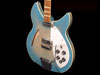
Maple is known as a hardwood with tonal qualities that is capable of exhibiting many forms of flame. I believe the Capris on display have maple tops showing a ribbon flame. I have seenthis described as flamed alder, but I do not believe alder is capable of this type of flame. I don't believe birch was used in RIC production of Capris.
Another "flamed maple" attribute of many Capris is their flamed maple necks. Some '58, '59 and '60 Capris have incredibly flamed neck wood.
Another "flamed maple" attribute of many Capris is their flamed maple necks. Some '58, '59 and '60 Capris have incredibly flamed neck wood.
Re: Ok, Capri experts: what kind of wood is this?
libratune wrote:......... Some '58, '59 and '60 Capris have incredibly flamed neck wood.
+1 !!
Re: Ok, Capri experts: what kind of wood is this?
I'm well aware of the flamed maple necks on Capri's and they clearly are maple. But I guess my thought is this: Why haven't we seen this distinctive grain over and over on Ric's, on MG 330s, 360s or 381s? I haven't seen a single modern era Ric with this grain, yet I can find 10+ examples of Capri's where they are clearly made of this wood. I know, most modern guitars don't use figured wood like this, but still. It seems like it would have cropped up at some point.libratune wrote:Maple is known as a hardwood with tonal qualities that is capable of exhibiting many forms of flame. I believe the Capris on display have maple tops showing a ribbon flame. I have seenthis described as flamed alder, but I do not believe alder is capable of this type of flame. I don't believe birch was used in RIC production of Capris.
Another "flamed maple" attribute of many Capris is their flamed maple necks. Some '58, '59 and '60 Capris have incredibly flamed neck wood.
We all know Rickenbacker in the 50's was full of awesome experimentation: Painted on soundholes, long/short soundholes, butcher block bodies, alder/maple laminated necks, solid/ply backs etc, etc. There wasn't a standard set in stone for how things would go, so it doesn't seem strange to me that there may have been birch tops, considering that flamed birch is a fairly hard wood and has been used by luthiers before and after the 50's.
The flamed maple used on Capri necks and butcherblock maple bodies has a different look to it. I have never questioned that it was maple, because all of the ones I have seen just look like maple, with a tight flame pattern. I have seen figured ribbon maple with a lighter figure, but not with the random swirls of flame this wood has. Granted, I'm no expert and that's why I asked here.
We know some Capri's were Alder, some were maple, and some, like this:
Dave Kim has 3 of the guitars with flame like this and he says it's flamed alder, I have to assume he's basing that off something. It's not like flamed maple would be a bad thing. But after looking for another example of flamed alder, the birch came up and it just struck me as having "that look". Maybe Paul can chime in and set me straight, but I'm not convinced it's maple. I haven't seen a maple board or a les paul top ever that has made me think, darn, there's that Capri figuring!
Great Ramp In My Opinion.
Re: Ok, Capri experts: what kind of wood is this?
I'm thinking quilted (or curly) ASH or BIRCH.
I've never seen grain patterns of this size in maple.
I've never seen grain patterns of this size in maple.
-
electrofaro

- Senior Member
- Posts: 3611
- Joined: Sun Apr 26, 2009 3:25 pm
Re: Ok, Capri experts: what kind of wood is this?
Trees are simply not old (and thus not thick) enough these days to get that kind of figure anymore...
'67 Fender Coronado II CAB * '17 1963 ES-335 PB * currently rickless
Re: Ok, Capri experts: what kind of wood is this?
The point is, you can get a figure very much like this with Birch, all day, every day. Not so that I have seen with Maple, although you can still get great looking wood(as Paul recently used on that lefty Combo). So which do you think is more likely? I think a wood other than maple is the easiest and simplest answer.Wildberry wrote:Trees are simply not old (and thus not thick) enough these days to get that kind of figure anymore...
Great Ramp In My Opinion.
-
electrofaro
- Senior Member
- Posts: 3611
- Joined: Sun Apr 26, 2009 3:25 pm
Re: Ok, Capri experts: what kind of wood is this?
If it would be a guitar made this year: yes - if it's a guitar from 60s: no.egosheep wrote:I think a wood other than maple is the easiest and simplest answer.
Let me make an example based upon a firm I know: Gibson.
The great figure that's on maple tops of 1958, '59 or '60 was actually the kind of wood that furniture builders didn't want at the time.
Furniture consumers wanted plain wood, with little to no figure.
The guitar tops or whole guitars were made of wood that's not bad in quality but rather cheaper just because of another, different kind of quality: the figure.
These days figure's something that people actually want to see in furniture and other wooden items,
so I assume the opposite can be said - good figure costs you money.
Plus there's less good figure available!
Furthermore it's also an age thing - back then the trees were bigger and better.
These days there's often the FSC "sustainable" "forest" (in reality mono- or duo-cultures like salads in a field, nothing environmentally friendly or sustainable about it) which produces horrible little figure, and which gets harvested at quite a young age.
Older wild forest trees have really remarkably more figure because of the environment (different types of trees and plants, not in rows like FSC, no insecticides or other rubbish sprayed like in FSC etc.)
The latter is something I learned in commercial print - just like people are often confused to learn that wood-free paper's actually made of wood-pulp...
...but, I must admit that's true for all kinds of trees, not just maple.
So, it can still be anything other than maple, although I'd go for maple because they're from the 60s (except if they're one-off prototypes or test guitars made of different wood, of course -but someone might know that at Ric?) .
It's no miracle the wood that's great to see often comes from "illegal" sources these days!
'67 Fender Coronado II CAB * '17 1963 ES-335 PB * currently rickless
Re: Ok, Capri experts: what kind of wood is this?
Werner, I agree with a lot of what you're saying, and the history of what woods were desirable is really interesting. However, there are a few things: You can still get spectacular maple today, flamed, quilted, figured, etc. It may not be cheap, but it's widely available. But can you show me a 50's Les Paul with Maple that looks anything like these Capris? I can't. The grain/flame pattern is just different to my eye. And yes, there are many Capri's made with Maple bodies, obviously so... but there were also other variations, Alder for one. If you can find Maple that looks like this, I'd be happy to see it. To me it looks most like Birch, when I see that table I posted above, I just think "Capri". Look at the swirls.
Great Ramp In My Opinion.
-
jingle_jangle
- RRF Moderator
- Posts: 22679
- Joined: Wed Dec 22, 2004 6:00 am
- Contact:
Re: Ok, Capri experts: what kind of wood is this?
Werner hit it on the head--available wood is coming mostly from much smaller trees these days.
As to the variety of wood, without seeing the guitar in person, I'd be hard-pressed to distinguish between flamed maple and flamed alder. The flamed maple necks on Capris I've worked on do exhibit a fairly large scale of flame, just as these tops do. Flamed alder used these days has a very small figure, but who knows what size the flame could have been a half-century ago?
Knowing how very few Capris were made back in '59 and '60 (as these examples seem to be), and also knowing that the billets from which these were routed are all over the map, grain-wise, it seems like a quantity of figured wood was ordered, but widths were not specified, so a number of these have tops made from wider billets, and some were glued up from narrower pieces to make the 16" (approximately)wide billet required to route a Capri body. These latter ones are the so-called "butcher block" tops.
The striped 340 that Thomas posts the photo of, looks very much like mahogany in the photo--very open-grained.
And I've seen '50s 4000s that looked (and weighed) like oak, too...
As to the variety of wood, without seeing the guitar in person, I'd be hard-pressed to distinguish between flamed maple and flamed alder. The flamed maple necks on Capris I've worked on do exhibit a fairly large scale of flame, just as these tops do. Flamed alder used these days has a very small figure, but who knows what size the flame could have been a half-century ago?
Knowing how very few Capris were made back in '59 and '60 (as these examples seem to be), and also knowing that the billets from which these were routed are all over the map, grain-wise, it seems like a quantity of figured wood was ordered, but widths were not specified, so a number of these have tops made from wider billets, and some were glued up from narrower pieces to make the 16" (approximately)wide billet required to route a Capri body. These latter ones are the so-called "butcher block" tops.
The striped 340 that Thomas posts the photo of, looks very much like mahogany in the photo--very open-grained.
And I've seen '50s 4000s that looked (and weighed) like oak, too...
Re: Ok, Capri experts: what kind of wood is this?
Thanks for the info, Paul. I agree that the 340 looks like Mahogany. I was posting that as an example of an "outside the box" wood being used on a Capri.jingle_jangle wrote:Werner hit it on the head--available wood is coming mostly from much smaller trees these days.
As to the variety of wood, without seeing the guitar in person, I'd be hard-pressed to distinguish between flamed maple and flamed alder. The flamed maple necks on Capris I've worked on do exhibit a fairly large scale of flame, just as these tops do. Flamed alder used these days has a very small figure, but who knows what size the flame could have been a half-century ago?
Knowing how very few Capris were made back in '59 and '60 (as these examples seem to be), and also knowing that the billets from which these were routed are all over the map, grain-wise, it seems like a quantity of figured wood was ordered, but widths were not specified, so a number of these have tops made from wider billets, and some were glued up from narrower pieces to make the 16" (approximately)wide billet required to route a Capri body. These latter ones are the so-called "butcher block" tops.
The striped 340 that Thomas posts the photo of, looks very much like mahogany in the photo--very open-grained.
And I've seen '50s 4000s that looked (and weighed) like oak, too...
So do you think Birch is in the realm of possibility? And do you think these tops are consistent with any Maple you have dealt with? To me the maple used on "butcher tops" has more of a tight flame pattern, as you would see on some Les Paul tops.
Great Ramp In My Opinion.
-
jingle_jangle
- RRF Moderator
- Posts: 22679
- Joined: Wed Dec 22, 2004 6:00 am
- Contact:
Re: Ok, Capri experts: what kind of wood is this?
Wood grading (especially on hardwoods) is not super-specific; suppliers' standards vary substantially. As to type and size of flame, this is not generally part of the grading process; super-flamey maple is sold as such, but classifying and supplying by type of figuring seems to be optional with each supplier.
To say that the butcher block figuring is smaller in scale would seem to me to be a "given"; it's glued up because the trees were smaller, hence smaller flame, too.
To say that the butcher block figuring is smaller in scale would seem to me to be a "given"; it's glued up because the trees were smaller, hence smaller flame, too.
Re: Ok, Capri experts: what kind of wood is this?
It seems to me that the butcher tops were made by design, not nessesity, but I could be wrong. The laminated flame is a very cool look. I say the flame looks smaller, but I see that kind of flame in larger scale on tops all the time, although not a full billet body like a on a Ric.jingle_jangle wrote:Wood grading (especially on hardwoods) is not super-specific; suppliers' standards vary substantially. As to type and size of flame, this is not generally part of the grading process; super-flamey maple is sold as such, but classifying and supplying by type of figuring seems to be optional with each supplier.
To say that the butcher block figuring is smaller in scale would seem to me to be a "given"; it's glued up because the trees were smaller, hence smaller flame, too.
The question persists, though: Do you think these bodies could be Birch?
Great Ramp In My Opinion.
-
jingle_jangle
- RRF Moderator
- Posts: 22679
- Joined: Wed Dec 22, 2004 6:00 am
- Contact:
Re: Ok, Capri experts: what kind of wood is this?
Oh, is THAT the question?
My answer would be, "I don't know for sure, but I don't think so."
My answer would be, "I don't know for sure, but I don't think so."