

As I posted last year,I have installed a C64 (three screw) tail on my CS which had some lift on its original 5 screw tail.
The C64 tail is great although there is a slight lift of just under 1mm which I am looking into. The look of the three screw tail is the main reason I prefer the old aluminium one (apart from the aluminium saddles on the bridge of course) so when I ordered a new tail I went for the C64 to keep the bass looking more "vintage accurate".
The screws on the outside of the modern tail detract from its look and I think there should have been a bit more work done to retain the "original" look with regards to installing a modern style tail on Vintage Reissue basses.Its interesting that as well as the three screw tail,the C64 had vintage style tuners and some of the roundhead screws on the trc and pickups etc.
The bridge-tailpiece seems to be the only weak detail both in terms of vintage accuracy and mechanical strength which is a pity when compared with the fantastic woodwork and finish of the rest of the VR and CS bass series.
I cant make my mind up as to the absoloute cause of tail lift.
Could the string tension be the only factor?..I am not sure thats the whole story.
I think theres something in the way the space between the bottom of the tail and the recess where the screws holes are for the screws to create a downward pressure on the unit when they are tightened which bends the tail when string tension is added.Some guys have used washers to plug the gap which I am also going to try.
I have looked at the whole tail piece problem and I have arrived at an unusual but old school possible soloution that not everyone will agree with as it means drilling holes.
Reading up about Fender in the 40s and 50s they thought that tone was better with a string through body system.The old 50s Precision and the Telecaster were designed like that. I think Entwistle once said they should have kept that system and used it on the Jazz Bass.
When you think about it theres no reason (apart from it being a bit quicker to re-string by a few seconds)for Rickenbacker basses to have the strings terminate at the four holes at the back of the tailpiece.
I think that if four ferrules were installed front and rear of the body,properly countersunk flush and as discretely close to the string holes at the back of the tailpiece (out of sightlines when looking at the front of the bass),then the bass could be a string through system taking the pressure off the tail and eliminating tail lift.In fact there would be downward force on the rear of the tail.
Alternatively the ferrules could be installed on the top of the body inside the tailpiece forward of the string holes but there would be no downward force on the tail which might not make any difference because theres no upward tension on the tail either (would that be a better system?) and it might be a bit easier to thread the strings that way.
I am seriously considering altering my CS in this way.
What do you think?
Tail-lift a possible cure?
Moderators: rickenbrother, ajish4

Re: Tail-lift a possible cure?
interesting. There is an easier way that people here have done with the tail piece and some washers under the screws. Then there is the option of adding screws to hold it down, which would make it a seven screw bridge. The last option is replacement bridge....All have been discussed on here....

Re: Tail-lift a possible cure?
Maybe I'm crazy, but the tail lift on the bridge has never bothered me. My C64 has what I would consider "Significant" lifet and IMO has not made a bit of difference in sound quality or tone. But, what do I know?
Re: Tail-lift a possible cure?
Hipshot replacement bridge, (for a Rickenbacker) I put one on my V63 and my 77 4001 has one too, awesome bridge, like them much better..

Re: Tail-lift a possible cure?
Tail lift anyone?
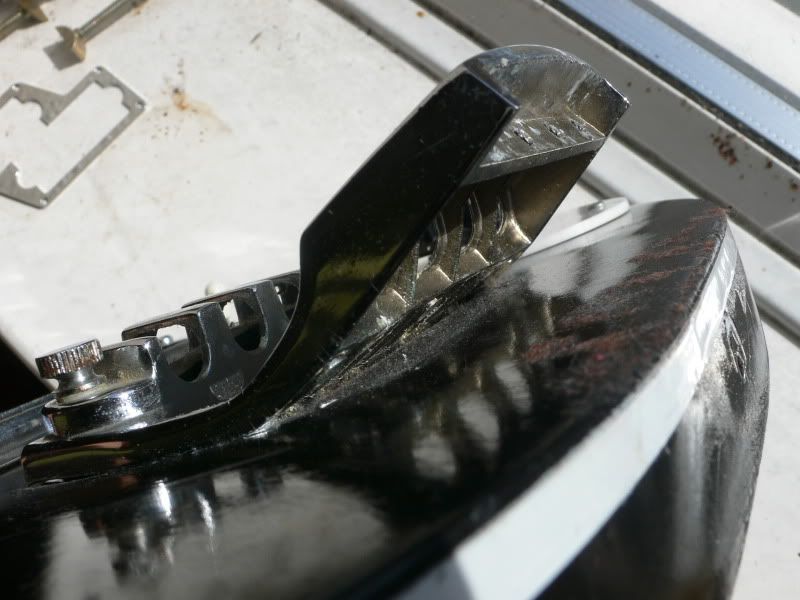
(That's a faker, btw. But black trim tailpieces are more prone to tail lift even on real Rics.)
(That's a faker, btw. But black trim tailpieces are more prone to tail lift even on real Rics.)
"A Noble Instrument Must Be Nobly Regarded"
Re: Tail-lift a possible cure?
Thats what you get for opening bottles of beer with your bass!
Re: Tail-lift a possible cure?
Notice that the point of weakness is where the bridge sits.
Thats why I wonder if the added pressure of the securing screws is partly to blame.
Thats why I wonder if the added pressure of the securing screws is partly to blame.
Re: Tail-lift a possible cure?
FGaker or not the mechanics are the same.
Re: Tail-lift a possible cure?
Typo ...not FG but would have been a good pun if it were FG!
Re: Tail-lift a possible cure?
-1. Mine rattles terribel. Sorry I've bought it.ricaddic wrote:Hipshot replacement bridge, (for a Rickenbacker) I put one on my V63 and my 77 4001 has one too, awesome bridge, like them much better..
68 4001|73 4001 MG|75 4000 MG|81 4001S AZG|86 4003 MID/BT|86 4003 Shadow|88 4003s Blackstar|89 4003 Grey/BT FL|93 4004 Ci|96 4003S/8 FG|98 4003S/5 JG|05 650D|05 4004Cii/5 TG|08 660/12 JG|18 4003S/5 MID|19 4003S/5 WAL ||TR35B|RB 30||
-
Ric N. Backer

- Member
- Posts: 427
- Joined: Sat Nov 13, 2010 11:12 pm
Re: Tail-lift a possible cure?
Now THAT"S a tail-lift!ilan wrote:Tail lift anyone?
(That's a faker, btw. But black trim tailpieces are more prone to tail lift even on real Rics.)


Intonation has got to be a real drag.
If Mozart were with us today, he'd play a Fireglo 4001C64! ~~~*~~~ Beethoven, on the other hand, would play a Matte Jetglo 4001C64S!

Re: Tail-lift a possible cure?
I've always been curious but, why dosen't Rickenbacker just add extra screws to keep it secured?
I don't play bass so I only know about "tail-lift" by reputation, but it seems like it would be an easy problem to fix.
I don't play bass so I only know about "tail-lift" by reputation, but it seems like it would be an easy problem to fix.

Re: Tail-lift a possible cure?
They did for a while:Spike- wrote:I've always been curious but, why dosen't Rickenbacker just add extra screws to keep it secured?
I don't play bass so I only know about "tail-lift" by reputation, but it seems like it would be an easy problem to fix.
I have NO idea what to do with those skinny stringed things... I'm just a bass player...

Re: Tail-lift a possible cure?
Pete, I think this could be the crux here. There is a gap under the screws...that gives it somewhere to go. Torque the screws down a little and you can pull the under surface of the bridge below the sitting plane plane of the surface of the bass - initiating the bend. If my memory is correct (which is questionable) I never saw any lift on my 4001 until after I went thru and tightened the bridge screws. If mine ever gets bad I'll do the two extra screw like my 4003s5 has.pag wrote:Notice that the point of weakness is where the bridge sits.
Thats why I wonder if the added pressure of the securing screws is partly to blame.
I wonder if the 'cure' here would alter THE 'sound' of the bass???
The only thing we can perceive are our perceptions - George Berkeley

Re: Tail-lift a possible cure?
There are a couple threads on this already, and it was determined to fill the gap between the bottom of the tailpiece and the rout it sits in. Washers or maple plug were used, depending on your desire. Allowing the screws to pull the tailpiece down into the too-deep rout starts the end to pop up, and loading with strings just adds to it.
Pete, I'd take the tailpiece off, make sure it is flat again, determine the gap between the bottom of the metal and the wood of the rout, then fill it.
Pete, I'd take the tailpiece off, make sure it is flat again, determine the gap between the bottom of the metal and the wood of the rout, then fill it.