
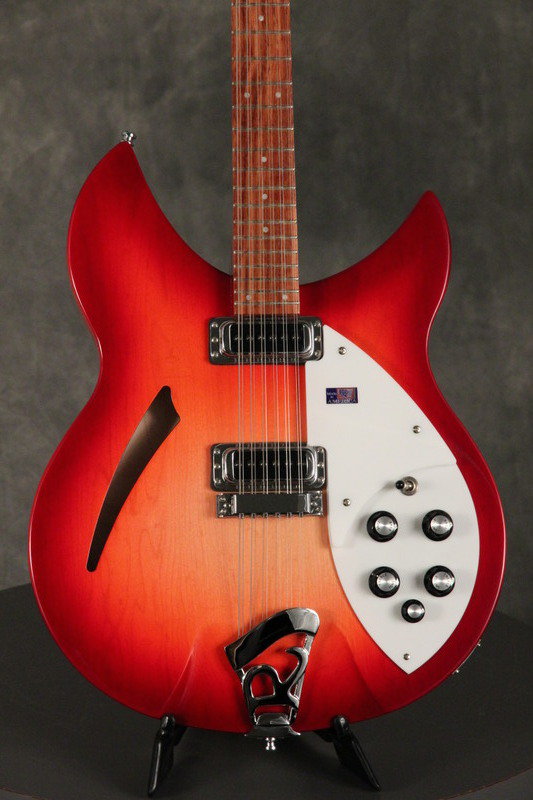
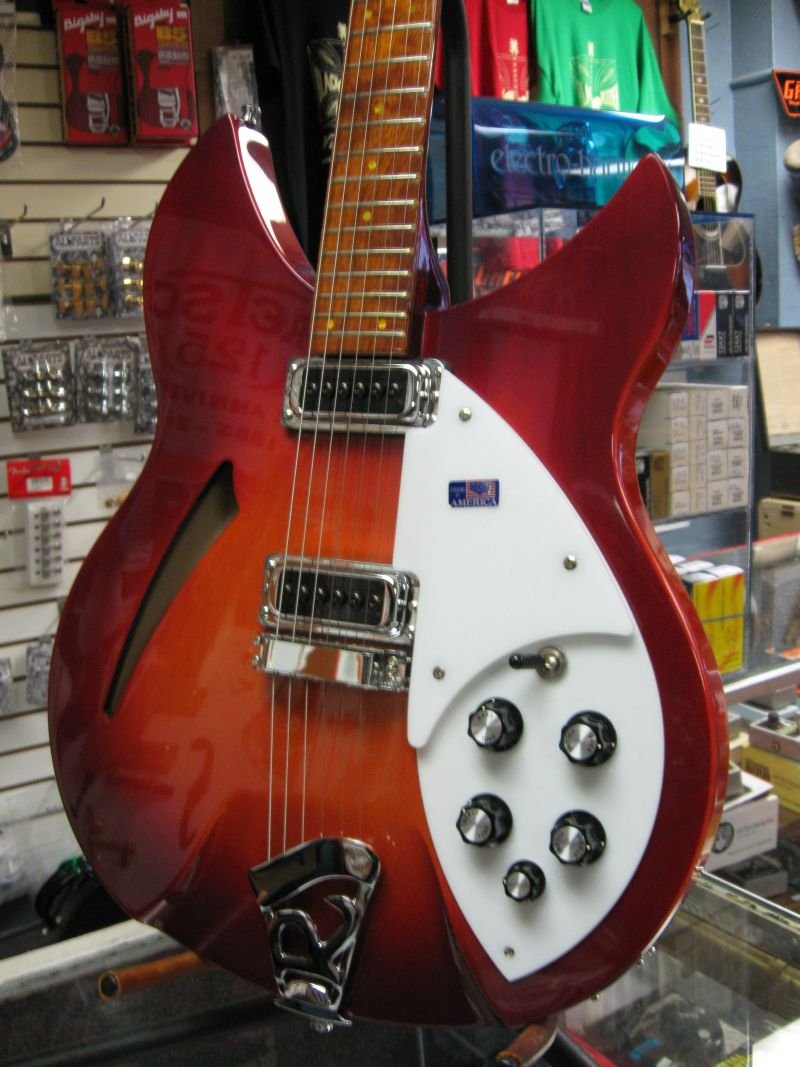
I was looking over the register and noticed a few things. Compare the ramp on this 2010 330/6:
http://www.rickresource.com/register/us ... llsize.jpg
To this one from a 2009 330/12:
http://www.rickresource.com/register/us ... llsize.jpg
Why are they so different? I assumed this would be CNC'ed into stone. Are the ramps still done by hand?
Then look at the ramp on this 1989 Ruby 330:
http://www.rickresource.com/register/us ... llsize.jpg
So wide! Looking around it seems like every ramp is a little different, like a fingerprint. Do you prefer the wider ramps or the smaller ones? I like it when the lower edge of the ramp is parallel to the curve of the top of the pickguard.
Varying ramp widths over the years
Moderators: rickenbrother, ajish4
Varying ramp widths over the years
Great Ramp In My Opinion.
-
jingle_jangle

- RRF Moderator
- Posts: 22679
- Joined: Wed Dec 22, 2004 6:00 am
- Contact:
Re: Varying ramp widths over the years
I don't think that every ramp is different anymore (since the tops have been CNCd), but back in the ol' days, I'm sure that there were variations, since they were hand-routed and hand-finished back then.
The ramps on my 2 new 330s (a MID 6 and a MG 12) are, indeed,the only feature that I'm not 100% happy with.
It seems to me that the guard edge and ramp edge lines should relate, too. That Ruby looks perfect, IMO.
The ramps on my 2 new 330s (a MID 6 and a MG 12) are, indeed,the only feature that I'm not 100% happy with.
It seems to me that the guard edge and ramp edge lines should relate, too. That Ruby looks perfect, IMO.
-
deaconblues

- RRF Consultant
- Posts: 2390
- Joined: Tue Feb 06, 2007 5:14 pm
Re: Varying ramp widths over the years
+1, the ramp should echo the pickguard. The narrow ramps look really weird to me. Time-saving measure?jingle_jangle wrote:
It seems to me that the guard edge and ramp edge lines should relate, too. That Ruby looks perfect, IMO.
Re: Varying ramp widths over the years
Yeah I thought so too(about CNC), but in the photos I posted, the '09 and '10 have pretty different ramps. One almost touches the guard, although both of them are narrow. It seems well outside the tolerances of CNC. Also, I have seen other guitars in the register... an 07 I think.. with a wider ramp. I'm judging a ramp "wide" if it is wider on the right side than the point of the end of the pickguard.jingle_jangle wrote:I don't think that every ramp is different anymore (since the tops have been CNCd), but back in the ol' days, I'm sure that there were variations, since they were hand-routed and hand-finished back then.
Here is one example, the '07:
http://www.rickresource.com/register/us ... llsize.jpg
This would be my ideal ramp... courtesy of Johnny Marr's '83 330JG:
http://4.bp.blogspot.com/_6TD08BbShLk/S ... 7-p2-1.JPG
Great Ramp In My Opinion.
-
electrofaro

- Senior Member
- Posts: 3611
- Joined: Sun Apr 26, 2009 3:25 pm
Re: Varying ramp widths over the years
My 2007 360 is like that - I never really noticed it, and although the 2008 ramp is parallel to the lower pickguard, I like my 360 as it's my 360!egosheep wrote:Here is one example, the '07:
http://www.rickresource.com/register/us ... llsize.jpg
'67 Fender Coronado II CAB * '17 1963 ES-335 PB * currently rickless

Re: Varying ramp widths over the years
egosheep wrote:Yeah I thought so too(about CNC), but in the photos I posted, the '09 and '10 have pretty different ramps. One almost touches the guard, although both of them are narrow. It seems well outside the tolerances of CNC. Also, I have seen other guitars in the register... an 07 I think.. with a wider ramp. I'm judging a ramp "wide" if it is wider on the right side than the point of the end of the pickguard.jingle_jangle wrote:I don't think that every ramp is different anymore (since the tops have been CNCd), but back in the ol' days, I'm sure that there were variations, since they were hand-routed and hand-finished back then.
Here is one example, the '07:
http://www.rickresource.com/register/us ... llsize.jpg
This would be my ideal ramp... courtesy of Johnny Marr's '83 330JG:
http://4.bp.blogspot.com/_6TD08BbShLk/S ... 7-p2-1.JPG
Interesting discussion. I worked in the automobile industry back in the mid '80's when CNC tooling was being introduced bigtime. I recall that the incredibly accurate machining tolerances which became possible in mass manufacturing processes at that time were a source of wonder to long serving craftsmen within the toolrooms. Accurately programmed CNC equipment will replicate the same part to within 000's of an inch and therefore with absolutely no discernible difference to the human eye. The differences in the ramp profiles pictured here are different in spec not by 000's of an inch but, to this human eye at least, the best part of a whole inch!! This can only mean that the people programming the CNC equipment in the RIC factory are inputting completely different specifications year over year (week over week?)....this of course begs the question why? The normal objective of introducing expensive CNC equipment into a factory is to ensure mass manufactured components are produced at a consistently high quality to the best manufacturing spec and at the cheapest cost (over time as the initial capital investment cost is recouped). I would have thought that after producing essentially the same line of guitars for half a century, the factory would have decided by now what the best ramp shape was from a quality (or indeed even an aesthetic) perspective so why would a CNC machine be reprogrammed to dramatically change the shape of 2009 model ramp versus a 2010 model? Beats me, maybe someone at the factory would like to comment...

Re: Varying ramp widths over the years
With all this talk lately of CNC machining I will add a couple of points. Most machines used are flexible and use more than one cutter/hold to machine an item. All of these cutters need to be accurately mounted into the holder by a setup person using jigs, fixtures, and even shadow graphs. This is tedious work. Any inaccuracies here will cause changes even though the numeric program remains the same. Cutter wear and tool life also has an impact. Remember JH has stated that there are still hand operations that are done after the CNC work so there is human variability with the procedures.
"The best things in life aren't things."
-
RIC_FACTORY
- RIC
- Posts: 508
- Joined: Sat Dec 08, 2007 7:00 pm
Re: Varying ramp widths over the years
At the risk of rehashing the discussion from another thread...
This might be the easiest way to convey this:
1) We made the decision to change the ramp, we like it better. The CNC machine can cut it however we want. The V and C Series have the same "traditional" ramp as always and it is cut using the exact same tooling as the new ramp.
2) To anyone wondering why we would change something on a model that has been in production for 50 years, maybe you're not familiar with all the changes that we made over just the past decade? 12 string headstocks, full width inlays, walnut ears on 4003's, two piece necks, thinner bass necks, neck pickup on 4004's moved to bottom of fretboard, vintage headstocks on 300 Series, less stubby crest on bass headstocks, more rounded crest on 600 Series, UV cured polyester coating,etc. I feel like I'm omitting something, point is, the way we make our line constantly evolves because we think it makes the products better.
3) Everything I listed above is subjective. As all the RRF vets know, many of those changes were hotly contested and still come up from time to time. We still get flak from people that don't like the through slots on the 12 strings or the full width inlays.
4) Scoops, no matter how we CNC them, will often very a little. After they are machined, there is a tremendous amount of hand sanding involved that may alter them somewhat. However, in 99% of cases, there is no discernable difference. After all, scoops have always been hand sanded and nobody mentioned a difference until we decided to cut the scoop differently on the CNC machines.
This might be the easiest way to convey this:
1) We made the decision to change the ramp, we like it better. The CNC machine can cut it however we want. The V and C Series have the same "traditional" ramp as always and it is cut using the exact same tooling as the new ramp.
2) To anyone wondering why we would change something on a model that has been in production for 50 years, maybe you're not familiar with all the changes that we made over just the past decade? 12 string headstocks, full width inlays, walnut ears on 4003's, two piece necks, thinner bass necks, neck pickup on 4004's moved to bottom of fretboard, vintage headstocks on 300 Series, less stubby crest on bass headstocks, more rounded crest on 600 Series, UV cured polyester coating,etc. I feel like I'm omitting something, point is, the way we make our line constantly evolves because we think it makes the products better.
3) Everything I listed above is subjective. As all the RRF vets know, many of those changes were hotly contested and still come up from time to time. We still get flak from people that don't like the through slots on the 12 strings or the full width inlays.
4) Scoops, no matter how we CNC them, will often very a little. After they are machined, there is a tremendous amount of hand sanding involved that may alter them somewhat. However, in 99% of cases, there is no discernable difference. After all, scoops have always been hand sanded and nobody mentioned a difference until we decided to cut the scoop differently on the CNC machines.
-
RIC_FACTORY
- RIC
- Posts: 508
- Joined: Sat Dec 08, 2007 7:00 pm
Re: Varying ramp widths over the years
FWIW, a fellow from a company that makes robots capable of sanding, painting, and buffing guitars contacted me last week. Perhaps the day will come when machines not only cut the parts out like they do now, but also sand, paint, buff, and set-up (think Plek) Ricks and the human element responsible for the craft aspect (and thus any variation) of the guitars is removed from the equation entirely. Except for the eggheads in labcoats programming the bots of course!
-
coolingitdown

- Intermediate Member
- Posts: 595
- Joined: Tue Dec 14, 2010 12:47 am
Re: Varying ramp widths over the years
I hope not! I like that some of the process is still done by hand. I feel it gives my instruments a character all their own and makes them unique. It's fun to look at other Ricks and see the subtle differences.
2010 4003 FG
1997 4003FL Turquoise
Set neck 4001S (color TBD)
1997 4003FL Turquoise
Set neck 4001S (color TBD)
Re: Varying ramp widths over the years
Thanks for the detailed response Ben. I have not read the other CNC thread(s) you refer to so I guess my earlier points have probably been beaten to death elsewhere. What you say makes it much clearer to me how the factory is approaching use of technology. At the end of the day the use of CNC technology at RIC is obviously just one element dictating how the factory achieves its manufacturing specs year over year. I think the fact that you maintain more traditional product specifications in the V and C series guitars whilst striving to continuously improve the current "standard" range makes strong business sense as it should satisfy a wide range of customer demands. On a purely personal and of course totally subjective level, I believe Rickenbacker guitars, whether in reissue or standard current range spec, continue to be the best looking guitars available by some distance - and long may they continue to be so!RIC_FACTORY wrote:At the risk of rehashing the discussion from another thread...
This might be the easiest way to convey this:
1) We made the decision to change the ramp, we like it better. The CNC machine can cut it however we want. The V and C Series have the same "traditional" ramp as always and it is cut using the exact same tooling as the new ramp.
2) To anyone wondering why we would change something on a model that has been in production for 50 years, maybe you're not familiar with all the changes that we made over just the past decade? 12 string headstocks, full width inlays, walnut ears on 4003's, two piece necks, thinner bass necks, neck pickup on 4004's moved to bottom of fretboard, vintage headstocks on 300 Series, less stubby crest on bass headstocks, more rounded crest on 600 Series, UV cured polyester coating,etc. I feel like I'm omitting something, point is, the way we make our line constantly evolves because we think it makes the products better.
3) Everything I listed above is subjective. As all the RRF vets know, many of those changes were hotly contested and still come up from time to time. We still get flak from people that don't like the through slots on the 12 strings or the full width inlays.
4) Scoops, no matter how we CNC them, will often very a little. After they are machined, there is a tremendous amount of hand sanding involved that may alter them somewhat. However, in 99% of cases, there is no discernable difference. After all, scoops have always been hand sanded and nobody mentioned a difference until we decided to cut the scoop differently on the CNC machines.
-
electrofaro
- Senior Member
- Posts: 3611
- Joined: Sun Apr 26, 2009 3:25 pm
Re: Varying ramp widths over the years
This so reminds me of the discussion of how a LP should be build in exact construction and what it should look like to the minute detail. There's re-issue series for that, and the evolved current production model for people who don't care about small details.
We all have our preferences, I for instance love the new 360 horn shape, don't really care about the new ramp width, although its look's not bothering me.
Maybe in a few years the ramp will have yet another shape and we'll be discussing the different ramp styles like we discuss headstock shapes and sizes (the current "classic" headstock is just a tad too small to my liking).
We all have our preferences, I for instance love the new 360 horn shape, don't really care about the new ramp width, although its look's not bothering me.
Maybe in a few years the ramp will have yet another shape and we'll be discussing the different ramp styles like we discuss headstock shapes and sizes (the current "classic" headstock is just a tad too small to my liking).
'67 Fender Coronado II CAB * '17 1963 ES-335 PB * currently rickless
Re: Varying ramp widths over the years
while the OP asked: Do you LIKE it one way or the other..1) We made the decision to change the ramp, we like it better. The CNC machine can cut it however we want.
I interpreted the inquiry to be as much: with CNC being so precise.. WHY the variance?
and the answer is: RIC decided to do it this way.
The decision can spawn discussion.. like / dislike, better/worse, old/new.. That's valid discussion.. everyone gets to have an opinio n (I'm NOT telling RIC what to do! )
but the change in the ramp.. is not a mistake.. it's not an oversight.. it's not tooling learning curve..
I agree RIC should move forward.. when they decide to.. maybe even take the leap a little more often!
While I certainly respect the business model of RIC: ( conservative.. if it ain't broke... don't change anything.. selling everything they make..) That's why we still have crafted Rickenbackers.. today.
I'd love it if they were to push the envelope ! ( without losing sight of the existing history. . ) .. No .. they don't NEED to..
George Beauchamp went WAY out on a limb to develop the electric guitar pickup. ( at a huge $ risk ) .. I think he laid out $100k in 1930... ( how much risk would that represent in TODAY's $$ ? )
Hiring Roger Rossmeisl to DESIGN a guitar.. !
John Hall who went out on a limb to create a 12 string guitar.. and get it into the hands of the Beatles. Innovators.. Risk takers !
.. so they decided to change the ramp.. Good for them!
.. . Pickups? Neck widths/woods/frets ? colors/options? Bring it on!




Re: Varying ramp widths over the years
If only he did. However, it was his dad, F.C., who did that.Ric_MEL wrote:John Hall who went out on a limb to create a 12 string guitar.. and get it into the hands of the Beatles.

Re: Varying ramp widths over the years
oops.. that's right: F.C. Hall! thanks!
amazing ingenuity to take advantage of that once in a lifetime opportunity - to create, then get your product into the hands ( and resulting publicity ) of one of the biggest musical acts in history.
The presence of mind to strike when that opportunity presented itself! Right place.. right time: right entrepreneurial attitude!
amazing ingenuity to take advantage of that once in a lifetime opportunity - to create, then get your product into the hands ( and resulting publicity ) of one of the biggest musical acts in history.
The presence of mind to strike when that opportunity presented itself! Right place.. right time: right entrepreneurial attitude!