
Hi
As part of my rewiring i'm contemplating putting in the vintage tone mod. I know that the 0.0047μ cap is usually placed after the bridge p/u in series.
Would it work if i placed it after the pickup selector before the output in series so it worked for all pickups?
Cheers
Vintage tone mod Q
Moderator: jingle_jangle
Re: Vintage tone mod Q
Don’t know what wiring you are talking about (bass?), but for things to work as expected the components (tone control, 0.0047uF inline cap, volume pot) have to follow the original order.
I don’t understand how electronics work, but I’ve found by testing that if the order is changed it will have different effects on how things work. The inline cap will not work as expected if it’s after the volume pot, instead of in front of the pot. The volume pot will work differently if the tone control is before or after the volume pot. Tone control doesn’t work properly if the inline cap is before the tone control instead of after. Etc...
I don’t understand how electronics work, but I’ve found by testing that if the order is changed it will have different effects on how things work. The inline cap will not work as expected if it’s after the volume pot, instead of in front of the pot. The volume pot will work differently if the tone control is before or after the volume pot. Tone control doesn’t work properly if the inline cap is before the tone control instead of after. Etc...
Re: Vintage tone mod Q
Having a .0047µF cap in line with both the bridge and neck pickups will produce a pretty anemic tone, I would think.
-
parker_knoll
- Junior Member
- Posts: 196
- Joined: Mon Nov 08, 2010 7:09 pm
Re: Vintage tone mod Q
it's not dissimilar in concept to the thin switch on a Jaguar.
A guy on TDPRI suggested modding your tone pot into a thin pot, so i might try that:

A guy on TDPRI suggested modding your tone pot into a thin pot, so i might try that:
-
parker_knoll
- Junior Member
- Posts: 196
- Joined: Mon Nov 08, 2010 7:09 pm
Re: Vintage tone mod Q
and again updating my own thread, I once owned a Reverend which had a bass contour pot which is basically the same thing, and i discover G&L guitars also feature a bass roll off. Basically it's the same as the Ric vintage mod only attached to a pot rather than a switch.
G&L's schematic is here - the relevant bit is the "bass tone" knob with the 0.0022 cap bridged across it. I see people using a range of caps from 0.002 to 0.0047.
http://www.glguitars.com/schematics/Leg ... rawing.pdf
G&L's schematic is here - the relevant bit is the "bass tone" knob with the 0.0022 cap bridged across it. I see people using a range of caps from 0.002 to 0.0047.
http://www.glguitars.com/schematics/Leg ... rawing.pdf
-
parker_knoll
- Junior Member
- Posts: 196
- Joined: Mon Nov 08, 2010 7:09 pm
Re: Vintage tone mod Q
does it matter what the voltage of the cap is?
-
parker_knoll
- Junior Member
- Posts: 196
- Joined: Mon Nov 08, 2010 7:09 pm
Re: Vintage tone mod Q
it also seems like people (e.g. Mark) have been installing the cap just before the output plug so it obviously works at least to some extent there
Re: Vintage tone mod Q
Here is the standard sequence as wired by Rickenbacker, simplified for one pickup:
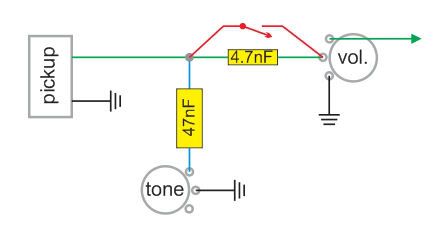
On the red bypass wire, using a switch or a pot doesn’t matter. I've seen someone over at the corporate forum sacrificing the tone control, and used the tone pot to control the bypass instead of the tone.
From you first post I got the impression you wanted to move the inline cap to after the volume pot:

In the diagram you linked to the inline cap is after volume. I’ve see other guitars controls (for example the Hofner violin bass) where a bass suppressing inline cap is put after the volume pot.
Experimenting with this myself I found the inline cap had very little or no audible effect when placed after the volume pot, when played through my amp. Strangely, if I plugged the bass straight into my computer’s soundcard it did have the expected effect. Suspect this has something to do with different input impedance (whatever that is ) on the soundcard than a guitar/bass amp.
Just wire thing up and do your own tests. After all, it is kind of fun messing around, testing and trying different ideas.
Btw: Guitar pickups produce very low voltage (micro volts or something), so the voltage rating of the cap is insignificant. Only consideration might be physical size, and that the lower the voltage rating the smaller the cap will be.
On the red bypass wire, using a switch or a pot doesn’t matter. I've seen someone over at the corporate forum sacrificing the tone control, and used the tone pot to control the bypass instead of the tone.
From you first post I got the impression you wanted to move the inline cap to after the volume pot:
In the diagram you linked to the inline cap is after volume. I’ve see other guitars controls (for example the Hofner violin bass) where a bass suppressing inline cap is put after the volume pot.
Experimenting with this myself I found the inline cap had very little or no audible effect when placed after the volume pot, when played through my amp. Strangely, if I plugged the bass straight into my computer’s soundcard it did have the expected effect. Suspect this has something to do with different input impedance (whatever that is
) on the soundcard than a guitar/bass amp.Just wire thing up and do your own tests. After all, it is kind of fun messing around, testing and trying different ideas.
Btw: Guitar pickups produce very low voltage (micro volts or something), so the voltage rating of the cap is insignificant. Only consideration might be physical size, and that the lower the voltage rating the smaller the cap will be.
Re: Vintage tone mod Q
The voltage rating of the cap doesn't matter since the voltages involved in a guitar circuit are so small. The only thing a higher voltage rating will get you is a larger physical size.
OK, now for some info on where the cap goes and why. Sorry, this does get a bit technical...
<Nerd Mode>
What is a capacitor anyway? Well in it's simplest sense, it's a couple of metal plates separated by something that can store a charge. But we won't go into all of that, we'll just get into how it behaves in a circuit. A capacitor acts like a frequency dependent resistor. A resistor is something that inhibits the flow of electric current at all frequencies, even DC. The capacitor, since it's 2 plates not touching will not let DC through at all. So, what's this frequency dependent part?
The "resistance" of a capacitor is is given by the following equation (Oh no! MATH!):
Xc = 1/(2*PI*F*C)
Where "PI" is the constant 3.14159265..., F is the frequency in Hz, and C is he capacitance in Farads.
But that's more than we need. All we care about with that equation is that both C & F are on the bottom of the fraction. So if either gets bigger, the resistance (We call it Xc because it's not pure resistance) gets smaller. So, for a given C, the higher the frequency, the lower the resistance and the more signal gets through.
So, a capacitor will "do the same thing" regardless of where it is in the circuit. BUT, we're talking about a "circuit" and all of the different components act together to do something so you can't just ignore them and stick the capacitor wherever you want and have the circuit do the same thing!
Now, the 0.0047uF "vintage" tone cap is placed in the circuit to act as a "high pass filter" meaning it will pass higher frequencies and block lower ones. A simple high pass filter consists of a capacitor in series with the signal and a resistor to ground: This is the same as what's in the Rick circuit, but they use the volume pot (which is just a variable resistor) as the resistor. So, what does this filter do? Well, we said it passes high frequencies and blocks low ones. But how low?
Well, the frequency where output has dropped to half of the input is given by:
Fc = 1/(2*PI*R*C)
Which is called the "cut off" frequency. Here, R is the resistance in ohms, C, F, and PI as as above. So what? Well, as we can see, the resistor factors into the equation, so you can't ignore it. It's basically bleeding off some of the signal that manages to get through the cap, which is what makes the filter "cut off" as the signal gets lower. If you put it before the cap, it just lowers ALL of the signal and things won't behave the same way.
Now, in reality, it's a whole lot more complicated than that. The whole circuit works together and affects everything. The tone control affects the frequencies getting to the in-line cap as well as affecting how the "high pass" filter part works. Even the "input impedance" of the amplifier affects how this all works (the amp input impedance is the "resistance" to ground of the amplifier input).
But in simple terms, you can, for the most part, think of things happening in sequence as the signal encounters the different parts.
So, if you put the cap after the volume control, it will still act like a high pass filter, but the "R" part of the equation becomes the amp input impedance and the way it will sound then becomes very dependent on the amplifier.
</Nerd Mode>
Well, that's probably enough for now, hope it was at least a bit helpful...
OK, now for some info on where the cap goes and why. Sorry, this does get a bit technical...
<Nerd Mode>
What is a capacitor anyway? Well in it's simplest sense, it's a couple of metal plates separated by something that can store a charge. But we won't go into all of that, we'll just get into how it behaves in a circuit. A capacitor acts like a frequency dependent resistor. A resistor is something that inhibits the flow of electric current at all frequencies, even DC. The capacitor, since it's 2 plates not touching will not let DC through at all. So, what's this frequency dependent part?
The "resistance" of a capacitor is is given by the following equation (Oh no! MATH!):
Xc = 1/(2*PI*F*C)
Where "PI" is the constant 3.14159265..., F is the frequency in Hz, and C is he capacitance in Farads.
But that's more than we need. All we care about with that equation is that both C & F are on the bottom of the fraction. So if either gets bigger, the resistance (We call it Xc because it's not pure resistance) gets smaller. So, for a given C, the higher the frequency, the lower the resistance and the more signal gets through.
So, a capacitor will "do the same thing" regardless of where it is in the circuit. BUT, we're talking about a "circuit" and all of the different components act together to do something so you can't just ignore them and stick the capacitor wherever you want and have the circuit do the same thing!
Now, the 0.0047uF "vintage" tone cap is placed in the circuit to act as a "high pass filter" meaning it will pass higher frequencies and block lower ones. A simple high pass filter consists of a capacitor in series with the signal and a resistor to ground: This is the same as what's in the Rick circuit, but they use the volume pot (which is just a variable resistor) as the resistor. So, what does this filter do? Well, we said it passes high frequencies and blocks low ones. But how low?
Well, the frequency where output has dropped to half of the input is given by:
Fc = 1/(2*PI*R*C)
Which is called the "cut off" frequency. Here, R is the resistance in ohms, C, F, and PI as as above. So what? Well, as we can see, the resistor factors into the equation, so you can't ignore it. It's basically bleeding off some of the signal that manages to get through the cap, which is what makes the filter "cut off" as the signal gets lower. If you put it before the cap, it just lowers ALL of the signal and things won't behave the same way.
Now, in reality, it's a whole lot more complicated than that. The whole circuit works together and affects everything. The tone control affects the frequencies getting to the in-line cap as well as affecting how the "high pass" filter part works. Even the "input impedance" of the amplifier affects how this all works (the amp input impedance is the "resistance" to ground of the amplifier input).
But in simple terms, you can, for the most part, think of things happening in sequence as the signal encounters the different parts.
So, if you put the cap after the volume control, it will still act like a high pass filter, but the "R" part of the equation becomes the amp input impedance and the way it will sound then becomes very dependent on the amplifier.
</Nerd Mode>
Well, that's probably enough for now, hope it was at least a bit helpful...
I have NO idea what to do with those skinny stringed things... I'm just a bass player...
Re: Vintage tone mod Q
GREAT stuff! Thanks.cjj wrote:OK, now for some info on where the cap goes and why. Sorry, this does get a bit technical...
<Nerd Mode> . . . </Nerd Mode>
Well, that's probably enough for now, hope it was at least a bit helpful...

-
coolhandjjl
- Intermediate Member
- Posts: 621
- Joined: Wed Dec 30, 2009 5:42 pm
Re: Vintage tone mod Q
There are many tone mods that use different value tone caps. Varitones work this way. A .047 is a standard value tone cap for single coil pups. Using a .022, or a .056 will affect how much of the mids stay present when you begin to dial down the tone pot. I use .022s tone caps because it leaves more of the mids intact as you dial down. The resulting effect is different than just partially dialing down a standard value cap and pot, or using different pot values. Of course, when you bottom out the pot, it muds down everything and the value of your tone cap is then moot.
The .0047 cap is a high pass filter used solely on the bridge pup, placed in between the selector switch and the first pot in the bridge circuit portion of the Ric harness. If you have a standard VVT harness, then it simply goes in between the bridge pup and the bridge volume pot (not on the ground wire). It does two things, cuts out frequencies below around 150~200hz, and shifts the phase of that signal so it cancels/combs less with the neck pup signal. (Combing is what gives growl, or that 'Fenderesque' Jazz Bass type of tone.) So if you use the .0047 cap, you will get more of the pure tone of each pup. The neck stays full and deep, and the bridge can give you that vintage sharp thunky attack if you hit the strings just right, or use a pick. I really like using the .0047 cap, and even put it on one of my Hamer Cruise Bass's bridge pup.
The .0047 cap is a high pass filter used solely on the bridge pup, placed in between the selector switch and the first pot in the bridge circuit portion of the Ric harness. If you have a standard VVT harness, then it simply goes in between the bridge pup and the bridge volume pot (not on the ground wire). It does two things, cuts out frequencies below around 150~200hz, and shifts the phase of that signal so it cancels/combs less with the neck pup signal. (Combing is what gives growl, or that 'Fenderesque' Jazz Bass type of tone.) So if you use the .0047 cap, you will get more of the pure tone of each pup. The neck stays full and deep, and the bridge can give you that vintage sharp thunky attack if you hit the strings just right, or use a pick. I really like using the .0047 cap, and even put it on one of my Hamer Cruise Bass's bridge pup.
'09 4003 | '93 4003s
John Luke aka Coolhand
John Luke aka Coolhand
-
8mileshigher

- Senior Member
- Posts: 4886
- Joined: Tue May 23, 2006 12:34 pm
Vintage tone mod Q
CJ
I am impressed with your scientific and engineering talents !!
I am impressed with your scientific and engineering talents !!
Re: Vintage tone mod Q
Thanks! Probably has something to do with earning my living for the last 35 years designing electronics "stuff"...
I have NO idea what to do with those skinny stringed things... I'm just a bass player...
-
parker_knoll
- Junior Member
- Posts: 196
- Joined: Mon Nov 08, 2010 7:09 pm
Re: Vintage tone mod Q
yeah, this is all really useful, thanks so much. As i started to dig around the web i started to see how many tone alternatives there are.
I might try wiring a 0.0047 cap across both tone pots as illustrated in the Jag forum (see my post above) just because it utilises the existing hardware i have. Do people think it's worth altering the pots to no load or does it not make much difference? i have a few spare pots. I recently wired my bridge higain direct to the selector with no volume or tone control and liked the liveliness i got.
I might try wiring a 0.0047 cap across both tone pots as illustrated in the Jag forum (see my post above) just because it utilises the existing hardware i have. Do people think it's worth altering the pots to no load or does it not make much difference? i have a few spare pots. I recently wired my bridge higain direct to the selector with no volume or tone control and liked the liveliness i got.
-
coolhandjjl
- Intermediate Member
- Posts: 621
- Joined: Wed Dec 30, 2009 5:42 pm
Re: Vintage tone mod Q
Let us know how it goes. I overlooked the part where you wanted to wire it across the tone pot rather than in-line with the pup. Sorry.
'09 4003 | '93 4003s
John Luke aka Coolhand
John Luke aka Coolhand