
My 4001FL is an amazing bass in so many ways but action was not one of them. It was "Fender hanging on a wall in Guitar Center" high and I couldn't get it lower, and the break angle on the strings was pathetic. So I ultimately bit the bullet and had my luthier countersink the Hipshot bridge, because this bass has already been to hell and back in a lot of other ways and I don't have any plans to sell it if I can help it.
The results are downright amazing. With a clean, tight fit, you can't even tell that it was countersunk, and the action is the lowest I have ever played (only a fretless could be capable of this, combined with the truly DEAD STRAIGHT neck), not to mention the strings actually have the proper break angle now. This may be my new favorite bass, although it remains to be seen if it can permanently oust my beloved 4003FL. Even the tone "beefed up" and the E string that sounded weak before, which I attributed to the bad setup because of the high action, sounds great.
My band has been doing some pro recordings lately and if I get a chance, I'll throw the 4001FL into the mix (hopefully the 4003FL doesn't get jealous). The engineer is already super thrilled with the 4003FL so just wait till he sees this...
Countersinking a bridge: my experience
Moderators: rickenbrother, ajish4
-
cassius987

- Senior Member
- Posts: 4723
- Joined: Mon Aug 04, 2008 2:11 pm

Re: Countersinking a bridge: my experience
I can't wait to hear the results. I quite enjoy your playing.
The action these basses deliver with 'dead straight' necks is really a joy to play.
The action these basses deliver with 'dead straight' necks is really a joy to play.


-
cassius987
- Senior Member
- Posts: 4723
- Joined: Mon Aug 04, 2008 2:11 pm
Re: Countersinking a bridge: my experience
Both ASAP, I promise! The best part is though, neither have changed much. What has changed is the bass is way, way, way easier to play than it was before, with its bad neck angle and the higher action of the Hipshot bridge. Obviously only some basses will ever need this procedure. In its current state my 4003FL clearly doesn't. The big surprise to me, though, was how extraordinarily effective this was in improving the action and break angle. I expected just some small returns for the effort.

Re: Countersinking a bridge: my experience
I've seen this done a couple of times. Sometimes there's really no choice. The neck is kept as straight as it can be with the truss rods, but over the years develops an upward angle where it meets the body wings. I've heard there's another cure for that but it involves detaching the body wings. Unless it's a rare vintage Ric, I'd go with countersinking the tailpiece. And to think that in a bolt-on Fender this is a 5 minute DIY fix...
"A Noble Instrument Must Be Nobly Regarded"
Re: Countersinking a bridge: my experience
The other option it to fill the neck pickup route and then reroute just enough to let the pickup in and no more. Done properly it will wedge the neck back where it should be. I have done this on a 70s 4001 with great results (and probably should do it on my 4008)
Dane has done it several times I think as well.
My Rm1999 at some time sported a countersunk bridge so it has been a done thing for years.....
Eden.
Dane has done it several times I think as well.
My Rm1999 at some time sported a countersunk bridge so it has been a done thing for years.....
Eden.
-
cassius987
- Senior Member
- Posts: 4723
- Joined: Mon Aug 04, 2008 2:11 pm
Re: Countersinking a bridge: my experience
That is frustrating BUT I'm so happy with the results it kind of negates that for me now. If you're the only one who can tell it's countersunk, it really isn't a big deal (to me, a player, not even remotely a collector). Besides, we could say the same thing about how easy it is to replace RIC truss rods.ilan wrote:And to think that in a bolt-on Fender this is a 5 minute DIY fix...
-
superdick2112

- Member
- Posts: 256
- Joined: Fri May 08, 2009 11:46 am
Re: Countersinking a bridge: my experience
Joshua, this sounds like a very cool tone-enhancing mod.
Who did the work? I've yet to find a Denver luthier who really impresses me.
What effect did lowering the bridge have on the Hipshot saddles? Do you still have to lock or paralyze them?
Please post some pix when you get a chance.
Who did the work? I've yet to find a Denver luthier who really impresses me.
What effect did lowering the bridge have on the Hipshot saddles? Do you still have to lock or paralyze them?
Please post some pix when you get a chance.
Re: Countersinking a bridge: my experience
I've seen a few of these over the years, including my '64 RM 1999. It gets the job done usually, but it's a last resort.

My '73 FL neck is as straight as straight can be, and the action with light gauge Chromes is probably as low as you can get on a FL.

My '73 FL neck is as straight as straight can be, and the action with light gauge Chromes is probably as low as you can get on a FL.

Re: Countersinking a bridge: my experience
Good call with that particular bridge on this particular instrument. I've gotten to play Cassius' '76 4001 FL. The neck profile is almost identical to the '76 4001 I used to own in the '80's. It even sounds the same through the same amp I used with mine back then. This bass had been butchered almost beyond the pale when Cassius got it. He's done a great job bringing it back from the brink, as it was not a candidate for conventional "restoration."
In general, anytime you can do anything to marginally increase the break angle over the bridge you will get better stability, tuning, tone, sustain, and intonation. On my custom fanned fretted bass, the G string makes a 90-degree bend over the saddle then goes through the body for maximum sustain and fundamental (eliminate as much "twang" as possible), and each string thereafter has less angle over the bridge to re-balance sustain versus tone until the E string has as little as possible and still be secure to get the maximum overtones, as the mass of the E string doesn't need much for stability or sustain.
That, and the Hipshot bridge has individual screw-driven saddles mounted on a plate, like all the famous bridges we know about otherwise, so this particular bridge does need the added downforce over the saddles that insetting helps.
In general, anytime you can do anything to marginally increase the break angle over the bridge you will get better stability, tuning, tone, sustain, and intonation. On my custom fanned fretted bass, the G string makes a 90-degree bend over the saddle then goes through the body for maximum sustain and fundamental (eliminate as much "twang" as possible), and each string thereafter has less angle over the bridge to re-balance sustain versus tone until the E string has as little as possible and still be secure to get the maximum overtones, as the mass of the E string doesn't need much for stability or sustain.
That, and the Hipshot bridge has individual screw-driven saddles mounted on a plate, like all the famous bridges we know about otherwise, so this particular bridge does need the added downforce over the saddles that insetting helps.
-
cassius987
- Senior Member
- Posts: 4723
- Joined: Mon Aug 04, 2008 2:11 pm
Re: Countersinking a bridge: my experience
I would not say there is a change in tone that could be isolated from the change in action although my luthier claims the increased surface contact is a plus for the sustain. Maybe, maybe not. I don't hear much difference there and the sustain was already "for days" as it was. Dave Dougherty, of Colfax Guitar Shop, did the work. He's a great guy and so is Christian, the other luthier who works there. They are both plenty knowledgeable about Rics and I go to them with all of my concerns... besides this forum's own Scott Pope, probably my favorite luthiers/techs ever (Dave and Christian are both bona fide luthiers). I have dealt with plenty of bad ones to know when I find a good one.superdick2112 wrote:Joshua, this sounds like a very cool tone-enhancing mod.
Who did the work? I've yet to find a Denver luthier who really impresses me.
What effect did lowering the bridge have on the Hipshot saddles? Do you still have to lock or paralyze them?
Please post some pix when you get a chance.
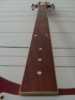
Here are pics of the work. You can see trace gaps in the close-ups... Dave claims he had to free-hand parts of it because he didn't trust any of his router bits for some of the curvature, but apparently this is the first time he's ever done a tailpiece this shape (basically, the RIC shape). I'm very pleased with the work and most especially the amazingly low action that resulted. I am lucky that whoever sanded and finished the fingerboard at the factory in 1976 did an immaculate job as it is perfectly radiused, allowing for some frighteningly low action even with rounds. I have never played a bass with action this low. It's less than a 1/16'' along the entire fingerboard. The tailpiece is askew, but that's based on the factory placement of the 5 screws, so apparently it was always like this. It intonates just fine... I love this bass, flaws and all, especially now that it plays like butter.
EDIT: Sound clips to come. E string is LOUD. String spacing is 18 mm center-to-center.


Re: Countersinking a bridge: my experience
Nice work.

Re: Countersinking a bridge: my experience
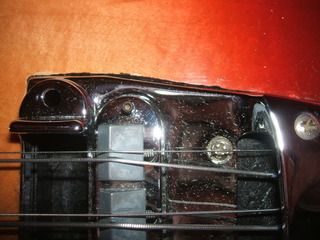 The previous owner of my 87 4003s8 also had the bridge sunk...I'm sure to try and compensate for the bowing neck/high action. Maybe it temporarely cured the problem but the action was always high from the day I got it. Finially, I decided to add two new/larger/stronger truss rods after reading somewhere that it might cure my banana-necked s8. I bought some stock steel rods from HD and machined the threads myself.. IT WORKED!!!! Now my bass is playable and the neck is almost straight and very stable.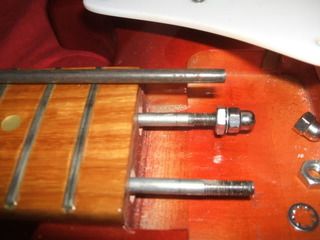

Re: Countersinking a bridge: my experience
Countersinking the tailpiece works in cases when the neck is dead straight and the action is still too high. It's the neck-thru equivalent of shimming the neck. For bowed necks that the rods don't correct there are other cures. Like heat treatment, pressure refret, or the one that worked wonders for me, pre-bent rods inserted in a back-bow (post-'85 only).
"A Noble Instrument Must Be Nobly Regarded"